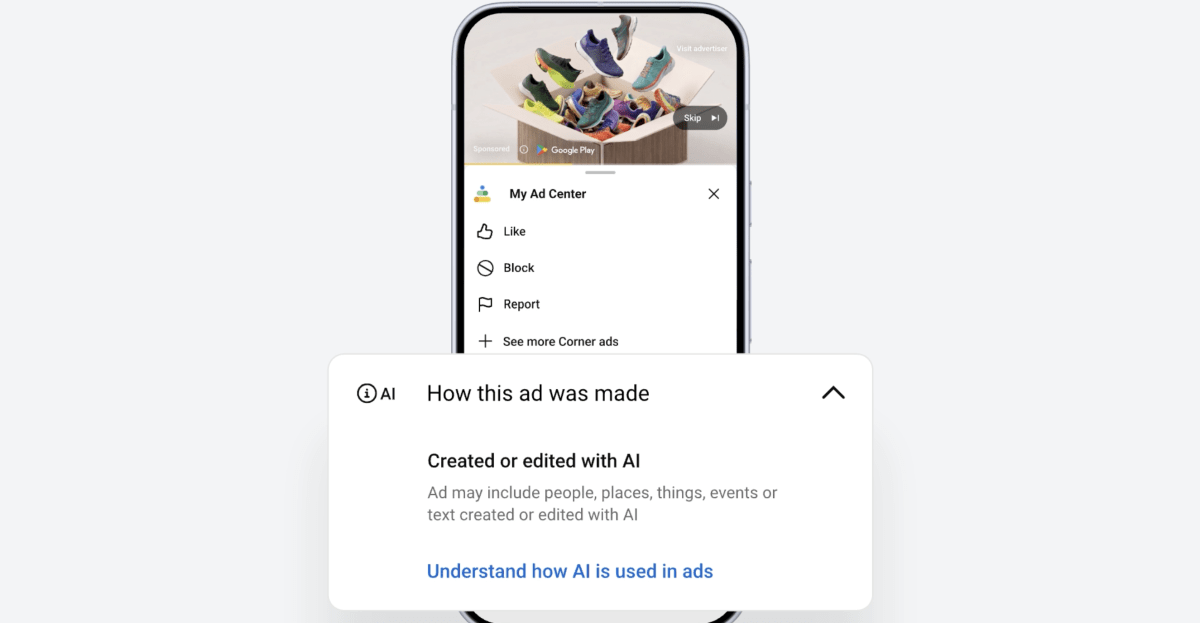
Google is adding an AI disclosure to the ad information panel people see on Google Search, Google Discover, and YouTube, giving users a way to check whether an ad was made or altered with generative AI.
The company announced the change Thursday in a Google Ads update. The new notice appears in My Ad Center under the “how this ad was made” section, using the label “created or edited with AI.” Users can reach that panel by tapping the three-dot menu or information button on an ad. That is the same place Google already puts controls to block or report ads.
Google says the label will be applied automatically to ads built with its own generative AI advertising tools. That is the clean part of the system: if the ad came through Google’s AI ad machinery, Google can tag it without asking the advertiser to remember, or pretending a checkbox is a transparency regime.
The messier part is everything made somewhere else. According to Google, ads created or edited with outside AI tools will need to be labeled manually. In other words, Google’s automatic disclosure does not amount to universal AI detection for every ad running across its services. It covers ads made with Google’s own tools, while other AI-made ads depend on advertiser disclosure.
Google also says that, in some regions, the AI disclosure may show up directly on the ad itself. That can happen automatically, or when an advertiser manually says the ad was made with AI. Google did not specify in the announcement which regions will see the label on the ad rather than only inside My Ad Center.
TechCrunch reported earlier on the update.
Google joins a familiar disclosure pattern
Google is not alone in putting AI notices inside ad transparency panels. Meta has a similar “AI info” label in the “About this ad” section for ads on its platforms, according to Meta’s help documentation.
Google has also been adding AI and synthetic-media disclosures in adjacent parts of its business. In 2024, the company introduced a disclosure for “synthetic or digitally altered content” in political ads. Earlier this year, Google expanded access to SynthID and C2PA content labels, tools that can help identify deepfake content.
The ad label is a narrower move than those broader provenance systems. It tells users what Google knows about how a particular ad was made, at least when that ad used Google’s own generative AI tools or when an advertiser discloses outside AI use. That is useful, but it still leaves plenty of room for the oldest problem in ad tech: the platform can show a label only when its systems or the advertiser supply the information.
This story draws on original reporting from The Verge.