Midjourney has put more of its experimental ultrasound scanner on camera, giving the public a better look at the machine it says could make imaging cheaper and more accessible. The demonstration does less to answer the harder question: whether the system can produce clinically useful images at the scale and speed the company has suggested.
The AI company, best known for its image-generation tools, is developing a scanner built around a water tank and arrays of ultrasound probes. Midjourney has said it wants to place the system in spas and start with wellness-style measurements, especially body composition, rather than launch it first as a diagnostic medical device.
The new video runs nearly 20 minutes and was posted by Marcin Plaza, a tech YouTuber who also works as an engineer at Midjourney. Plaza presents the hardware and the people assembling it, and describes the system in rough shop-floor terms: many ultrasound probes modified and mounted around what amounts to a hot tub with a lift, tied into standard computers and Raspberry Pis.
That is the useful part of the tour. It shows that Midjourney is building physical hardware, not just rendering a concept for investors and fanboys. It also makes the project look very much like a prototype: conventional ultrasound components, consumer-grade compute boards, and a lot of integration work sitting between an idea and a reliable product.
The missing proof is still the problem
The video does not spend much time on the technical objections raised by imaging experts after Midjourney first discussed the scanner. Those experts told The Verge that the company had not shown convincing evidence that it could get around ultrasound’s known limits, even though the underlying technology has been used in medicine for decades.
Ultrasound is attractive because it does not use ionizing radiation, but it is not magic. Image quality depends on tissue, angle, signal processing, probe placement, and operator skill. A full-body system has to manage those constraints across many body shapes and anatomical targets, then turn the returning sound signals into images that can be trusted. Midjourney’s public material has not yet established that it can do that at the level of detail or throughput it has implied, according to The Verge’s reporting.
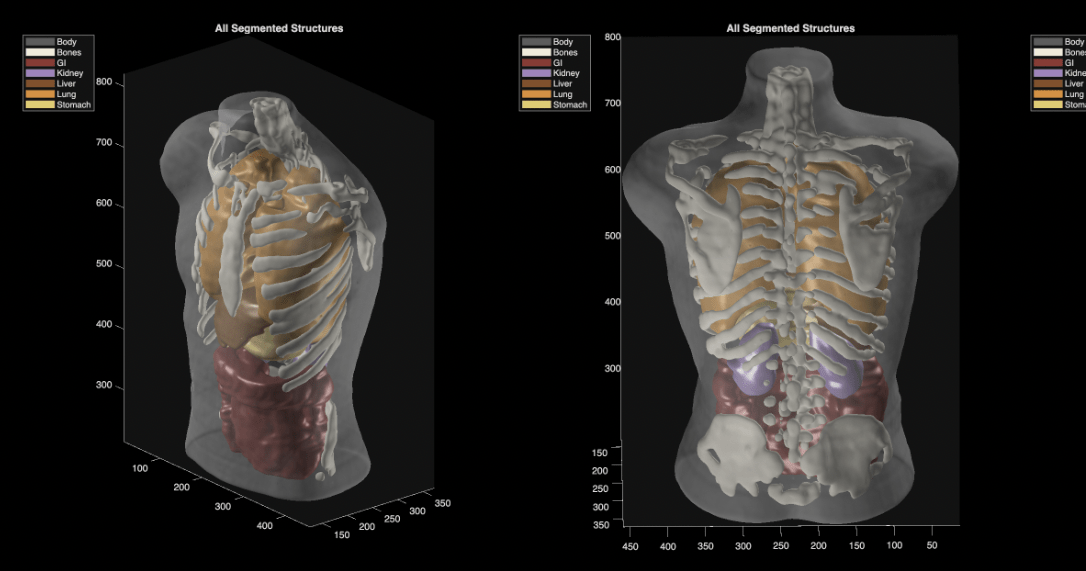
One image associated with the project shows a scan of an imaging phantom, segmented to check how cleanly structures can be separated under controlled conditions. Phantom tests are common in imaging work, but they are not the same as proof that a device performs well on real people in messy clinical conditions.
Wellness first, medicine later
Midjourney’s stated launch plan also matters. The company has framed the first version as a wellness product centered on body composition. That route avoids the immediate burden of selling it as a diagnostic medical device, a category that would require FDA clearance and clinical trials, according to The Verge.
Tom Calloway, Midjourney’s head of medical, said in the video that focusing on body composition would let the company move quickly and open once testing is complete. That may be a practical regulatory strategy. It also means early users should not confuse a spa scanner with a validated diagnostic system.
For now, Midjourney has shown more plumbing, wiring, and ambition than evidence. The next meaningful step would be data that outside experts can evaluate: performance, failure cases, comparison with existing imaging systems, and clear limits on what the scanner can and cannot measure.
This story draws on original reporting from The Verge.