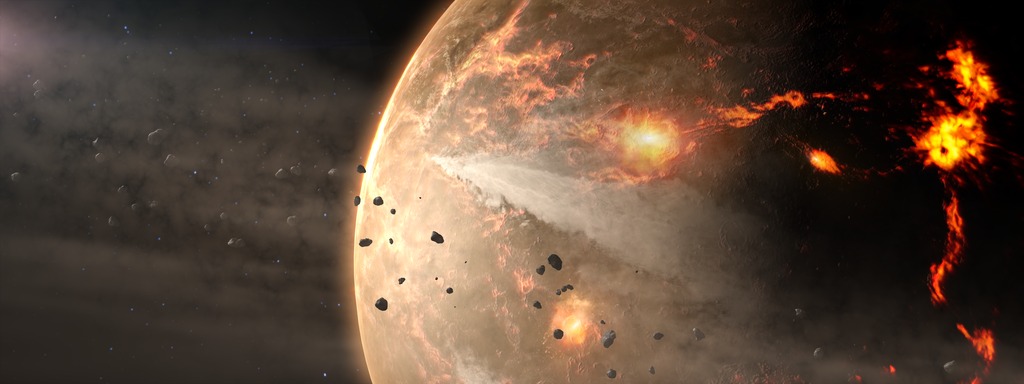
A new model from Tim Johnson of Curtin University and colleagues puts space rocks at the center of one of geology’s messier origin stories: why Earth’s continents appeared only after the planet had already been around for about half a billion years.
In a 2026 paper in Science, the researchers argue that the early Earth was not heated mainly from within during the Hadean eon. Instead, they say repeated asteroid and meteorite impacts delivered enough energy to keep the young crust thin, hot and partly molten. That would have delayed plate tectonics while setting up the conditions for buoyant, silica-rich continental crust to form later.
The gap is real. Earth is about 4.5 billion years old, while the oldest known continental-type rocks crystallized roughly 4.03 billion years ago. A few basaltic rocks reach about 4.2 billion years, and rare zircon crystals extend the record to about 4.4 billion years. Beyond that, geologists are working with scraps, because Earth has been busy recycling its surface into the mantle.
Why the Moon matters
Johnson’s team used the Moon as a ledger for impacts that Earth has mostly erased. The Moon lacks plate tectonics, so its crust still preserves ancient crater records. By matching crater counts to dated lunar samples, the researchers estimated the impact rate in the early Solar System, then scaled that rate to Earth’s larger size and stronger gravity.
Johnson said that scaling implies Earth was struck by thousands of objects larger than 10 kilometers across. The team then calculated how much kinetic energy those bodies would have deposited, and how much of that energy became heat in Earth’s crust and upper mantle.
Previous heat-budget models emphasized leftover heat from Earth’s formation, core formation and radioactive decay. Johnson’s group says those sources were not the whole bill. In their model, impact heating exceeded internal heat sources through much of the Hadean by about an order of magnitude.
A crust too weak for plates
The mechanism is blunt physics. A large impact melts and vaporizes rock near the collision site, but much of the energy also travels into the upper mantle. The researchers argue that this would have driven more melting and basaltic volcanism for tens or hundreds of millions of years after the impacts themselves.
When the revised heat budget was fed into geodynamic simulations, the Hadean crust came out thin and mechanically useless for modern-style tectonics. The models produced crust less than 5 kilometers thick, with partial melting beginning only 2 to 3 kilometers below the surface. At around 5 kilometers down, melt made up more than 30 percent of the volume, enough that rock would no longer behave as a coherent slab.
That matters because subduction needs cold, rigid lithosphere. Johnson argues that if the team’s calculations are close, Hadean plate tectonics could not have operated in a familiar form.
The simulations also produced crustal recycling after large impacts, with material sinking to at least 600 kilometers. The team says that could help explain why so little Hadean crust remains, and why shock-deformed Hadean zircons are nearly absent. In their interpretation, shallow melt would have absorbed and scattered shock waves before crystals could preserve the damage.
The cooldown
The impact rate fell over time. Between 3.9 billion and 3.5 billion years ago, Johnson’s team says internal heating again became the dominant control on the crust. As bombardment faded, the upper mantle cooled and the basaltic crust thickened.
By the early Archean, the model gives a crust about 30 kilometers thick. That cooler, stronger lid could support a mantle lithosphere and allow continent-building to begin. The timing lines up with the first continental rocks known in the geologic record.
The caveat is obvious and not small: the argument rests heavily on modeling because the relevant rocks are scarce. Johnson told Ars Technica that modeling should be taken seriously when the rock record is mostly gone. He also pointed to the Nuvvuagittuq Greenstone Belt in Canada, where researchers have dated a dark mafic rock to 4.2 billion years, and said another group may have found an even older rock.
This story draws on original reporting from Ars Technica.