Reported releases of dangerous chemicals increased sharply from 2021 through 2025, according to a new analysis by Public Employees for Environmental Responsibility, just as President Donald Trump’s EPA is preparing to loosen federal accident-prevention rules for industrial sites.
PEER, a nonprofit that works with current and former government employees, said Monday that reported accidents involving hazardous chemical releases rose from 83 in 2021 to 131 in 2025, a 57 percent increase. The group also found that injuries and deaths tied to those incidents rose from 60 to 89 over the same period.
The broader federal record is not comforting. Incident reports released by the Chemical Safety Board, the independent agency that investigates chemical disasters, show more than 650 chemical accidents between April 2020 and May 2026. Of those, 103 involved deaths, 355 caused injuries and 314 caused substantial property damage, according to the board’s reports.
About 150 million people live within 3 miles of facilities covered by these kinds of hazards. PEER said historically overburdened communities, including Black and Latino residents, face the highest exposure risk. Jeff Ruch, PEER’s senior counsel, said aging infrastructure is compounding the problem because many refineries were built before 1985.
Hydrogen fluoride remains the nightmare case
One of the clearest examples is hydrogen fluoride, also called hydrofluoric acid or HF. The chemical is used in refining and in manufacturing products including refrigerants, gasoline, pesticides and fluoropolymers. It is also acutely toxic and corrosive.
Physicist Ronald Koopman, now with Hazard Analysis Consulting, tested HF in the 1980s for Amoco, later acquired by BP. At a Southern California Air District meeting in 2018, Koopman said researchers released 1,000 gallons expecting the material to pool and release a limited amount of gas. Instead, it formed a low, moving cloud that could carry deadly gas miles downwind.
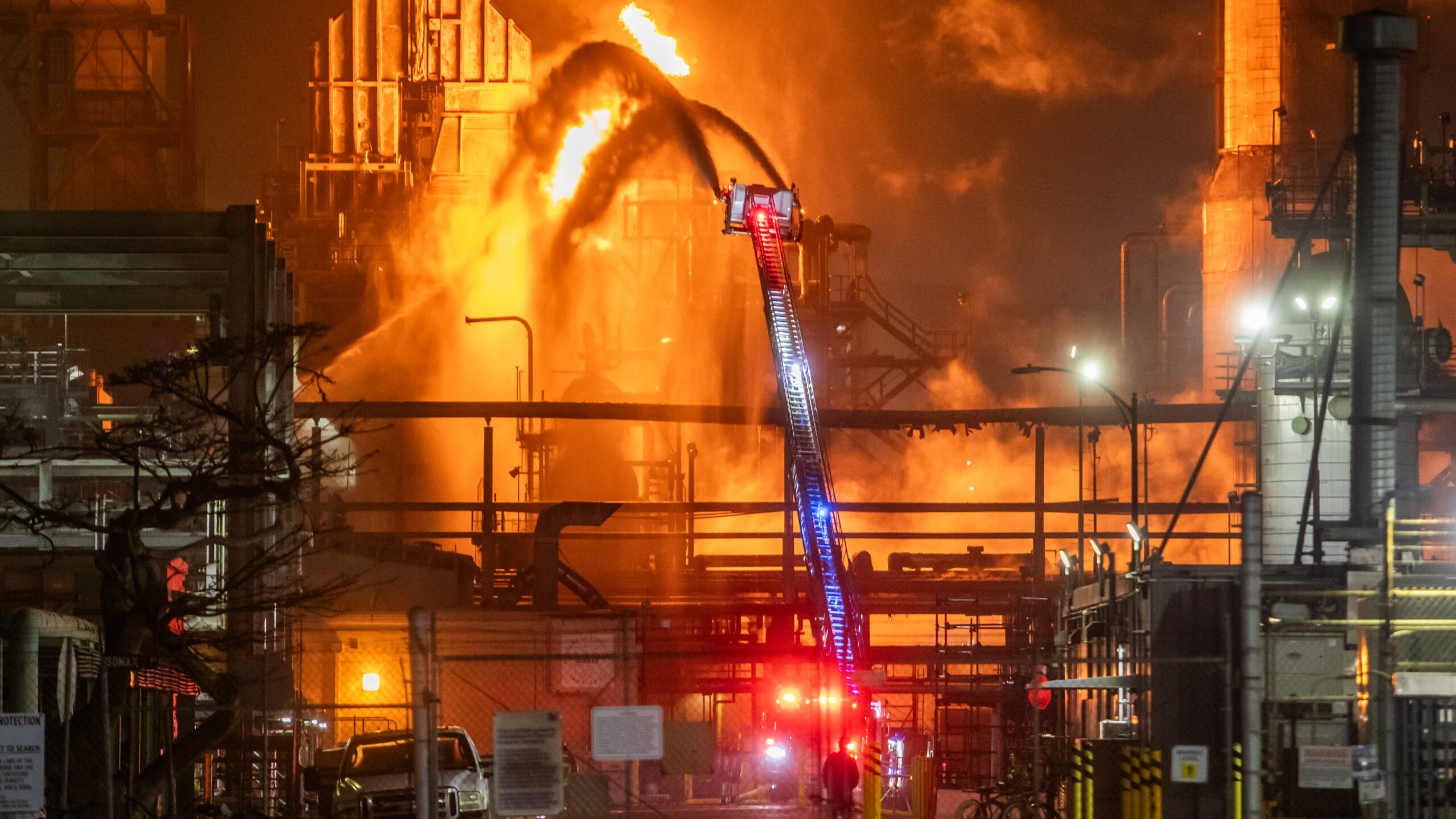
The danger was not theoretical in 2019, when explosions at the Philadelphia Energy Solutions refinery released more than 5,000 pounds of hydrogen fluoride. The Chemical Safety Board said nearby South Philadelphia neighborhoods, largely Black and brown, avoided a worse outcome because winds were favorable. Koopman later told NPR that allowing people to live so close to refineries using the chemical was “unconscionable.”
The Centers for Disease Control and Prevention says exposure to 170 parts per million of hydrogen fluoride for 10 minutes can cause death or serious injury. PEER petitioned the EPA after the Philadelphia explosion to ban hydrogen fluoride at refineries. The agency declined to consider the request.
Public Health Watch reported that nearly 50 refineries use hydrogen fluoride and have reported more than 200 accidents involving serious injuries and deaths to the EPA over the past 25 years. Those sites are a subset of roughly 12,000 facilities covered by the EPA’s Risk Management Program under the Clean Air Act.
EPA says older rules were enough
The Biden administration finalized tougher Risk Management Program rules in 2024. Those rules require measures including safer-alternatives reviews, independent root-cause analysis after accidents, worker involvement in prevention planning and preparation for climate-related hazards.
The Trump EPA proposed earlier this year to weaken those requirements, saying the change would “reduce regulatory burden.” Public comments closed in early May, and an EPA spokesperson said the agency is reviewing comments and expects to finish the rule in late 2026.
The EPA spokesperson said the proposal relies on an analysis of reportable incidents from 2014 through 2023 showing accidental releases “unequivocally declined significantly” during that period. The spokesperson said that means covered facilities already had effective prevention programs before the 2024 rule.
Ruch disputed that reading, saying the Biden EPA used the same data and reached the opposite conclusion. He also said EPA does not have data proving that any decline came from industry prevention plans.
The accident data became public after PEER and other groups sued to force the Chemical Safety Board to disclose industrial chemical releases under the Clean Air Act. A federal judge ruled in 2019 that communities have a right to know which hazardous chemicals are being released nearby. Trump’s EPA removed a public risk-information tool last year, and Trump has sought to eliminate the Chemical Safety Board by withholding funding, though Congress has continued to fund it.
This story draws on original reporting from Ars Technica.