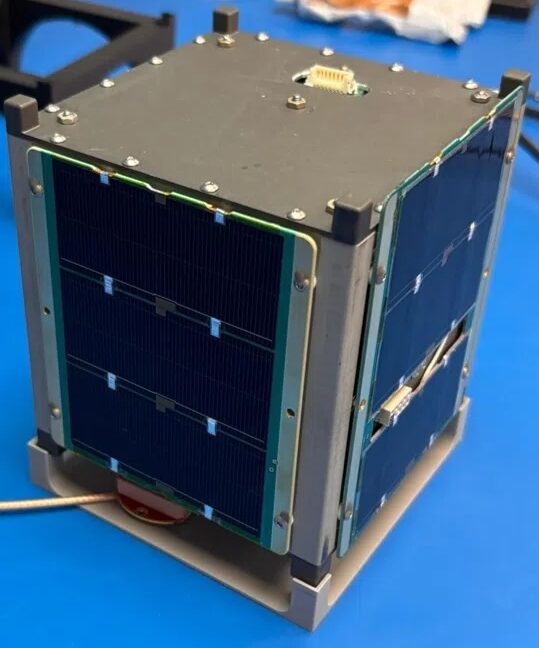
Miami-based City Labs put a commercial nuclear power experiment in orbit Tuesday, sending a small CubeSat named BOHR to space on a SpaceX Falcon 9 rideshare mission.
The payload matters less for raw power than for precedent. City Labs says BOHR, short for Betavoltaic Orbital High-Reliability, is the first commercial nuclear-powered satellite and the first nuclear CubeSat. That claim comes with a large caveat: the spacecraft itself still uses solar power for routine operations, while the company’s NanoTritium generator is being tested in demonstration mode to run an onboard payload.
SpaceX launched BOHR with 80 other payloads and deployed it into an orbit between 350 and 400 miles up, roughly 600 kilometers, according to the mission description. Images released by City Labs indicate the satellite uses a 1U CubeSat frame, the small cube format used for very compact spacecraft.
What the battery actually does
City Labs’ power source is a betavoltaic battery. Instead of using sunlight or a chemical cell, it produces electricity from the radioactive decay of tritium, an isotope of hydrogen. The output is tiny: City Labs’ systems operate in the nanowatt-to-microwatt range, far below what would run a phone, a large spacecraft, or anything resembling a lunar base.
That makes the technology a poor fit for high-power applications and a plausible fit for devices that need to sip electricity for a long time. City Labs says its betavoltaic systems are aimed at remote sensors, including undersea and polar instruments, secure communications hardware, and heaters for microelectronics in harsh environments. The company has also studied NanoTritium power for implantable medical devices.
NASA has worked with City Labs on concepts for tritium-powered sensor networks that could be placed in permanently shadowed lunar craters to search for resources such as water ice. The U.S. Air Force and Space Force have also awarded City Labs research contracts, including work on an experimental tritium AA battery for cryptographic devices and a self-powered wireless imaging sensor.
Small isotope, real regulatory test
The BOHR launch also tested the paperwork path for commercial nuclear hardware in orbit. City Labs says the mission was the first commercial nuclear launch to go through the Federal Aviation Administration’s new nuclear launch approval process. The FAA authorized the mission last September.
The review was eased by the scale and material involved. BOHR carries only a small amount of radioactive material, and tritium decays faster than plutonium or uranium. The Nuclear Regulatory Commission says tritium emits low-energy beta radiation that does not travel far in air and cannot penetrate skin.
That does not make BOHR a preview of a space reactor. Future nuclear missions meant to power lunar infrastructure or drive spacecraft through the Solar System would require far more radioactive material and a much harder regulatory and engineering case. Until now, nuclear-powered spacecraft have been owned by government agencies such as NASA and the U.S. military.
City Labs is presenting BOHR as a pathfinder for later civil and national security spacecraft. For now, it is a very small nuclear battery proving that commercial operators can get such hardware through launch approval and into orbit without pretending a microwatt device is a Moon base power plant.
This story draws on original reporting from Ars Technica.