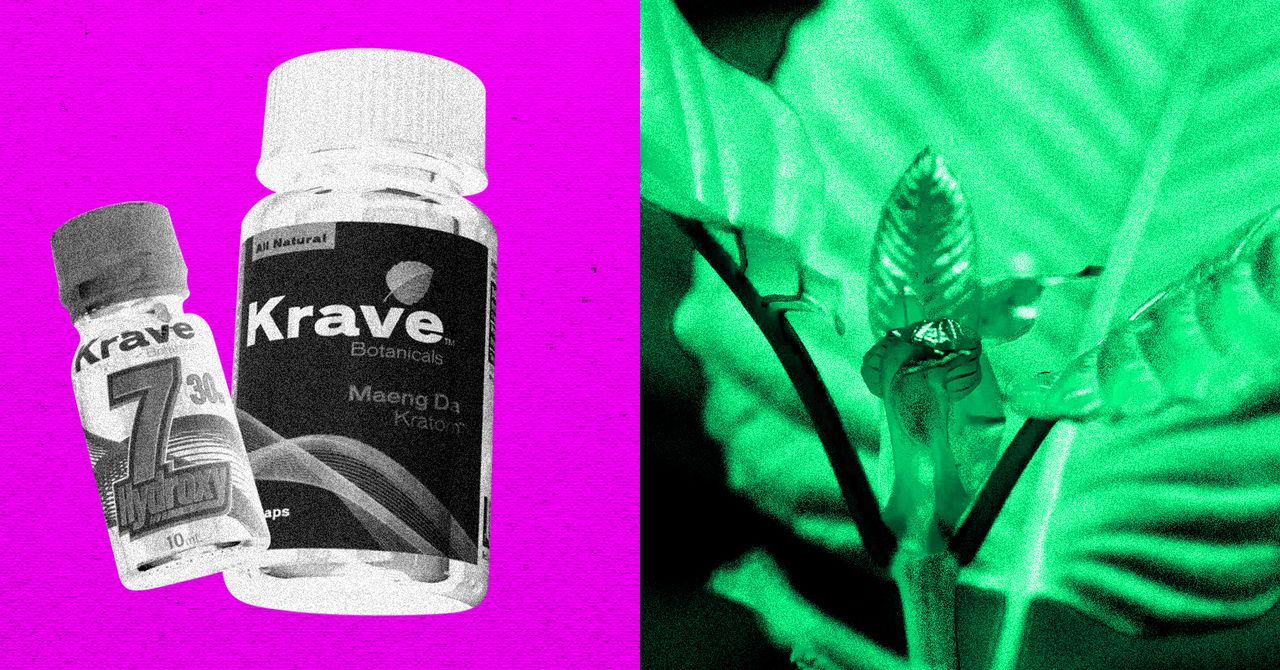
The Drug Enforcement Administration plans to put 7-hydroxymitragynine, better known as 7-OH, under a temporary federal ban, according to a draft notice of intent in the Federal Register scheduled for publication Monday.
The move targets a fast-growing market of gummies, drinks and capsules sold in gas stations and smoke shops. The DEA says products above a specified 7-OH threshold would be placed in Schedule I of the Controlled Substances Act, the category that also includes heroin. The order would last two years and could be extended for a third.
In the notice, the DEA says 7-OH presents serious public health risks, including tolerance, dependence and addiction. The agency’s proposal would take effect after a 30-day public comment period.
What 7-OH is, and why kratom sellers care
Kratom is a plant from Southeast Asia. Research cited by WIRED has found that it can have pain-relieving and antidepressant effects at low doses. Natural kratom contains only trace quantities of 7-OH.
The market at issue is different: concentrated, unregulated 7-OH products that can be far stronger than ordinary kratom products, according to research cited by WIRED. Some critics call 7-OH “gas station heroin” because it activates mu-opioid receptors in the brain, the same receptor system involved in opioid effects. That receptor activity is why regulators and public health critics are focused on dependence and withdrawal risk.
The ban is a political and commercial victory for established kratom groups, which have tried to separate kratom leaf products from concentrated 7-OH products. Mac Haddow, senior fellow on public policy for the American Kratom Association, said in a press release that chemically manipulated 7-OH products are “not kratom” and accused them of exploiting kratom’s reputation while misleading consumers.
Kratom’s own safety fight is not cleanly solved by that distinction. WIRED noted that some kratom products not sold as 7-OH can also cause similar problems at higher doses, citing the Mayo Clinic and published research.
The politics around the ban
The crackdown lands in a messy corner of drug policy where industry lobbying, federal enforcement and MAHA-era health politics overlap. President Donald Trump endorsed what he called “natural 7-OH” in May, meaning kratom, and said his administration was looking at getting it approved, according to WIRED.
WIRED has also reported that Health and Human Services secretary Robert F. Kennedy Jr. and Markwayne Mullin have ties to the kratom industry. Kennedy has been photographed with JW Ross, the founder of Botanic Tonics, which makes the kratom drink brand Feel Free. The Food and Drug Administration was involved in a 2023 federal raid involving the company and said at the time there was inadequate information on whether kratom sold as a dietary supplement posed a significant or unreasonable illness or injury risk.
WIRED reported that Mullin invested up to $1 million in Botanic Tonics. A Department of Homeland Security spokesperson told WIRED that Mullin follows ethics and conflict-of-interest rules and has not lobbied for any person or company. The spokesperson said Mullin, as a senator, worked with Kennedy to regulate 7-OH, which the spokesperson described as a synthetic drug marketed to children through deceptive convenience-store packaging.
Some Feel Free users have reported severe withdrawal symptoms, according to WIRED. The Department of Justice dropped its case against Botanic Tonics in December. Months later, WIRED reported, an LLC connected to Feel Free gave $500,000 to the MAHA PAC.
Users and sellers push back
The 7-OH industry argues the DEA has not justified the ban scientifically. Jeff Smith, executive director of the Holistic Alternative Recovery Trust, told WIRED by email that hundreds of thousands of consumers want to explain how 7-OH helped them manage pain, work, care for relatives and rebuild their lives.
One unnamed 7-OH user told WIRED she had already stored a large supply because she expected a ban. She said 7-OH helped her stop using other opioids, including street drugs, and said she worried about what people in her position might turn to if 7-OH disappears from the legal market.
The DEA also announced action this week against 7-OH derivatives and other synthetic opioids, according to WIRED. That is the familiar problem with synthetic drug enforcement: regulators ban one molecule, chemists and sellers look for the next one.
This story draws on original reporting from WIRED.