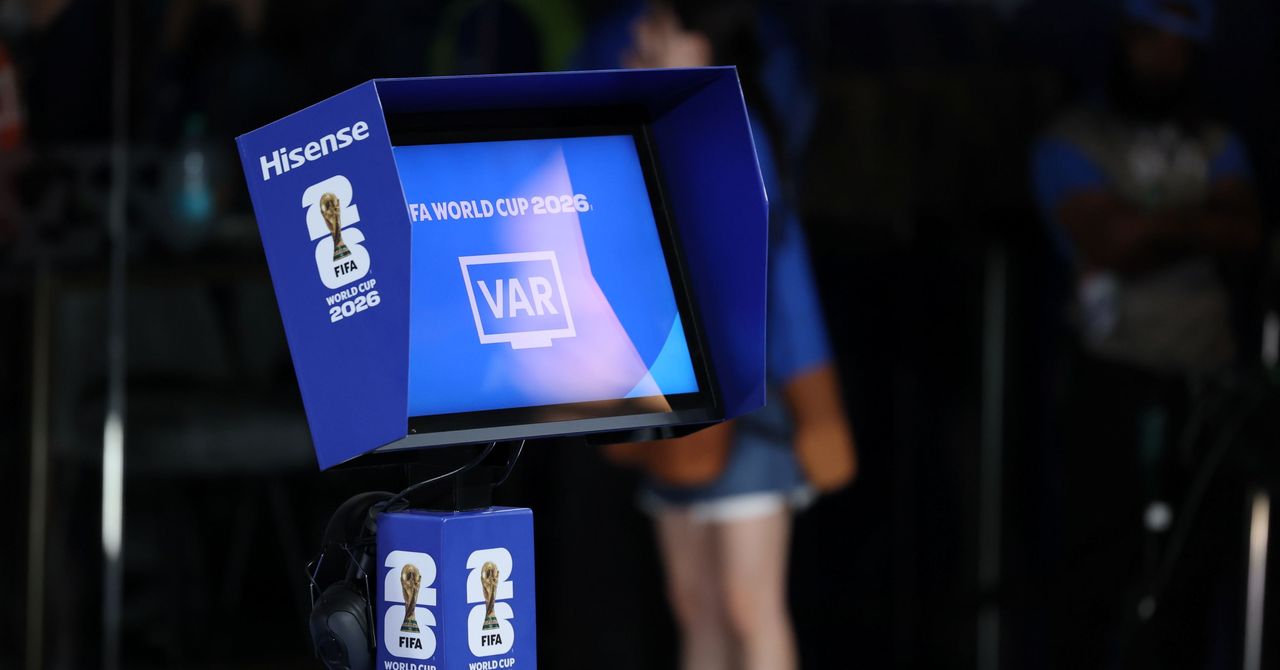
Egypt’s football authorities have asked FIFA to investigate refereeing decisions in the national team’s 3-2 World Cup defeat to Argentina, arguing that video review was not used properly in a match that ended Egypt’s tournament.
The Egyptian Football Association said on social media that it “cannot remain silent” about the decisions in the Round of 16 match, where Egypt gave up a two-goal lead before being eliminated. The federation said the “failure to properly use VAR” affected several calls and the final score.
The complaint lands in a tournament already thick with arguments about video assistant refereeing. Critics have pointed to disallowed goals and offside decisions that were not flagged on the field, while others have accused VAR of interrupting matches or being applied unevenly. Those are allegations, not proof of bias. The confirmed problem is more boring and more stubborn: the system gives officials more angles, then humans still decide what those angles mean.
How VAR is supposed to work
FIFA describes VAR as a support system for the on-field referee, not a replacement. The system first appeared at a World Cup in Russia in 2018 and has since been used in more than 100 competitions, including the 2022 World Cup in Qatar.
At this World Cup, the VAR operation can draw from 42 broadcast cameras. Eight provide super-slow-motion footage and four provide ultra-slow-motion footage. The team also has access to semi-automated offside camera feeds and the full FIFA host broadcast network.
A video assistant referee and three assistants review the footage. They examine different angles and alert the match referee when they see a possible error or missed incident in a category where VAR is allowed to intervene. The referee can then review footage on the field before making the final decision.
In previous World Cups, those categories included goals and attacking incidents before goals, penalty decisions and the buildup to penalties, direct red cards, and mistaken identity. FIFA expanded the list for 2026, according to WIRED en Español, adding reviews for clearly wrong second yellow cards, along with blocking, pushing, offside, or attacking fouls before free kicks and corners.
Armando Archundia, a former Mexican World Cup referee, told WIRED en Español that FIFA also added tools for incidents covered by the so-called Prestianni-Vinícius Rule, which punishes players with a direct red card for covering their mouth with a hand, arm, or jersey during a confrontation. He said the changes also aim to avoid confusion between corner kicks and goal kicks.
The weak link is consistency
Fernando Galván, a sports analyst and host of the podcast Más que Tres Puntos, told WIRED en Español that refereeing has spent years trying to catch up with the speed and complexity of modern soccer. VAR was meant to help, he said, after earlier systems added a fourth official and then extra officials behind the goals.
Galván said early VAR use created its own dependency, with some referees effectively handing decisions to the booth. FIFA’s current approach, in his view, tries to restore authority to the referee while giving that referee better evidence.
That still leaves interpretation. Galván and Archundia both said soccer decisions remain subjective. Archundia put it bluntly: the individual referee’s judgment decides the call, because VAR cannot do that part for them.
Training is the other pressure point. Archundia said FIFA gathers about 100 candidate referees after each World Cup and trains them during the four-year cycle through as many as four meetings a year. The final World Cup referee corps for this tournament included 54 specialists.
But Archundia also said only 20 percent of participating countries have VAR in their domestic competitions. That gap means some elite referees arrive at the World Cup with less routine exposure to the system than others. FIFA can run meetings and issue protocols. It cannot manufacture years of week-to-week VAR habits overnight.
Robot referees and AI officiating remain speculation. For now, FIFA’s expensive camera stack still ends with a person in a shirt deciding whether a clip is enough to change a match.
This story draws on original reporting from WIRED.


