Epilogue’s SN Operator is a $60 USB cartridge reader that lets people play original Super Nintendo Entertainment System and Super Famicom games on a computer instead of dragging a 1990s console back under the TV. WIRED reviewer Matt Kamen gave the device a 9 out of 10, praising its region support, accessory handling and emulator controls while calling out a few stubborn gaps.
The Romania-based company’s Operator hardware does not recreate a console in FPGA hardware, as systems from companies such as Analogue do. It reads the cartridge and runs the game through software emulation on Windows, macOS, Linux or Raspberry Pi using Epilogue’s Playback app. Power and data come through an included USB-C cable.
The device is larger than Epilogue’s earlier GB Operator because SNES cartridges are larger. According to WIRED, it measures 185 by 70 by 37 millimeters, weighs 230 grams, has protective flaps over the cartridge slot and uses a rubber base to stay put on a desk. The design is utilitarian, which is fine. This is a cartridge slot with manners, not a lifestyle object.
Playback ships with the BSNES emulator enabled by default, WIRED reported, and includes five Snes9X versions. Users can also add other emulator cores manually. The software offers visual filters, CRT-style looks, speed controls, fast-forward and rewind. Retro Achievements support returns, though WIRED notes that not every emulator core supports it.
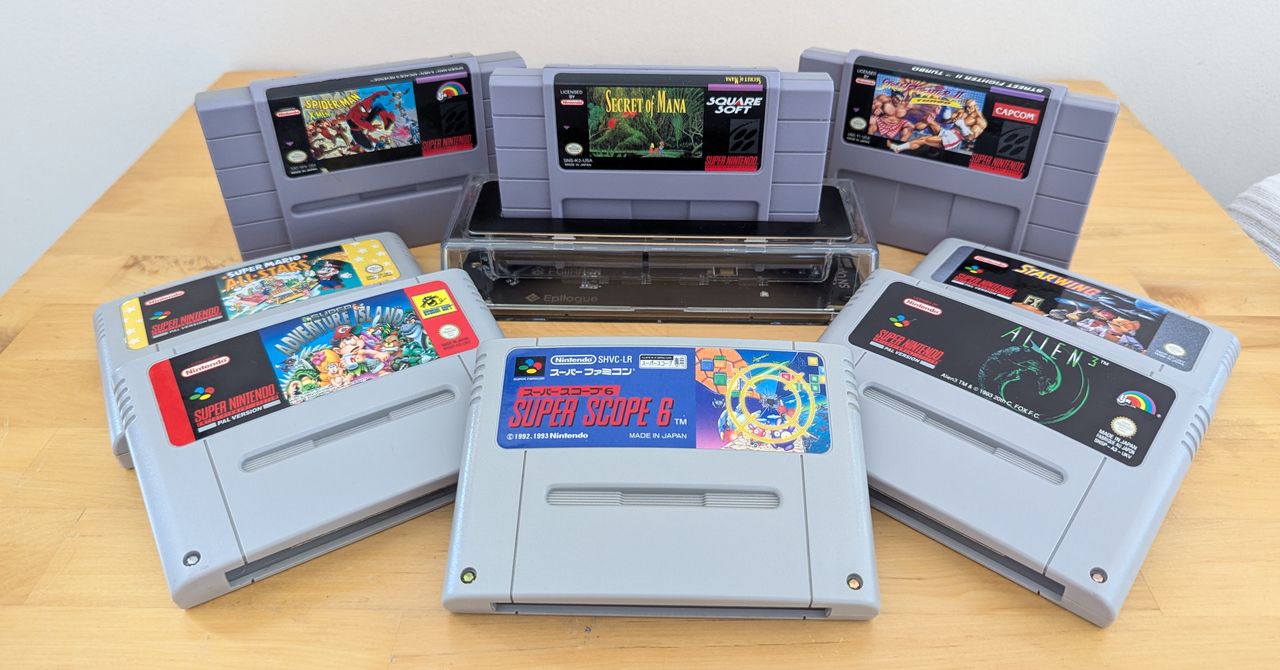
The big practical change is region handling. Original SNES hardware split players by cartridge shape, lockout chips and television standards. The SN Operator accepts North American, European and Japanese cartridges, and WIRED says the software ignores the old lockout restrictions. That means a working cartridge from any region should load on the same reader.
That matters because PAL releases often ran at 50 Hz rather than the 60 Hz used by NTSC games. WIRED’s reviewer, writing from the UK, said games such as Street Fighter II Turbo and Spider-Man and the X-Men in Arcade’s Revenge can be played at their intended speed. The Playback app also identified the region of his UK copy of Star Wing and detected counterfeit cartridges, according to the review.
Epilogue also accounted for some of the SNES’s stranger peripherals. WIRED says games built for the SNES Mouse, including Mario Paint and Populous II, can use a modern computer mouse. The same mouse can stand in for Nintendo’s Super Scope light gun, although Kamen found the accuracy of a modern high-dpi cursor made Super Scope 6 much easier than intended.
The strongest upgrade over the GB Operator is save handling. The SN Operator can write saves to the cartridge and move save files between the cartridge and computer, as before. It also supports save states, so players can freeze progress at a given moment rather than wait for a game’s own save point.
The limits are familiar and annoying. WIRED found that full-screen mode still leaves black borders on all sides rather than filling the display with a centered 4:3 image. The device also cannot currently load translation patches alongside cartridges, a problem for players hoping to import cheaper Japanese copies of role-playing games such as Chrono Trigger and play them in English.
Epilogue told WIRED it is looking at adding translation patch support in a future Playback update. The company also said it is working on online multiplayer for the SN Operator. Those are promises, not shipped features. For now, WIRED’s verdict is that the SN Operator is one of the cleaner modern ways to use real SNES and Super Famicom cartridges, assuming the buyer already owns the increasingly expensive games.
This story draws on original reporting from WIRED.