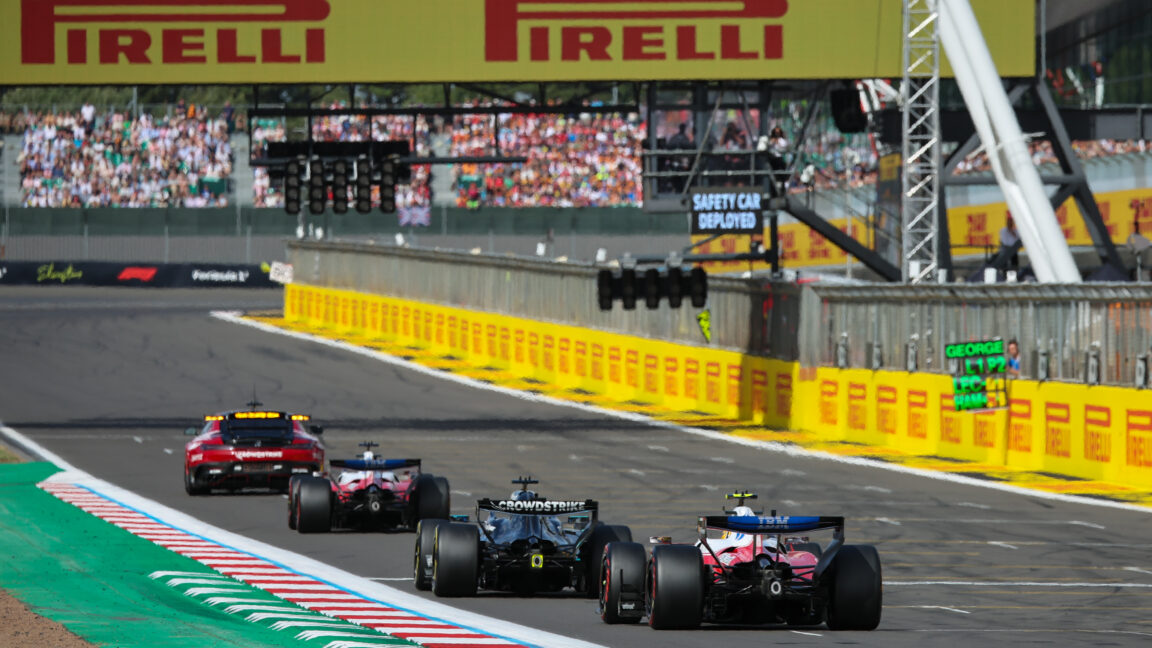
Charles Leclerc won the British Grand Prix at Silverstone after a late safety car, giving Ferrari a result it badly needed. The race’s final act, though, was shaped by software: an automated on-screen message told viewers the safety car would come in, creating an expectation of a one-lap sprint that never had a procedural path to happen.
According to Ars Technica’s race report, the mistaken graphic appeared after lapped cars were told they could pass the safety car on lap 51 of 52. Formula 1 rules require one full lap behind the safety car after that unlapping process. Race control had not issued an instruction to bring the safety car in, and the display was replaced about eight seconds later with another “safety car deployed” message.
That matters because late safety-car calls in F1 are radioactive after Abu Dhabi 2021, where the title-deciding finish was mishandled. At Silverstone, the rules were followed, per Ars Technica’s account. The failure was the broadcast-facing automation that told commentators and viewers to expect something the race director had not ordered.
How the race reached a safety-car finish
The caution came after Max Verstappen’s Red Bull went off at Stowe on lap 48. Ars Technica reported that the problem involved the car’s active rear wing. Under the 2026 rules described in the report, F1 cars run a lower-downforce setup on straights and switch to a higher-downforce state for corners. If the front and rear wings do not change state quickly enough together, the car can become unstable.
Verstappen had already suffered a similar active-aero issue in qualifying in Austria, according to the report. At Silverstone, his stoppage brought out the safety car with too little race distance left to clear the car, reorder the field and restart cleanly.
Leclerc had been leading before the caution and crossed the line first behind the safety car. George Russell finished second for Mercedes, while Lewis Hamilton took third for Ferrari. Ars Technica reported that Russell and Hamilton swapped positions in the final order because Ferrari pitted Hamilton under the safety car while Mercedes left Russell out.
Ferrari’s weekend was stronger than recent form
Silverstone had already looked promising for Ferrari. Hamilton, racing at the circuit where a straight bears his name, took sprint pole by 11 milliseconds from Mercedes driver Kimi Antonelli after what Ars Technica described as an inspired lap. Hamilton then finished second in the sprint, less than three seconds behind Antonelli after 17 laps.
For the main race, Antonelli started from pole, with Leclerc second and Hamilton third. Both Ferraris made better starts than Antonelli, putting Leclerc into the lead. Antonelli’s own race later deteriorated when Ars Technica reported a steering or suspension problem on lap 41, possibly after heavy contact with Silverstone’s serrated curbs. He made two additional pit stops, finished ninth on the road, and was classified 15th after penalties for repeated track-limits violations while trying to bring the damaged Mercedes home.
The weekend also tested F1’s latest hybrid and aero rules at a fast, exposed circuit. Ars Technica reported that qualifying deployment was capped at 6.5 megajoules per lap, compared with 8 megajoules for the sprint and grand prix, amid concern that the cars would run short of energy around Silverstone. The reduced qualifying allowance appeared to work better than at Suzuka, where cars had visibly slowed before 130R.
The sporting result will read as Leclerc’s first win in nearly two years. The operational lesson is less flattering: if F1’s timing and broadcast systems can tell the world a restart is coming when race control has not said so, the software needs tighter coupling to the actual command chain.
This story draws on original reporting from Ars Technica.