A new study in Nature reports evidence that the universe may keep large-scale structure in ways the standard cosmological picture does not expect. The claim is narrow but consequential: on some of the biggest observable scales, galaxies may not blur into statistical sameness as cleanly as cosmologists usually assume.
Francesco Sylos Labini, research director of physics at the Enrico Fermi Research Center in Italy and lead author of the study, said his team found “a network of enormous filaments and walls of galaxies that remain aligned and interconnected across billions of light-years.” His coauthor is Marco Galoppo.
The issue is a load-bearing assumption in modern cosmology. The usual model treats the universe as homogeneous and isotropic at sufficiently large scales. Homogeneous means matter is statistically spread the same way from place to place. Isotropic means it looks statistically the same in every direction. That assumption lets researchers use relatively compact mathematical models instead of trying to model every galaxy, filament and void as its own cosmic paperwork nightmare.
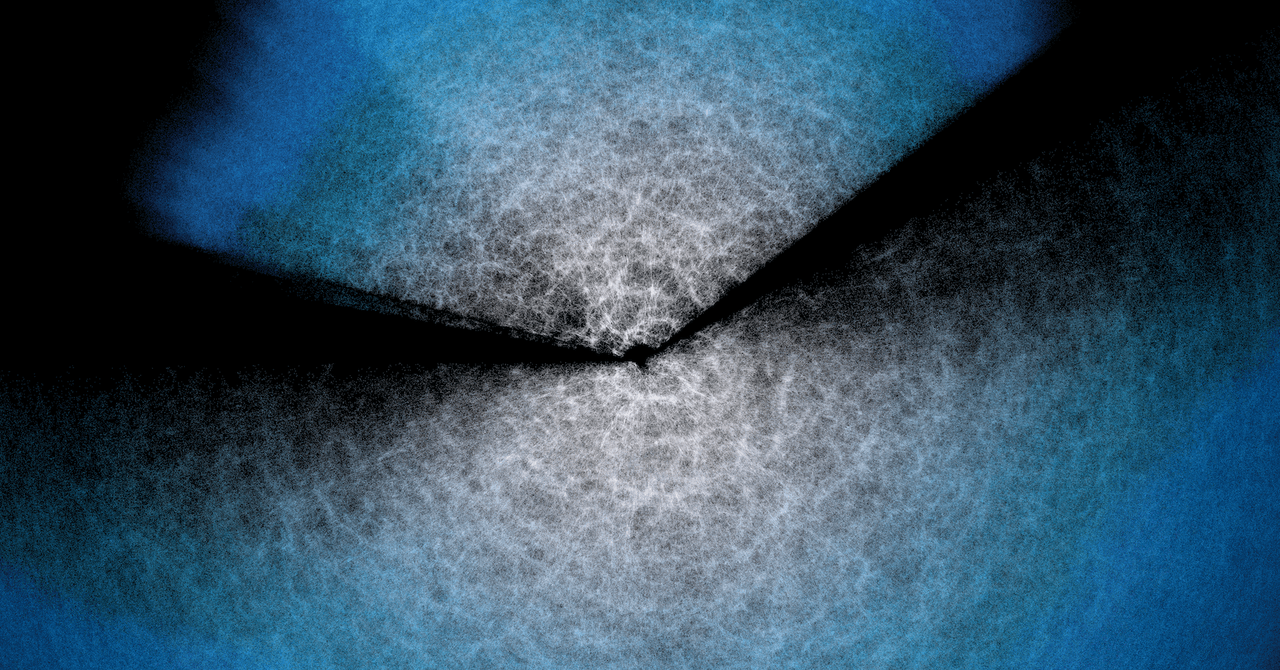
Sylos Labini framed the test with a map: mark each galaxy as a point, then zoom out. If the assumption holds, the detail should wash out into something close to a uniform background. According to the study, that washout did not happen in the expected way. The authors say coherent patterns in galaxy positions persisted as they examined larger volumes.
What the team measured
The researchers analyzed the positions of nearly 47 million galaxies observed by the Dark Energy Spectroscopic Instrument, or DESI. The dataset covers roughly 11 billion years of cosmic history, according to the study.
Rather than hunt for one grand direction in space, the team built a statistical method to test whether the orientations of millions of galaxy pairs remain correlated over very large distances. The analysis looked at scales approaching one gigaparsec, about 3.26 billion light-years.
That distinction matters. Sylos Labini told Wired that the researchers are not saying the universe has a single preferred axis, like a cosmic compass needle. The reported signal is subtler: galaxy filaments and walls appear to preserve organized relationships across distances where the standard model expects such patterns to fade below detectability.
The work follows more than two decades of research by Sylos Labini into whether large galaxy catalogs actually support the assumption that the universe becomes uniform and direction-independent at large enough scales. As catalogs have grown, astronomers have also identified structures larger than earlier expectations allowed, according to the report.
Replication is the hard part
The study does not, by itself, rewrite cosmology. The result depends on the authors’ statistical method and on the galaxy catalog they analyzed. Independent teams will need to test the same question with larger datasets and different methods before anyone should start throwing out models of dark matter, gravity or structure formation.
If the signal survives those checks, cosmologists may have to refine how they describe the emergence of large-scale uniformity. If it does not, the result may still clarify where current measurement techniques can mislead researchers. Sylos Labini said the larger question is whether nature is showing researchers something new about the universe at the largest scales, or whether the method has hit its limits.
This story draws on original reporting from WIRED.


