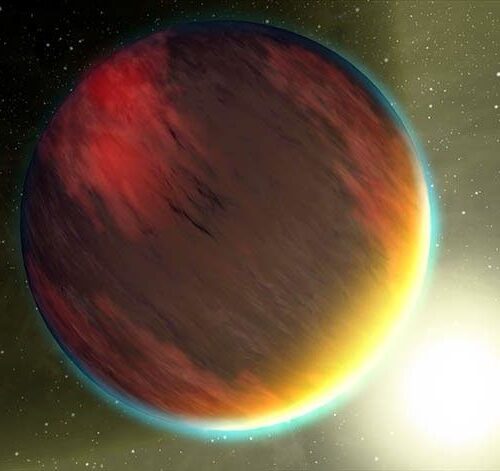
A rocky exoplanet orbiting LHS 1140 is losing helium from its atmosphere, according to a study published Wednesday in Nature. The star sits about 50 light-years from Earth, close enough in astronomical terms for researchers to study what is happening to gas around one of its planets rather than merely argue from theory.
The useful part is not just that helium is escaping. The study says the rate of helium loss can be used to infer something about the atmosphere that remains. For exoplanet science, where researchers often have to work with thin signals and thick uncertainty, that is a real measurement rather than another vibes-based atmospheric sketch.
Most gas in the universe is hydrogen and helium, and planetary scientists think many planets begin with atmospheres dominated by those two elements. Time is rude to that starting condition. Over billions of years, atmospheres can be chemically altered, stripped away, or replaced by later gases. Venus, Earth, and Mars are thought to have secondary atmospheres, after their early hydrogen-and-helium envelopes were lost, transformed, or both.
Why helium escape is useful
Atmospheric loss is a messy problem because several forces pull in different directions. Lighter elements are easier to remove from a planet’s atmosphere, which makes hydrogen and helium obvious candidates for escape. Hydrogen, however, can be tied up inside molecules such as methane and ammonia, which changes how readily it leaves.
A planet’s gravity also matters. More gravity helps hold gas down. A magnetic field can reduce the ability of stellar radiation to knock atmospheric material away. The planet’s distance from its star changes the problem again: radiation can drive loss directly, and heating can puff up an atmosphere so that gas sits farther from the planet, where gravity has less control.
That stack of variables is why predicting exoplanet atmospheres is not a clean exercise. Two planets can start with similar ingredients and end up with different skies, depending on their mass, magnetic environment, chemistry, age, and dose of stellar radiation.
The Nature observations around LHS 1140 therefore give researchers a concrete case to test against those models. Seeing helium leave a rocky exoplanet links the broad story of atmospheric evolution to a specific world outside the Solar System. The measurement does not, by itself, reveal every gas still present or reconstruct the planet’s full history. According to the study, it does provide a way to reason from today’s helium escape back toward the atmosphere the planet still has.
That is the kind of incremental progress exoplanet atmospheres usually allow: one escaping element, one nearby star, one better constraint on a process that helped shape Venus, Earth, and Mars too.
This story draws on original reporting from Ars Technica.