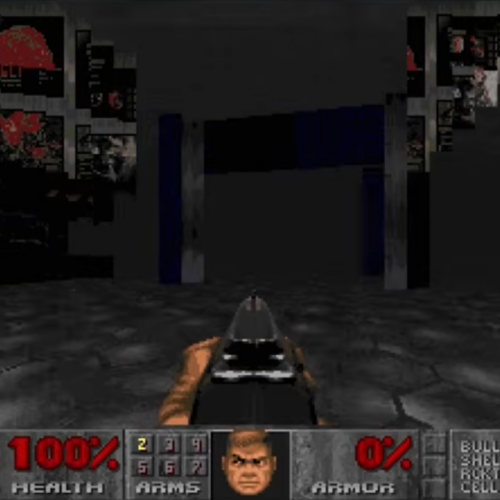
Two homebrew projects have made progress on getting Doom working on stock Neo Geo hardware, shortly after Modern Vintage Gamer argued that such a port was “functionally impossible.” The work does not make the Neo Geo a secret 1990s PC, and Modern Vintage Gamer says both efforts come with major visual trade-offs. Still, the projects show that “impossible” remains a dangerous word around people who enjoy abusing old hardware for sport.
The original technical objection was straightforward. The Neo Geo was built around sprite-based display hardware and does not provide the kind of frame buffer that Doom normally wants. A frame buffer gives software a place to draw a full image before it appears on screen. Doom leans on that model because its renderer is producing a view into a 3D-like world, rather than placing conventional 2D sprites and tiles in the way many arcade-style systems expected.
Modern Vintage Gamer, who previously made the case against a practical Neo Geo port, has now published a new video discussing the recent attempts. His conclusion, as described there, is not that these projects would have made sense as a polished commercial release in the 1990s. The compromises are too visible for that. The more useful point is that determined programmers can sometimes route around hardware assumptions that look fixed from a distance.
How Doom64KB gets a picture on screen
One of the projects is Doom64KB by coder FrenkelS. For the Neo Geo version, FrenkelS adapted work from an earlier Doom port aimed at 16-bit PC processors such as the 8088 and 286. That matters because the engine was already designed for constrained machines, rather than assuming the memory and graphics model of a more comfortable PC setup.
On the Neo Geo, FrenkelS’s code uses the console’s fix layer as a rough stand-in for a frame buffer. The fix layer is normally used for interface elements such as menus and heads-up display information over gameplay. In Doom64KB, it becomes a place to build something closer to the screen layout that the Doom renderer needs.
That is a hack in the older, better sense of the word: it takes a part of the machine intended for one job and presses it into service for another. It also explains why the result is constrained. The source of the earlier objection, the Neo Geo’s lack of a normal frame buffer, has not gone away. The project works by finding an awkward substitute, not by changing the console into something it is not.
Modern Vintage Gamer’s new video also discusses a second recent Neo Geo Doom effort, though the available details here center on Doom64KB. Together, the projects weaken the broad claim that Doom cannot be made to run on the machine at all. They do not erase the harder claim that a smooth, marketable 1990s-style port would have been a poor fit for the hardware.
This story draws on original reporting from Ars Technica.