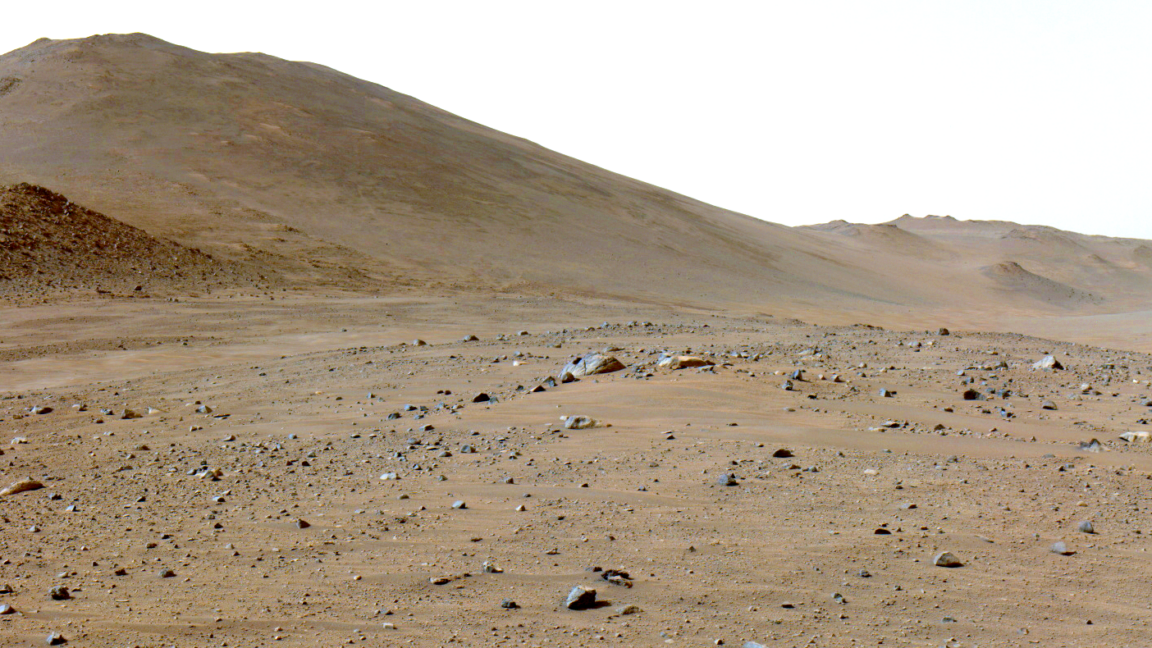
NASA’s Perseverance rover has detected complex organic carbon on the exposed surface of rocks near an ancient Martian river channel, according to a study published in Science Advances. That is a sharper find than the rover’s earlier organic-carbon detections, which mostly came after drilling or scraping into rock.
The site, called Bright Angel, sits along the edge of Neretva Vallis in Jezero Crater. Ashley E. Murphy of the Planetary Institute in Tucson, Arizona, who led the study, said the team knows of no shallower detection of organic matter yet made on Mars.
The awkward part is the same one that follows nearly every interesting Mars-organics result: organic carbon is not a biosignature by itself. On Earth, comparable macromolecular carbon is often tied to biology. Mars, being Mars, gives scientists several non-biological ways to make confusing carbon chemistry and then dares them to sort it out with a rover.
What Perseverance saw
The measurement came from SHERLOC, the ultraviolet Raman spectrometer mounted on Perseverance’s arm. SHERLOC shoots a deep-ultraviolet laser at rock and reads how the returned light shifts in energy. Those shifts reveal molecular bonds.
Between Martian sols 1180 and 1218, the rover examined four Bright Angel targets. One, Steamboat Mountain, served as a nearby comparison rock. Three others, Cheyava Falls, Apollo Temple and Walhalla Glades, showed a graphitic-band signal associated with macromolecular carbon.
Murphy’s team describes the material as a cross-linked network dominated by reduced carbon atoms. It is resistant to chemical and thermal breakdown. Within the limits of Perseverance’s instruments, the signal resembles terrestrial kerogen, but the researchers avoided that label because kerogen on Earth is overwhelmingly biological in origin. Murphy said “macromolecular carbon” is the safer term because the Martian material’s origin remains unknown.
The team checked the boring explanations first
The researchers had to rule out rover weirdness before treating the signal as Martian. Bright Angel was the first site SHERLOC examined after a dust-cover problem disabled its focusing mechanism, forcing operators to use a new observing mode.
Kyle Uckert, SHERLOC’s deputy principal investigator at NASA’s Jet Propulsion Laboratory, and colleagues compared the new mode against spare flight optics in the lab, calibration targets on Mars and empty-sky-style checks. The team also pointed SHERLOC at Steamboat Mountain. Uckert said nearby rocks did not show the same graphitic-band signal, supporting the conclusion that the signal was not coming from SHERLOC hardware.
Contamination from Earth was the other obvious suspect. The abrasion bit used by Perseverance was sterilized before launch and has worked on other Jezero rocks without producing such a strong graphitic-band signal, according to the study team. Cheyava Falls also matters because the rover did not touch it with the abrasion hardware. It cleared dust using a nitrogen puff. Steamboat Mountain again came up clean, Uckert said.
Two possible episodes of carbon placement
The chemistry around the carbon differs by target. At Apollo Temple, the carbon signal appears with carbonate and sulfate minerals, which can form when water moves through older rock. At Walhalla Glades, the carbon occurs in silicate-rich sediment.
Murphy said that split suggests carbon may have entered or been preserved in the rocks during at least two separate geological events. One possibility is that organic material was buried with lake mud. Another is that later groundwater carried or altered carbon as it deposited carbonate and sulfate minerals.
Kevin P. Hand, Perseverance principal investigator at JPL, said the rover’s instruments were built to identify samples worth returning to Earth, not to settle whether a process was biological. He pointed to isotopic measurements, chirality tests and high-end microscopy as analyses that Earth labs could use on returned samples.
The non-biological options remain very much alive. Murphy noted that water-rock reactions can make organic compounds without life, and carbon associated with carbonates on Earth can come from microbes or chemistry depending on the setting. Hand said Perseverance is now examining rocks outside Jezero Crater that may be among the oldest ever studied by a Mars rover, a useful place to keep looking if Mars ever had early life.
This story draws on original reporting from Ars Technica.


