Satellite companies are beginning to design spacecraft around SpaceX’s Starship rather than waiting for rocket builders to accommodate them, a reversal of the launch market’s usual pecking order.
The reason is not subtle. Starship is designed to carry more than 100 metric tons to low Earth orbit, far beyond Falcon 9-class vehicles, and SpaceX wants the whole system to be reusable. The rocket has not yet proved Elon Musk’s broadest claims, and its commercial pricing remains unknown. Even so, NASA, the U.S. military, scientists, and satellite manufacturers are already planning for what that much volume and mass could do if SpaceX makes the vehicle work at scale.
For decades, rocket designers generally chased the payload market. A small satellite bought a small launch, a heavy spacecraft bought a bigger one, and almost everything rode under a disposable aerodynamic fairing at the top of the rocket. NASA’s Space Shuttle broke that pattern for a while with its cargo bay, but it lost commercially to cheaper expendable rockets and did not force a lasting redesign of satellites.
Starship’s dispenser changes the shape of the payload
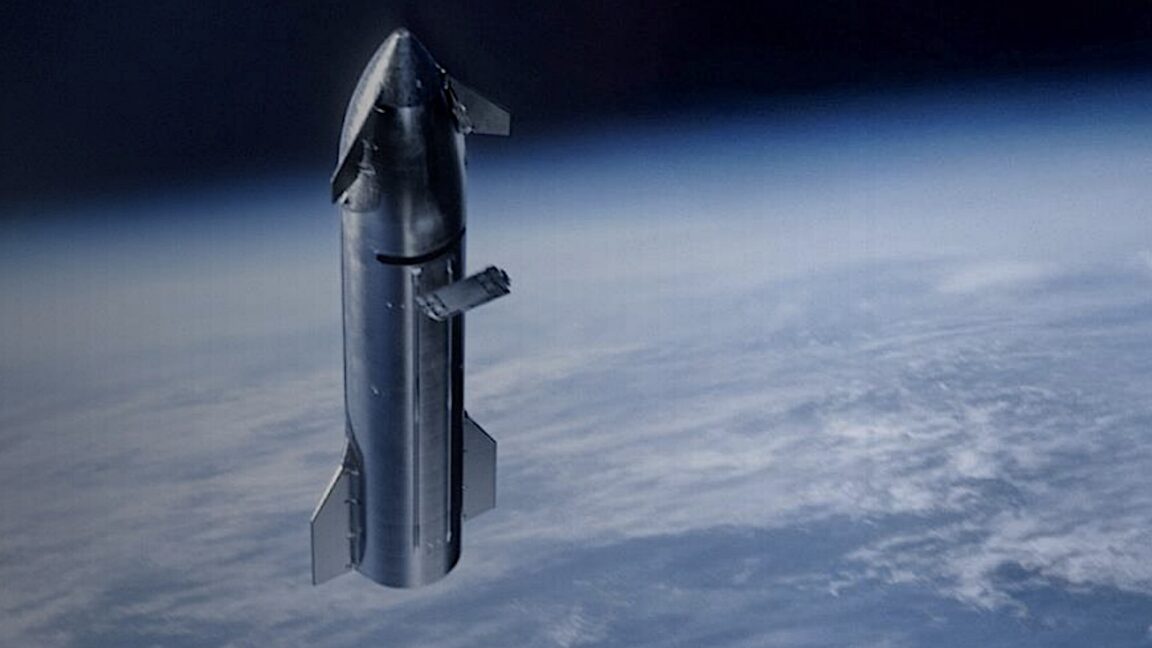
SpaceX’s first operational Starship payloads are expected to be its own Starlink V3 broadband satellites. The company has said Starship can carry up to 60 of them per flight. Unlike conventional box-shaped spacecraft, Starlink satellites use a flat, stackable layout that SpaceX began flying on Falcon 9 in 2019.
On Starship, SpaceX plans to deploy the satellites from inside the vehicle’s body through a side opening. A cable-and-pulley mechanism moves each satellite into position and ejects it one at a time, a setup often compared to a Pez dispenser. That lets SpaceX avoid relying first on a large conventional fairing and keeps the vehicle compatible with its goal of full reuse.
Other manufacturers are responding. Muon Space said this month that it is developing Condor-Ultra, a high-power flat satellite bus aimed at communications, sensing, and orbital data-center-style missions. The company says the platform is optimized for stacked deployment from Starship, while still fitting medium-lift rockets such as Falcon 9 and Rocket Lab’s Neutron. Muon says Condor-Ultra will weigh about 1.5 metric tons at launch.
Greg Smirin, Muon Space’s president, told Ars Technica the design targets the near-term Starship deployment opening SpaceX is expected to offer around 2028. He said some missions will still need more traditional spacecraft bodies and payload fairings, but Condor-Ultra was built for the dispenser-style architecture.
Apex has announced a flat satellite chassis called Comet and advertises a larger Comet XL as optimized for Starship and future super-heavy launchers. Terran Orbital, owned by Lockheed Martin, lists a flat-packed Enterprise spacecraft platform. Vast, better known for private space station plans, said its new Vast Satellite business is based on a flat-panel design for dense launches and batch deployment.
John Rood, CEO of Momentus, told Ars Technica that SpaceX deserves credit for tighter integration between launch vehicle and satellite design. He also said flat-panel spacecraft are unlikely to become the only model, because tugs, hosted-payload vehicles, and other missions have reasons to keep different shapes.
The economics are still projections
A report from the Aerospace Corporation explains why companies are willing to think this way before Starship is routine. Karen Jones, a space economist and the report’s lead author, modeled scenarios in which a fully reusable Starship and Super Heavy system could drive launch costs from thousands of dollars per kilogram to hundreds, or less, if SpaceX achieves high reuse and full payload utilization.
Jones told Ars Technica that one optimistic case reached $67 per kilogram after nine reuse cycles, based on a $50 million initial launch cost and 20 percent marginal cost. Other scenarios using a $100 million initial cost landed between $133 and $233 per kilogram after 10 reuse cycles. Those are cost estimates, not customer prices.
SpaceX currently lists a dedicated Falcon 9 launch for commercial customers at $74 million, far above the roughly $15 million internal cost Ars Technica cited for some Starlink missions. Starship pricing will depend partly on competitors, especially Blue Origin’s New Glenn and planned upgrades.
Jones said megaconstellations are the immediate market most likely to feed Starship’s learning curve. She also said Starship could launch 60 larger Starlink V3 satellites per flight, compared with 27 V2 satellites on Falcon 9, increasing bandwidth deployed per launch from 2,600 gigabits per second to 61,000 gigabits per second.
The bet is clear enough: if SpaceX can make Starship reusable, cheap, and reliable, satellite builders that conform to its cargo geometry get more hardware into orbit per launch. If it cannot, the industry will have spent real engineering time designing around a rocket that still has to earn its own assumptions.
This story draws on original reporting from Ars Technica.