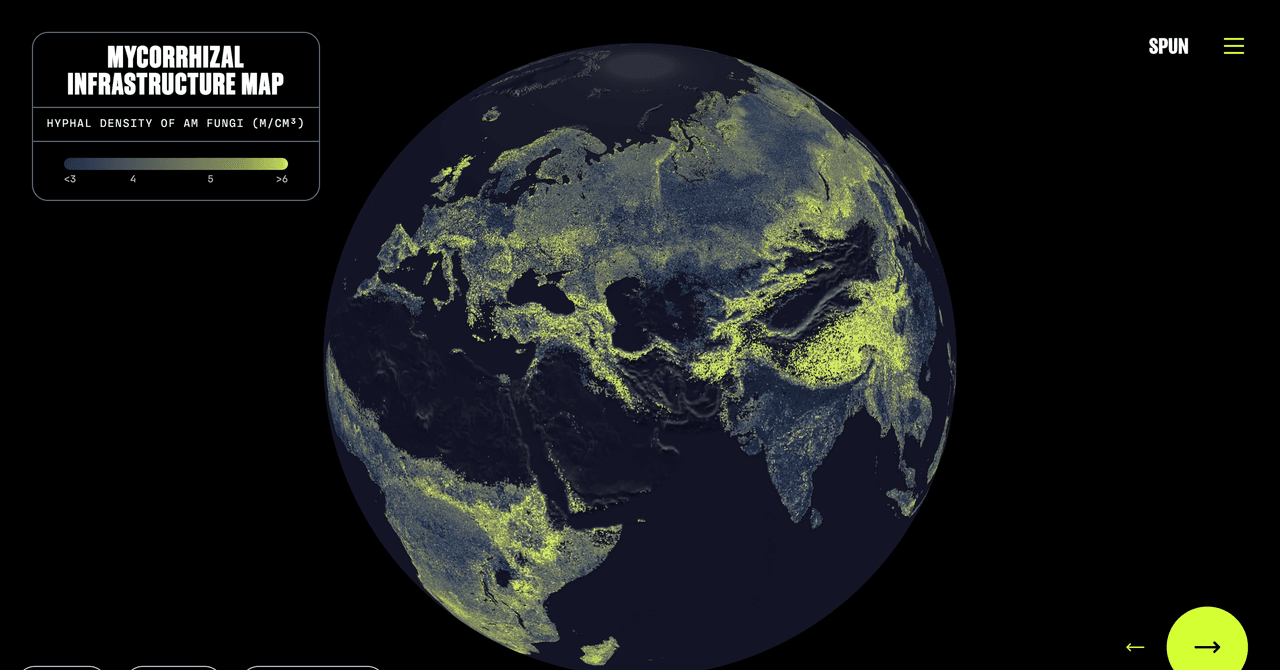
An international research team has produced a global map of arbuscular mycorrhizal fungi, the root-partnering fungi that help plants get water and nutrients and help move carbon into soil. The study, published in Science, estimates that these underground filaments stretch about 110 quadrillion kilometers in total. That is roughly 1 billion times the distance from Earth to the sun, which is the sort of number that makes ordinary infrastructure look like a garden hose.
The map matters because these fungi are not biological trivia. Arbuscular mycorrhizal fungi form networks of microscopic threads called hyphae. Those threads connect with plant roots in a trade: the fungi supply water and nutrients, while plants hand over carbon made through photosynthesis. Current estimates cited by the researchers say about 70 percent of plant species rely on these partnerships.
How the team built the map
The researchers combined data from 322 earlier studies with 16,000 soil samples from a wide range of land-based ecosystems. They used machine learning, high-resolution imaging and related technologies to estimate the density, distribution and biomass of the fungal networks. The result is a modeled estimate, not a direct measurement of every fungal thread on the planet, because nobody is unspooling quadrillions of kilometers of hyphae by hand.
The authors said earlier research had described global patterns in the diversity of underground mycorrhizal fungal communities, including a Nature study published last year. They said the new work is the first to quantify the worldwide density and distribution of the network itself.
What the study estimates
The Science study puts the carbon contained in the fungal biomass at about 300 megatons. The researchers compare that to roughly four to six times the total mass of all living humans.
The study also estimates that these fungal networks move the equivalent of about 4 billion metric tons of carbon dioxide into soil each year. According to the researchers, that equals around 11 percent of annual human-caused carbon dioxide emissions. That does not turn fungi into a climate policy substitute, despite the temptation to file them under miracle dirt. It does make them a material part of how carbon moves between plants, soil and the atmosphere.
Justin Stewart, the study’s lead author and a researcher at the Society for the Protection of Underground Networks, said a teaspoon of soil can contain up to 10 meters of mycorrhizal network. Coauthor Corentin Bisot said advances in imaging, machine learning and robotics are making it possible to observe structures that have largely been hidden underground.
A warning from farm soils
The researchers reported that fungal network density in agricultural soils is about half the density found in natural ecosystems. They also highlighted grasslands, which they estimate hold about 40 percent of the world’s arbuscular mycorrhizal biomass.
According to the study, grasslands are among the least protected ecosystems and are being converted to farmland at four times the rate of forests. The scientists warned that sparser fungal networks could weaken soils’ ability to store carbon and recycle nutrients.
Merlin Sheldrake, a coauthor of the study, said mycorrhizal fungi have influenced life on Earth for hundreds of millions of years, while their global distribution remains poorly understood. The new map gives researchers a first pass at the underground system’s scale, and a baseline for studying how land use changes the living plumbing beneath fields, forests and grasslands.
This story draws on original reporting from WIRED.


