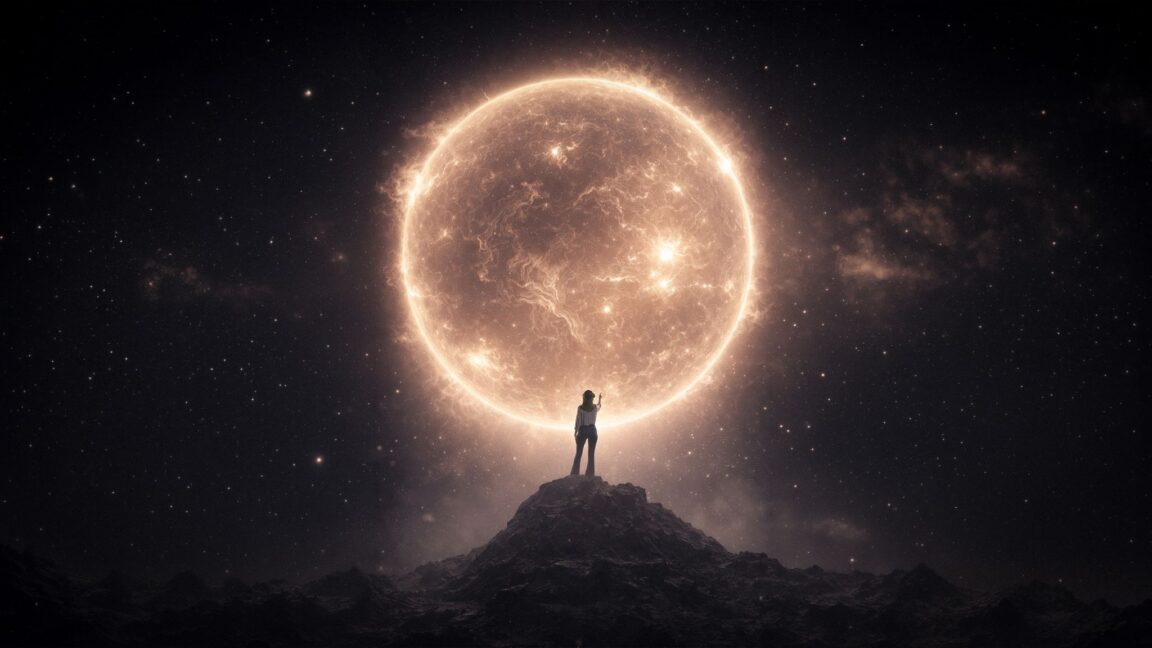
Smithsonian Starstruck, a ticketed virtual reality astronomy show, is now running in Washington, DC, giving visitors a 40-minute walk through cosmic set pieces that range from the Big Bang to the black hole at the center of the Milky Way.
The exhibit, formally called Smithsonian Starstruck: An Immersive Experience, premiered in May, according to the Smithsonian Institution. Adult solo tickets are listed at $29 to $35, with group tickets for four or more starting at $18 each; current listings show a 15 percent discount. The organizers also plan to open versions in Denver, Orlando, Florida, and San Antonio, Texas, later this year.
The setup is a free-roaming VR room rather than a seated planetarium. Visitors complete onboarding, choose options such as closed captioning, sign a waiver, put on an HTC Vive headset, and then follow a virtual guide voiced by narrator James Seawood. In Washington, the experience uses HTC’s Vive Focus 3, a standalone headset first released in 2021. Ars Technica reported that other cities are expected to use the newer Vive Focus Vision, and that the DC installation is also due to switch to that model.
What visitors see
The tour opens at the Multiple Mirror Telescope at the Smithsonian Astrophysical Observatory’s Whipple Observatory, under a simulated night sky. From there, visitors move between viewing spots in the room while the software replaces the floor, walls, and ceiling with astronomical scenes.
The itinerary includes a representation of the Big Bang, the Pillars of Creation made famous by Hubble images, a close pass by the Sun alongside NASA’s Parker Solar Probe, and encounters with models of Hubble, the Chandra X-ray Observatory, and the James Webb Space Telescope. Ars Technica reported that spacecraft segments include a “Take a picture” button and small manipulable models, including one of Webb’s folded-out mirror-and-sunshield design.
Much of the show tracks how stars and planets form, age, and die. One stop places visitors on a rendering of Janssen, also known as 55 Cancri Ae, an exoplanet orbiting the star Copernicus. The planet’s year lasts roughly 17 hours because it circles so close to its star. The experience depicts Janssen as rocky terrain cut by lava, with diamonds formed under extreme conditions. NASA’s Jet Propulsion Laboratory has described analyses suggesting the planet’s surface may be molten rock.
The production also visits Betelgeuse, the red supergiant in Orion, and shows it in a future supernova. Another segment brings visitors near Sagittarius A*, the supermassive black hole at the Milky Way’s center. In that scene, users can aim a beam of light and watch the simulation bend and redden it as it approaches the black hole’s gravity well.
The hardware is part of the story
VR astronomy lives or dies on display quality, tracking, and crowd choreography. Ars Technica reported visible blur when moving in the Washington headset and some visitor bumping as groups followed the same virtual guide through the room. That is the blunt tradeoff of location-based VR: a shared spectacle with a computer on your face, plus the occasional reminder that other humans still occupy the same patch of carpet.
The tour ends back on Earth at Chile’s Atacama Desert, showing the Giant Magellan Telescope as completed, with its seven primary mirrors pointed skyward. The real observatory is still under construction, according to the Giant Magellan Telescope project; the Smithsonian Astrophysical Observatory is one of its founding partners.
For visitors already spoiled by newer high-end headsets, the Washington version may not be the sharpest possible way to look at simulated space. For astronomy fans, the draw is more direct: Starstruck packages real observatories, famous targets, and hostile worlds into a guided VR field trip, with enough science attached to keep it from becoming just another pretty room with goggles.
This story draws on original reporting from Ars Technica.


