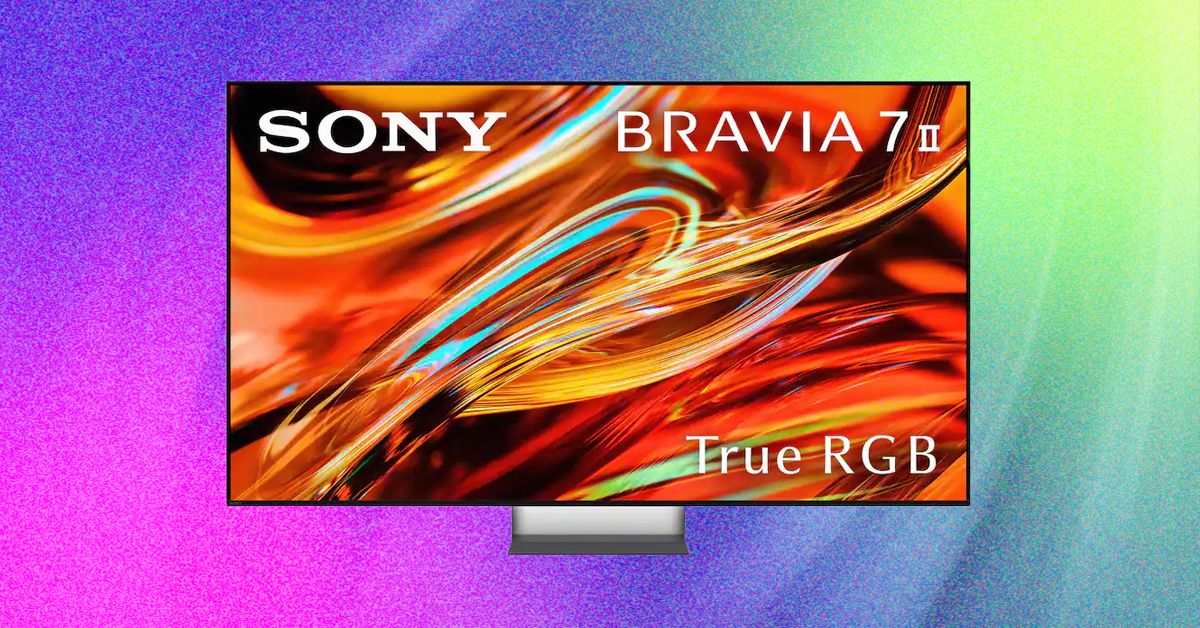
Sony’s Bravia 7 Mark II is one of the early TVs built around the new mini RGB LED category, but WIRED reviewer John Brandon found that the set’s price lands well ahead of its performance. In a review, Brandon gave the television a 6/10, saying its best moments came with bright 4K movies and games, while contrast, brightness and Sony’s picture-processing extras did not consistently separate it from rivals.
The Bravia 7 Mark II sells for $1,600 in a 50-inch size at Sony and Best Buy, according to the listed retail options. The 65-inch version is listed at $2,300 after a $300 discount from $2,600. Sony positions it below the Bravia 9 Mark II, which costs $3,600 at 65 inches, but Brandon wrote that the cheaper model still feels expensive for a midrange TV.
The underlying pitch is mini RGB LED. Instead of a conventional white or blue LED backlight with filters doing much of the color work, these TVs use small red, green and blue LEDs behind an LCD panel. The idea is better color volume and more precise control. Sony calls its implementation “True RGB,” and says it improves color, contrast, brightness and overall image quality. Brandon’s testing did not back that up across the board.
WIRED reported that the Bravia 7 Mark II joins other RGB LED models including the Hisense UR9 and TCL RM9L, while Samsung and LG use the “micro RGB” label for similar sets. Sony representatives told WIRED that the LEDs are the same size, pushing back on the claim that micro RGB is necessarily more advanced because its LEDs are smaller.
Strong color, weaker contrast
Brandon found the set could produce vivid color in some cases, especially with 4K material and games. He singled out smooth motion during World Cup 2026 matches on YouTube TV and convincing reds and blues in Subnautica 2 on Xbox. The animated film Hoppers on Disney+ also looked better on the Bravia 7 Mark II than much of the other test material, helped by the TV’s restrained backlighting.
The weaker results came in contrast-heavy scenes. Using Spears & Munsil benchmark material, Brandon said skin-tone variation was not distinct enough, and demo scenes with mist, grass, buffalo and dark trees lacked separation. Netflix films The Creator and Awake looked too dim in dark scenes, and Sony’s XR Contrast Booster did not materially fix the issue, according to the review.
Gaming followed the same pattern. The Vietnam level in 007 First Light looked clear in bright daylight scenes, then washed out in darker areas. Forza Horizon 6, Senua’s Saga: Hellblade II and Subnautica 2 could look too dark or matte unless brightness and picture settings were adjusted.
The spec sheet has some gaps
The Bravia 7 Mark II includes Nvidia G-Sync support, Sony Pictures Core access, Google TV, four HDMI ports, coaxial input and two USB ports. Only two of the HDMI ports support HDMI 2.1, however, and there is no DisplayPort. Brandon noted that means a connected PC tops out at 120 Hz, while the Hisense UR9 supports higher refresh-rate modes.
The physical design uses Sony’s Mirage Stand, a single-foot mount with a transparent plastic section meant to make the screen appear to float. Brandon found the assembly awkward and said the clear piece was foggy enough to be visible. Setup through Google TV took about 10 minutes after a failed QR-code sign-in through the Google Home app forced manual login.
Sound was uneven. WIRED found external Klipsch The Nines II speakers delivered strong surround effects through the Bravia 7 Mark II, but the TV’s built-in speakers were less capable than the Hisense UR9’s integrated audio.
Brandon’s bottom line was blunt: RGB LED is a real display technology, and Sony’s color handling can impress, but the Bravia 7 Mark II does not deliver enough contrast or gaming headroom to make $2,300 feel like a midrange bargain. A discount may change the calculation for Sony loyalists. At current pricing, WIRED said competing mini and micro RGB sets deserve a look.
This story draws on original reporting from WIRED.