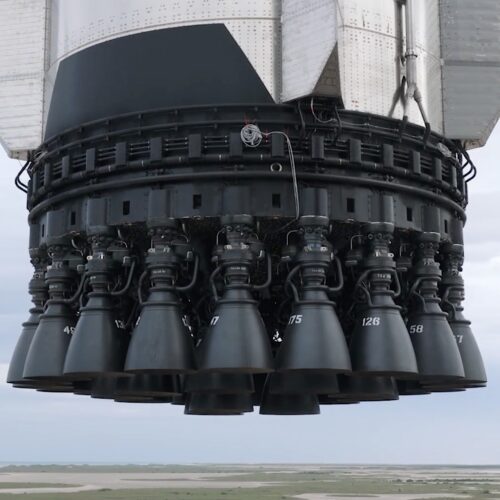
SpaceX is preparing to fly Starship again as soon as Thursday, with a launch window opening at 5:45 p.m. CDT, or 22:45 UTC. The roughly hour-long test is expected to follow much of the profile used on the previous Starship flight in May, but the payload bay will not be carrying practice hardware this time.
For the 13th full-scale Starship test flight, SpaceX technicians have loaded 20 functioning Starlink V3 satellites into the spacecraft’s deployer. It is also the second flight using SpaceX’s newest Starship version, according to the mission details described for the test.
The change matters because SpaceX is moving this part of the program from mass simulators to actual satellites. On an earlier flight, the company tested the payload deployment system with hardware built to mimic the size and weight of its next-generation Starlink broadband satellites. That checked the mechanics without putting real spacecraft through the process.
What SpaceX is testing
Starship’s satellite deployer uses pulleys and cables to push satellites out one at a time through an opening in the side of the spacecraft. SpaceX plans to use that system for Starlink V3, the company’s next-generation broadband satellites.
The 20 satellites on this flight are not meant to join SpaceX’s operational Starlink network. Instead, engineers will try to briefly create laser communication links between the Starlink V3 satellites and other spacecraft already flying in low Earth orbit.
If those laser links work, the test would show that Starlink V3 satellites can communicate with SpaceX’s earlier Starlink spacecraft. That interoperability is the point of the exercise, at least for this payload test. SpaceX is not presenting these satellites as part of a customer-facing service upgrade from this flight.
A familiar mission with a more serious payload
Most of the flight is expected to resemble the May Starship test. The main distinction is what sits inside the cargo bay and what SpaceX intends to learn from it. Simulators can prove that a door opens, a mechanism moves, and a stack exits in the intended order. Real satellites add the next layer: deployment behavior, spacecraft survival, and a short communications check with other orbital hardware.
The flight remains a test, and the payload plan is limited. SpaceX will attempt the deployment and laser-link checks during a mission expected to last about an hour. The company has not described these satellites as operational network assets, and the planned communications test is temporary.
If the schedule holds, Thursday’s launch will give SpaceX another data point for Starship’s newest configuration and for the Starlink V3 deployment method it wants the vehicle to support.
This story draws on original reporting from Ars Technica.