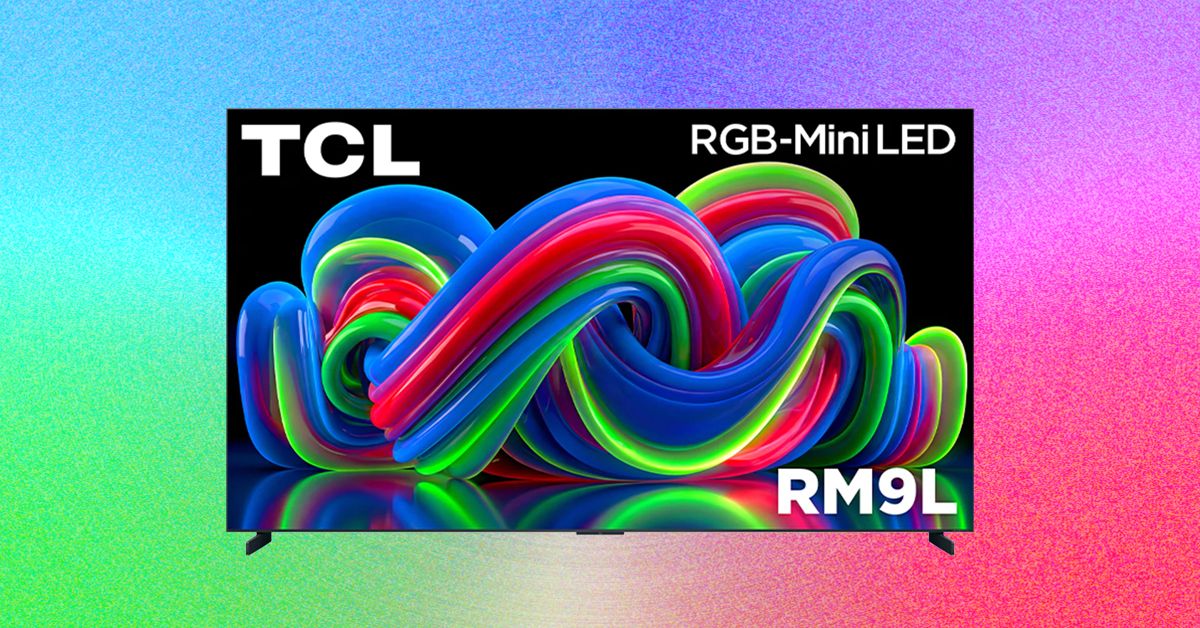
TCL’s RM9L RGB-Mini LED is an 85-inch reminder that new display hardware can look brilliant after tuning and weirdly undercooked before it. In a review for WIRED, John Brandon rated the television 7 out of 10, praising its picture quality, backlit remote and unusually flexible image controls, while faulting its high price, bulk and less convincing skin tones compared with LG’s Micro RGB Evo.
The set uses mini RGB technology, which sends red, green and blue light through an LCD panel. That differs from OLED, where each pixel emits its own light and can be controlled individually. Brandon found the RM9L could approach OLED-level quality after settings changes, but said the comparison is not kind to TCL on price: 85-inch OLED models were available for about $2,700 or less at the time of the review.
The 85-inch RM9L lists for $7,999.99, though WIRED reported it is often discounted by $2,000. TCL also sells a 98-inch version for $8,999.99, typically $1,000 off, and a 115-inch model for $24,999.99. Retail links in the review showed the 85-inch model at $5,999 from TCL and $4,999 from Best Buy.
A very large, very heavy TV
Brandon’s testing made the physical problem plain. The 85-inch model weighs more than 114 pounds and is 1.4 inches thick at the edge, which made it hard to grip. He needed two other people to position it, and initially had to place it on a folding table before moving it to a larger stand. The setup itself was uncomplicated: the legs slide in and are secured with screws.
The port selection is less annoying. WIRED reported four HDMI 2.1 ports, each supporting 144Hz refresh rates, with one also handling eARC audio passthrough. The TV also includes two USB ports, Ethernet, digital optical audio and Wi-Fi 6. Brandon tested it with an Xbox Series X, a Google TV and Klipsch The Nines II speakers.
The remote received rare praise for a TV accessory, which is usually where good interface ideas go to die. Brandon liked the backlight, side-mounted brightness controls and tactile notches for volume and channel buttons, though he said extra buttons for free channels felt unnecessary and the off-center Home button was harder to locate.
Excellent moments, inconsistent defaults
WIRED’s review found the RM9L at its best with vivid, high-resolution content. Disney+ titles such as Tron: Ares and Hoppers showed strong blacks, intense color and fine detail, according to Brandon. He also said a planet-ring scene in Project Hail Mary delivered striking color.
The weaker moments came in darker or more demanding scenes. In Awake on Netflix, Brandon said the image needed Vivid mode before shadow detail became clear. In The Creator on Fandango at Home, he found an ocean scene too gray even after trying Vivid and Dolby Vision IQ modes. He also reported visible artifacts, blotchy patterns and jagged lines in some 4K tests, though Intelligent picture mode helped reduce them.
Skin tones were another limitation. Brandon said the RM9L did not match the LG Micro RGB Evo’s tonal variation and looked closer to the Sony Bravia 7 Mark II and Hisense UR9 in that respect. He found the LG stronger on several color-heavy demo scenes, including flowers, a cactus, a butterfly and nighttime trees.
Gaming was a stronger case for TCL. Brandon said all four HDMI ports supported low-latency play, game settings were easy to find, and 330Hz variable refresh rate worked after enabling a High Refresh Rate setting. Crimson Desert, 007: First Light and Forza Horizon 6 all performed well in his testing, with the PC version of Forza feeling more responsive than Xbox.
WIRED’s bottom line was that TCL has built one of its strongest TVs and one of the better mini RGB models, ranking below LG’s Micro RGB Evo and Samsung’s Micro RGB R95H. The catch is the obvious one: if mini RGB is meant to make big screens cheaper, this model does not yet prove the point.
This story draws on original reporting from WIRED.