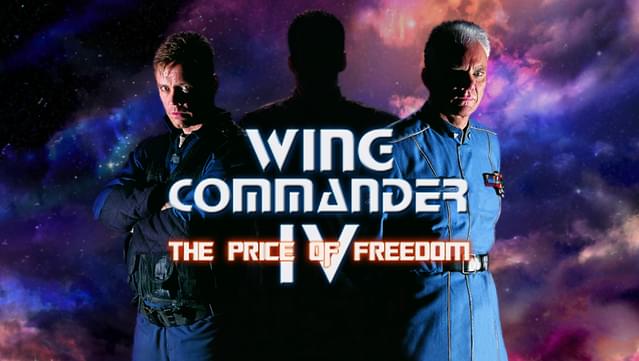
Wing Commander IV: The Price of Freedom remains one of the clearest exhibits from the mid-1990s moment when game makers thought Hollywood and PC software were about to merge into one expensive, disc-swapping medium.
Origin Systems released the game in February 1996 after missing a planned Christmas 1995 launch, according to Ars Technica senior technology editor Lee Hutchinson. It arrived on six CD-ROMs, up from the four used by Wing Commander III, with nearly four gigabytes of compressed full-motion video. That was not a small ask for the era’s PCs, especially for players still running older machines.
The production scale was the point. Mark Hamill, Tom Wilson, Malcolm McDowell and other returning cast members performed on 35mm film, with large physical sets replacing the earlier game’s videotape and digital-background approach. Digital Antiquarian writer Jimmy Maher has reported that Origin spent $12 million on the project. Hutchinson cites Daily Variety describing it at the time as “The most expensive CD-ROM production ever.”
The Silliwood bet
The game belonged to the so-called “Silliwood” idea, promoted in the 1990s by figures including Ken and Roberta Williams and Chris Roberts: games would absorb film production values, while movies would become interactive. The prediction was tidy, confident and wrong in the way many 1990s multimedia predictions were wrong. The hardware improved, but the form did not settle into filmed cutscenes stitched between action sequences as its dominant mode.
Wing Commander IV pushed that model hard. Hutchinson notes that players sat through more than 20 minutes of narrative video before reaching the first real mission. The game later received a single-disc DVD version with better video, but the original CD-ROM release had to compress its filmed material enough to run from mid-1990s optical media.
The plot follows Hamill’s Christopher Blair after the Kilrathi war, pulling him out of retirement amid pirate attacks around the Border Worlds. The story grows into a conspiracy involving the Terran Confederation, and the player faces a major branching decision midway through. The script, including alternate paths, runs 652 pages, according to a copy posted by Wing Commander News.
The movie ate the game
The flying, by contrast, changed less. Hutchinson describes the space-combat engine as close to Wing Commander III, with some lighting improvements and a shift from fighting Kilrathi ships to mostly human opponents. Maher reports that about 90 percent of the budget went to the filmed side rather than the game side. A contemporary PC Gamer review quoted by Maher called the result “a little hollow.” That diagnosis has aged better than most box blurbs.
The finale leaned into conversation rather than cockpit spectacle. After a string of combat missions, Blair confronts McDowell’s Admiral Tolwyn in the Terran Confederation’s Grand Assembly chamber, with John Rhys-Davies’ character involved as a presiding figure. The ending depends on dialogue choices and uses flashbacks to earlier events, according to Hutchinson’s retrospective.
Hutchinson’s verdict is that Wing Commander IV now matters less as a great game than as a well-preserved example of a design future that game studios largely abandoned. It is still sold on GOG, where Hutchinson notes it is priced at about $4. The artifact is cheap. The lesson cost Origin a lot more.
This story draws on original reporting from Ars Technica.


