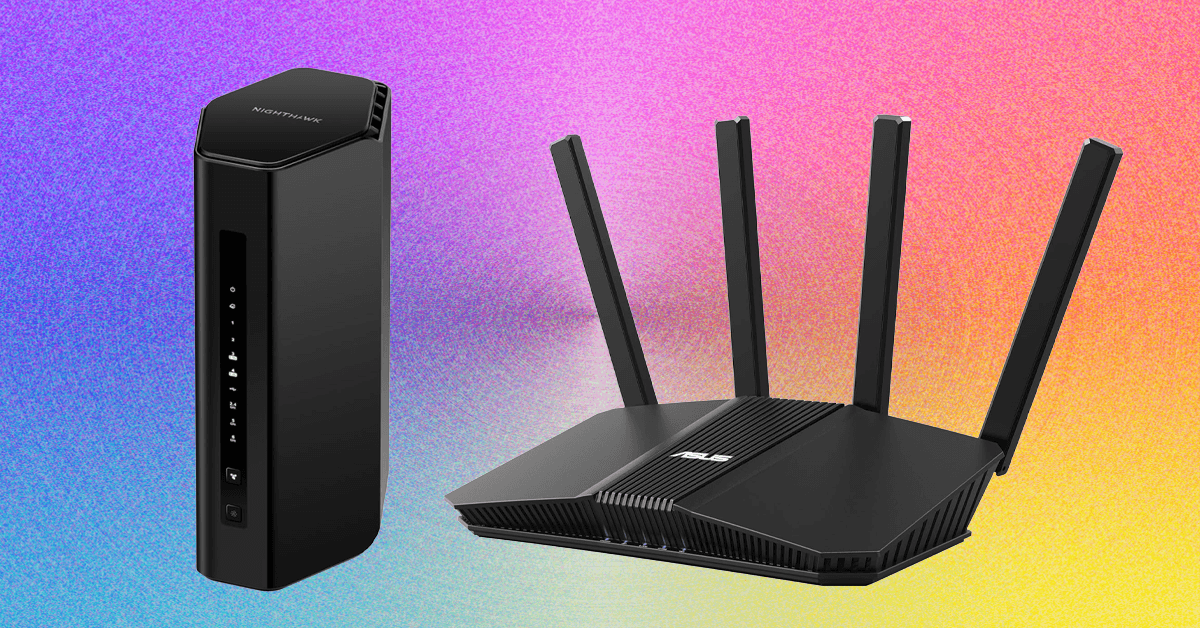
WIRED reviewer Simon Hill has updated his router recommendations for July 2026, putting the Asus RT-BE96U at the top after testing more than 40 models in a family home with heavy streaming and gaming use. For households trying to fix dead zones, speed drops, and the usual mystery sludge of home networking, the pick is blunt: spend big if you want the most capable single-router Wi-Fi 7 setup Hill tested.
The RT-BE96U is a tri-band Wi-Fi 7 router using 2.4-GHz, 5-GHz, and 6-GHz bands. Hill reported that only one router he tested performed better, Asus’ GT-BE98 Pro. He said the RT-BE96U delivered wide coverage across his home and garden and stayed stable during downloads, file transfers, gaming, and streaming.
The hardware is not subtle. WIRED describes it as a large router with eight antennas, two 10-Gbps ports, four gigabit LAN ports, USB 3.2, and USB 2.0. Hill’s main complaints were price and size, plus the fact that the four gigabit LAN ports are less generous than the 2.5-Gbps ports on some rivals. The router was listed at $531 on Amazon in the guide.
Cheaper Wi-Fi 7, with strings attached
For buyers who do not want to spend flagship money, Hill picked TP-Link’s Archer BE9700, also called the BE600, as a more affordable Wi-Fi 7 option. It was listed at $190 on Amazon, down from $250. The router supports 2.4-GHz, 5-GHz, and 6-GHz bands and includes one 10-Gbps port, four 2.5-Gbps ports, and USB 3.0.
Hill found its 6-GHz close-range performance strong, but said its 5-GHz and 2.4-GHz results were less impressive. He also noted that TP-Link’s app can split bands, show connected devices, create a guest network, prioritize devices, and enable multi-link operation. The catch is familiar and irritating: TP-Link charges subscriptions for several enhanced security and parental-control features.
WIRED also flagged the political and regulatory baggage around TP-Link. The Commerce, Defense, and Justice departments are investigating the company, according to the Wall Street Journal, after reports that vulnerabilities in TP-Link routers were used in attacks linked to China. WIRED said no evidence of deliberate wrongdoing has emerged. TP-Link president Jeff Barney told WIRED the company is cooperating, has manufacturing in Vietnam rather than China, and is now headquartered in California after splitting from TP-Link Technologies, which focuses on mainland China. Texas attorney general Ken Paxton sued TP-Link in February, alleging the company allows the Chinese Communist Party access to Americans’ devices.
Mesh pick and the coming US rules
For larger homes, Hill selected Netgear’s Orbi 770 Series as the mesh-router pick. WIRED listed the two-pack at $550. Mesh systems use multiple units to spread coverage through a home, which matters more than raw router swagger when walls and distance are the enemy.
Hill also added a policy warning. The FCC’s foreign-made router ban, announced in March, may block companies without Conditional Approval from selling new routers in the United States. Existing routers can still be sold, and WIRED said they can receive firmware updates until at least January 1, 2029. As of the update, WIRED said Netgear and Eero were the only consumer router makers with Conditional Approval.
WIRED says its editors independently select featured products, though it may receive compensation from retailers or from purchases through its links.
This story draws on original reporting from WIRED.