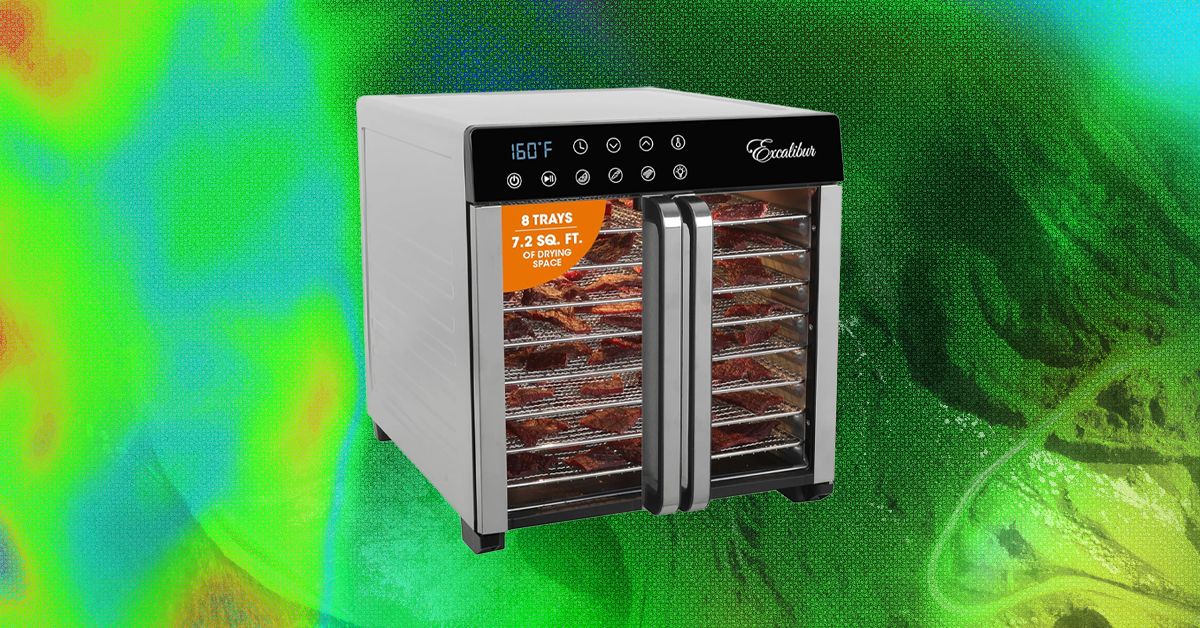
WIRED has ranked the Excalibur DH08SCSS13 Select Digital Food Dehydrator as its best overall food dehydrator for 2026, after testing machines on produce, meat and fish. For people trying to store seasonal surplus without dedicating freezer space or standing over canning jars, the takeaway is practical: tray layout, airflow, noise and cleanup matter more than the box promising self-sufficiency cosplay.
The guide says food dehydrators can be used for herbs, vegetables, fruit leather, beans, jerky, dried citrus and full dehydrated meals for backpacking. WIRED also disclosed that its editors independently choose featured products, while the publication may receive compensation from retailers or purchases made through its links.
Excalibur leads on capacity and speed
WIRED’s top pick, the Excalibur DH08SCSS13, is an eight-tray, 7.2-cubic-foot unit listed at $171 on Amazon in the guide. The machine has stainless steel trays, French doors, a light, mesh sheets, solid fruit-roll sheets, a digital timer and a QR-linked digital recipe book.
According to WIRED, the Excalibur dried fruit, tomatoes, beef and marinated salmon in close to half the time of an older round Nesco Snackmaster used for comparison. The guide measured the 700-watt motor at 40 decibels in an open kitchen and living room. The main complaint was the one-year warranty, which WIRED considered short.
The published specs list 1,037 square inches of drying area, a footprint of 17.32 by 13.39 by 14.08 inches, a 16.5-pound weight, an 85-to-165-degree Fahrenheit temperature range and a timer that runs from 30 minutes to 80 hours.
Cheaper and smaller picks trade materials for price
For buyers trying not to spend Excalibur money, WIRED named the Cosori Pioneer 5-Tray Food Dehydrator its budget pick at $50. WIRED contributing reviewer Lisa Wood Shapiro said the stackable plastic-ring design, with its fan in the base, produced consistent results for the price. She also praised Cosori’s recipe library.
The Cosori uses BPA-free plastic, and its trays are described as dishwasher-safe, though WIRED said they do not fit easily in a dishwasher. Its round shape also makes it less convenient on a crowded counter. The guide lists five 11-inch diameter trays with a 1.1-pound capacity, a 12-by-12-by-9-inch footprint, 4.9-pound weight, a 95-to-165-degree temperature range, a 30-minute-to-48-hour timer and a two-year warranty.
For tighter kitchens, WIRED selected the Elite Gourmet EFD329WD Digital Food Dehydrator, listed at $46. Wood Shapiro said the cylindrical unit is about the diameter of a vinyl record. Its stackable trays collapse to 6 inches high or expand to 10.4 inches. She dried two thinly sliced sweet potatoes at 131 degrees Fahrenheit in about six hours. The guide notes it lacks fruit-roll mats.
Solar option targets outages and off-grid use
WIRED’s emergency-preparedness pick was the Dehytray Solar Dehydrator, listed at $138 on Amazon, $142 at Walmart and $100 through Jua Technology in the guide. It is fully solar-powered and measures 33 inches long by 16 inches wide by 5 inches high.
Wood Shapiro dried sweet potatoes in about eight hours with the Dehytray. She also warned that drying meat outdoors can raise the risk of insects and vermin, which is the part of the off-grid fantasy that marketing photos tend to leave out. WIRED lists 528 square inches of drying space, a 5-pound weight and a 90-day limited warranty.
Among models WIRED tested but did not make category winners, Wood Shapiro liked the Magic Mill Pro’s seven-tray design and fast mode but said it used too much counter space for its capacity. She also found the Nesco FD-41GB Snackmaster Jr. easy to operate, though its sub-4-square-foot capacity made the prep work harder to justify.
This story draws on original reporting from WIRED.


