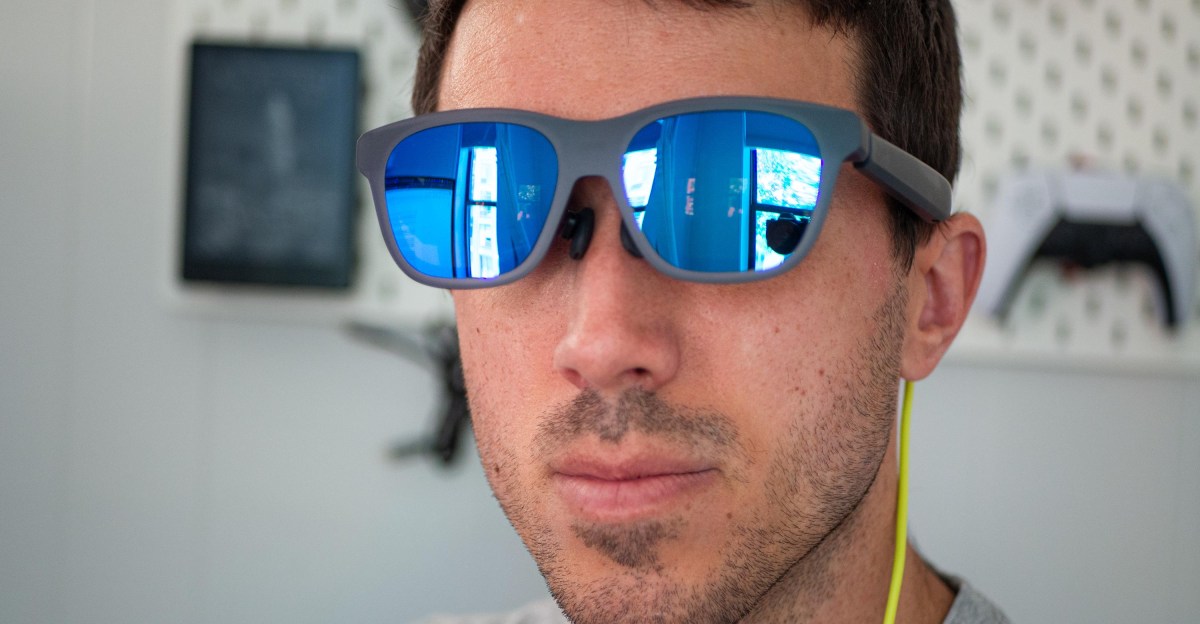
Xreal has a cheaper pair of display glasses for people who want a private USB-C screen without paying for the company’s pricier 1S model. The A01 Plus costs $299, which is $150 less than Xreal’s $449 1S, and The Verge’s Cameron Faulkner reports that the trade is straightforward: less structure, fewer controls, and no three-degrees-of-freedom screen locking, in exchange for a much lighter headset with bright 1080p micro-OLED displays.
The A01 Plus weighs 62 grams, more than 20 grams lighter than the 1S, according to The Verge. That matters for a category that still asks users to wear a monitor on their face. Faulkner found the glasses comfortable and compact, with strong brightness and contrast for the price. He also found the frame less reassuring than the 1S, especially while adjusting the temple arms to line up the image.
The display system uses micro-OLED panels and birdbath optics, the familiar arrangement in these tethered AR glasses: a small screen reflects through angled optics so it appears as a large virtual display in front of the wearer. The A01 Plus outputs at 1080p with a 120Hz refresh rate and a 50-degree field of view. The apparent screen size is fixed at the equivalent of 147 inches, according to The Verge, and cannot be resized from the glasses.
Cheaper hardware, fewer tricks
Xreal removed electrochromic dimming from the A01 Plus. On many AR glasses, that feature lets users change lens opacity electronically so the display is easier to see in bright environments. Faulkner reports that Xreal instead uses reflective films behind the optics and removable front shells. One included shell blocks light from the sides and, in his testing, handled glare better than the 1S in some conditions.
The removable shells are also part of Xreal’s customization pitch. The Verge reports that the A01 Plus ships with a tinted lens shell, and that Xreal expects other covers, including 3D-printed ones, to be possible later. Removing the shell requires pulling near the temple-arm area, which Faulkner described as delicate work until the process becomes familiar. Tiny modular parts near fragile optics: what could possibly make consumers nervous.
The largest missing feature is three degrees of freedom, usually called 3DOF. On the 1S, that lets the virtual screen stay pinned in space as the user moves their head. The A01 Plus instead has a stabilization toggle that The Verge says behaves more like a gimbal: it reduces movement but does not eliminate it. Faulkner reported visible jitter, especially around text.
Prescription lenses may be part of the real price
Initial clarity was mixed in The Verge’s testing. Faulkner said games from a Steam Deck looked bright and high-contrast, but the image appeared blurry until Xreal supplied HonsVR prescription lens inserts. The glasses support an interpupillary distance range of 54.5mm to 74.5mm, according to the report, but buyers who need inserts may have to add about $50 to the cost.
Audio is another cut-down area. The Verge found the A01 Plus speakers usable, but quieter than the 1S and weaker in the low and mid frequencies. The button layout is close to other Xreal models, but Faulkner reports there is currently no volume control on the glasses themselves, so users must adjust sound at the connected device.
The result, according to The Verge’s hands-on testing, is a cheaper set of tethered AR glasses that handles the basic job: mirroring games, movies, or a computer screen over USB-C. Buyers who want sturdier construction, louder audio, 3DOF display locking, and more screen controls may still have reasons to pay for the 1S. For people trying to stay near $300, the A01 Plus appears to be Xreal’s leaner answer.
This story draws on original reporting from The Verge.