Cannes Lions, the advertising industry’s marquee annual gathering in France, functioned this year as a weeklong sales floor where the product was advertising itself, according to reporting by 404 Media’s Jason Koebler from the festival.
The event brought together big technology companies, adtech firms and major advertisers across beach clubs, hotels, stores, yachts and temporary brand compounds in Cannes. Koebler reported that companies used the festival to court ad buyers and partners with panels, concerts, meetings, parties and enough branded real estate to make a normal trade show look shy.
The business logic is not subtle. Cannes Lions is formally an awards show for creative advertising, and its Palais des Festivals venue displayed past campaigns and hosted daily ceremonies. But Koebler reported that much of the visible action happened outside the convention center, where companies sold marketers on new places to buy attention: apps, airline flights, rewards programs, delivery robots, drones, connected TV, social platforms and chatbots.
Every surface became inventory
According to 404 Media, Strava bought ads on Cannes trolley cars promoting sponsored challenges to reach more than 195 million active people. DoorDash took over a store beside Versace, PayPal occupied a patisserie, and Marriott, United Airlines and Chase promoted ways to advertise through their rewards, flights and cardholder relationships.
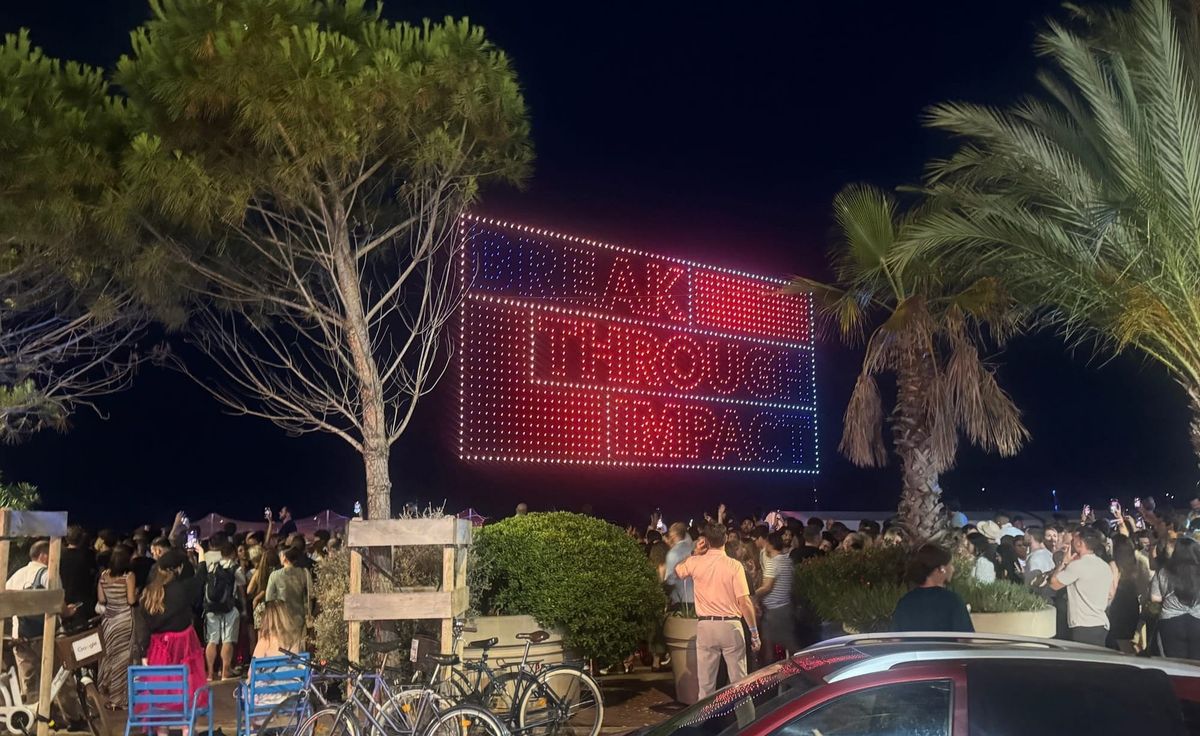
Koebler reported that Serve delivery robots moved around Cannes advertising the fact that marketers can advertise on the robots. Kargo staged drone light shows over the water, with formations that spelled out messages including “AI,” “ART & INTELLIGENCE” and “KARGO.” In another sequence, the drones formed the Kool-Aid Man and the phrase “BREAKTHROUGH IMPACT,” according to the report.
Reddit and OpenAI also had large presences. Koebler reported that Reddit executives presented the platform as a human corner of the internet while also operating in a market where Reddit data is widely used by large language models. OpenAI, meanwhile, pitched advertisers on the significance of people making choices based on chatbot outputs, according to 404 Media.
Meta hosted a beach compound, where Koebler observed a panel about Gen Z influencers and educational creator content. Tubi ran an indoor activation. Other panels and appearances featured celebrities and athletes including Kevin Durant, Shaquille O’Neal, Oprah, Alex Rodriguez, Seth Meyers and Bryson DeChambeau, who discussed media projects, partnerships and creative work, according to the report.
AI was everywhere, and often vague
Koebler reported that the festival did not offer one clean consensus about the future of advertising. Some attendees described artificial intelligence as a threat, while others treated it as a sales opportunity. Panels and billboards pushed both “human” creativity and automation, sometimes in the same general vicinity.
Several adtech pitches leaned on opaque wording. Koebler cited billboards and signs from companies including Tatari, Braze, Conveo, MiQ, Yieldmo and Smartly. One MiQ message promoted more than 1 million targeting options through generative AI audience tools, while another ad read, “an AI bought this ad,” according to 404 Media.
The yacht economy was part of the machinery. Koebler reported that companies rented or shared vessels for meetings and parties, including yachts associated with Hewlett Packard, Outfront, Xumo, InMarket, Mercedes-Benz/F1, Samsung Ads, Integral Ad Sciences, Accenture and HBO’s “The White Lotus.” Many stayed docked and served as floating meeting rooms and bars.
Inside the Palais, Cannes Lions framed itself around creative excellence. Outside, one Smartly billboard summarized the other half of the pitch: creativity may win a trophy, but return on ad spend gets the yacht, according to Koebler. That is about as honest as adtech copy gets.
This story draws on original reporting from 404 Media.