Euclid Squared Inc. has launched CaraComp, an AI face-comparison service aimed at private investigators, fraud teams, OSINT researchers and ordinary people trying to work out whether an online profile is using a real identity.
The pitch is straightforward: upload photos or video, get a same-person similarity score, and export a report that the company says is formatted for case files. That puts a class of face-matching workflow more often associated with government or enterprise tools into a consumer-accessible product, which is useful and uncomfortable for the same reason. Identity verification is no longer confined to institutions with procurement departments.
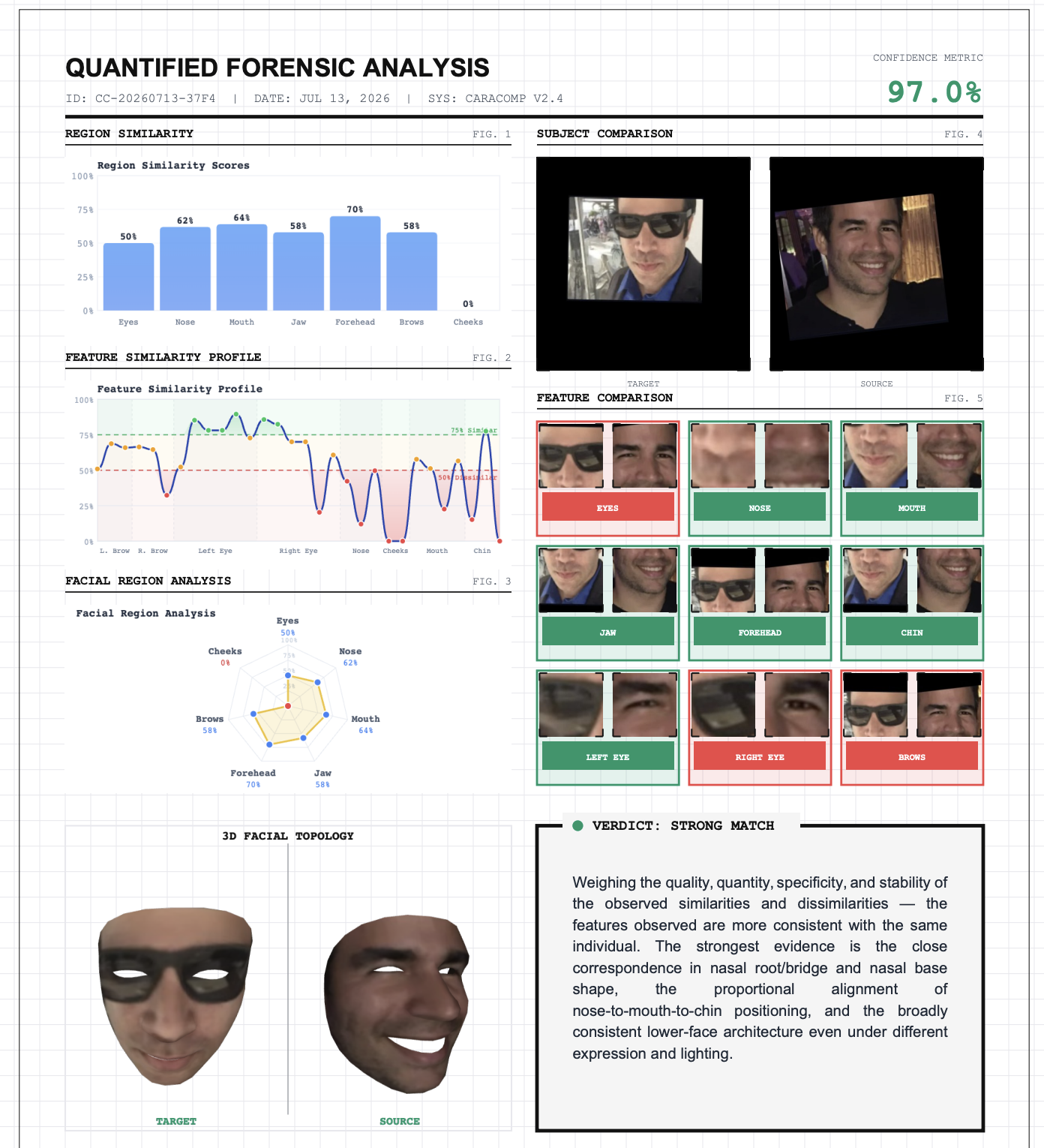
CaraComp compares faces in still images and video. Euclid Squared says the system returns results in about five seconds by running each comparison through multiple facial-recognition and image-processing models, then cross-checking the outputs with its own verification code. The result is a 0 to 100 percent similarity score, with confidence ratings attached to findings rather than a single naked percentage pretending to be certainty.
The company is leaning on the fraud angle. The Federal Trade Commission reported that consumers lost $1.16 billion to romance scams in the first nine months of 2025, up 22 percent from the year before. Generative AI has also made fake profile photos, face swaps and synthetic personas cheaper to produce. CaraComp is being positioned as a counter-tool for that same environment.
The reporting layer is the product’s more consequential claim. Each comparison generates what Euclid Squared describes as a forensic breakdown with more than 20 data points per image, including estimated age range, facial hair, eyewear, occlusion checks, landmark geometry around the eyes, nose and mouth, detected expressions, and image-quality scores for brightness and sharpness.
For contested matches, CaraComp includes an AI-written narrative that walks through the comparison in plain language while pointing to the facial regions involved. The report can be exported as a branded PDF. That does not make the output legally dispositive, but it does make the tool more than a quick “same person?” widget.
Kieffer Ramirez, founder of Euclid Squared, said the goal is to show users the evidence behind a match rather than only a percentage. He described use cases including a private investigator checking an insurance-fraud subject against surveillance footage and a family member testing whether a person messaging a parent matches the photos they are using.
The platform also supports video face search, batch comparison of one face against many images, and group detection across photos with multiple people. Euclid Squared says uploaded images are deleted after processing and that CaraComp does not build or search a public face database.
That privacy promise matters because face comparison tools sit in a sensitive category: they can help expose impersonation, but they can also normalize biometric checks by people who are not trained investigators. Making AI face comparison for online identity checks available outside government and large enterprise systems raises the usual questions about consent, error rates and how much confidence users place in machine-generated evidence.
Euclid Squared says CaraComp achieves more than 95 percent match-detection accuracy under standard conditions, with confidence scores on individual findings. The company also says no face-recognition tool should claim perfect certainty, a rare bit of restraint in a field that often markets probabilistic output as if it were a fingerprint.