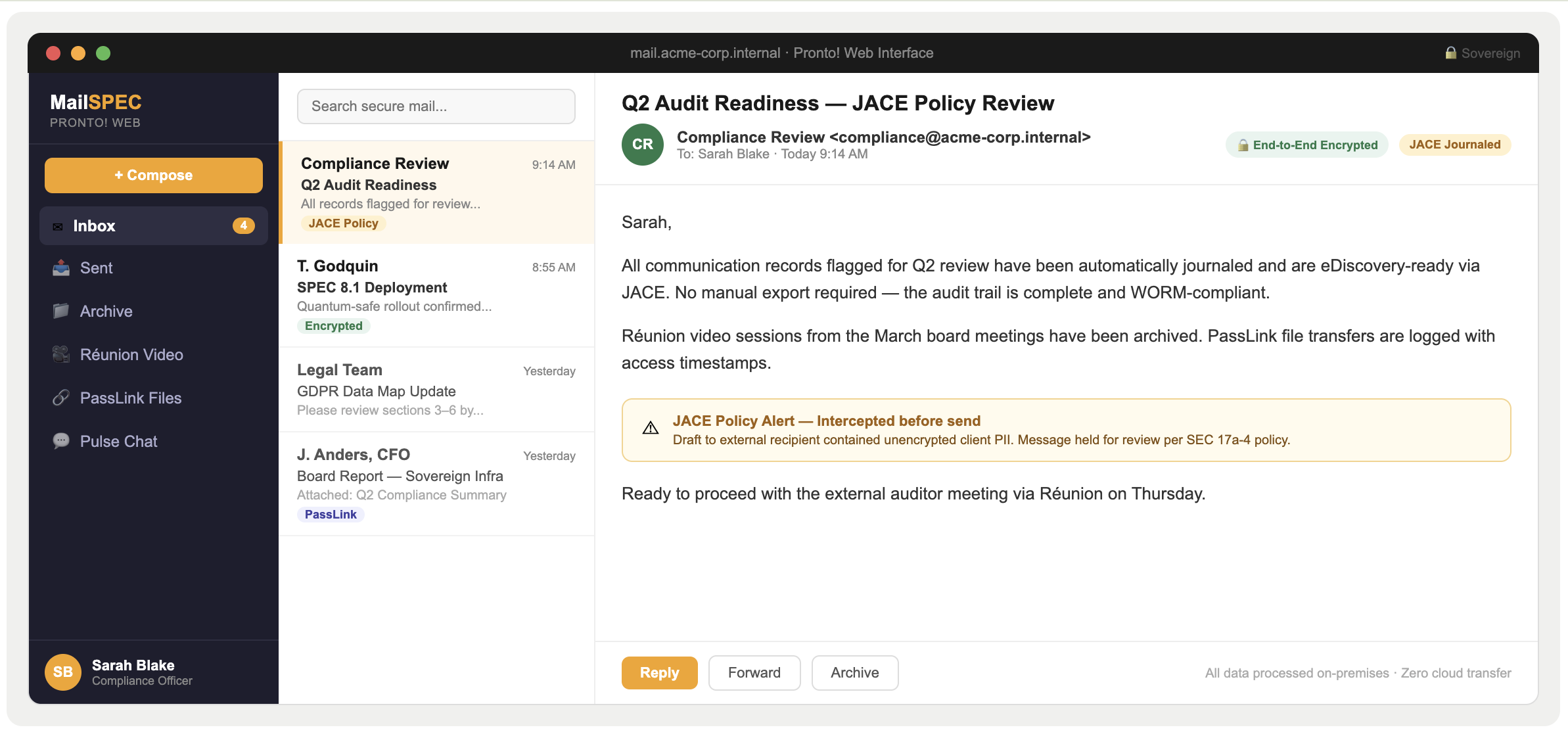
MailSPEC has released CommuniGate SPEC 8.1, a unified messaging platform aimed at organizations that want email, voice, video and file transfer to run inside their own infrastructure instead of a public cloud service.
The pitch is blunt: regulated enterprises have spent years moving collaboration into third-party platforms, then spent more years trying to prove to regulators that employees are not using WhatsApp, personal email or other off-channel tools for business records. MailSPEC says global regulators have issued more than $3.5 billion in fines tied to unmonitored consumer messaging apps.
CommuniGate SPEC 8.1 is built for on-premises, air-gapped and sovereign infrastructure deployments. That matters most to finance, healthcare and government customers, where data residency is not a branding exercise. It can determine which courts, regulators and intelligence laws may reach an organization’s messages, files and meeting records.
The release folds several functions into one controlled environment. Email remains the base layer, but the package also includes voice, video conferencing and encrypted file transfer. MailSPEC says the goal is to reduce the gap that pushes staff toward easier consumer apps when internal systems are clunky or fragmented.
What is new in 8.1
The Pronto web interface has been updated for modern browser use, with MailSPEC positioning it as a way to keep everyday communication inside approved systems. That is less glamorous than a new AI button, but it is the kind of usability issue that often decides whether compliance policy survives contact with office life.
Vivid, the built-in video component, is designed to keep meetings on internal infrastructure rather than sending audio, video and metadata through services such as Zoom or Teams. PassLink adds encrypted file sharing for exchanges with recipients who may still be using ordinary public email systems.
The company is also emphasizing protocol hardening. CommuniGate SPEC 8.1 includes defenses against SMTP smuggling and related spoofing attacks. SMTP smuggling exploits mismatches in how different mail servers interpret message boundaries, which can let a crafted message pass through one system and be treated as something else downstream. In practice, that can make forged mail harder to spot if gateways disagree about where one message ends and another begins.
A second security claim is quantum-safe cryptography. The concern here is “harvest now, decrypt later”: an attacker stores encrypted traffic today in the hope that future quantum computers can break older encryption schemes. MailSPEC says the new release includes encryption intended to resist that class of future attack.
Cloud exit, or at least cloud avoidance
The product arrives as more governments and regulated industries talk about “sovereign cloud” requirements while still depending on hyperscale providers. CommuniGate SPEC 8.1 takes the more old-fashioned route: keep the communication stack under the organization’s physical control, including in air-gapped environments.
Tanguy Godquin, MailSPEC’s director of research and development, described internal communication as an organization’s nervous system and argued that putting that data in public cloud systems weakens control over intellectual property. That is a vendor’s argument, but it reflects a real tension for security teams that need collaboration tools without expanding legal and surveillance exposure.
The on-premises secure messaging platform is available now for deployment in on-premises, air-gapped and sovereign infrastructure environments.