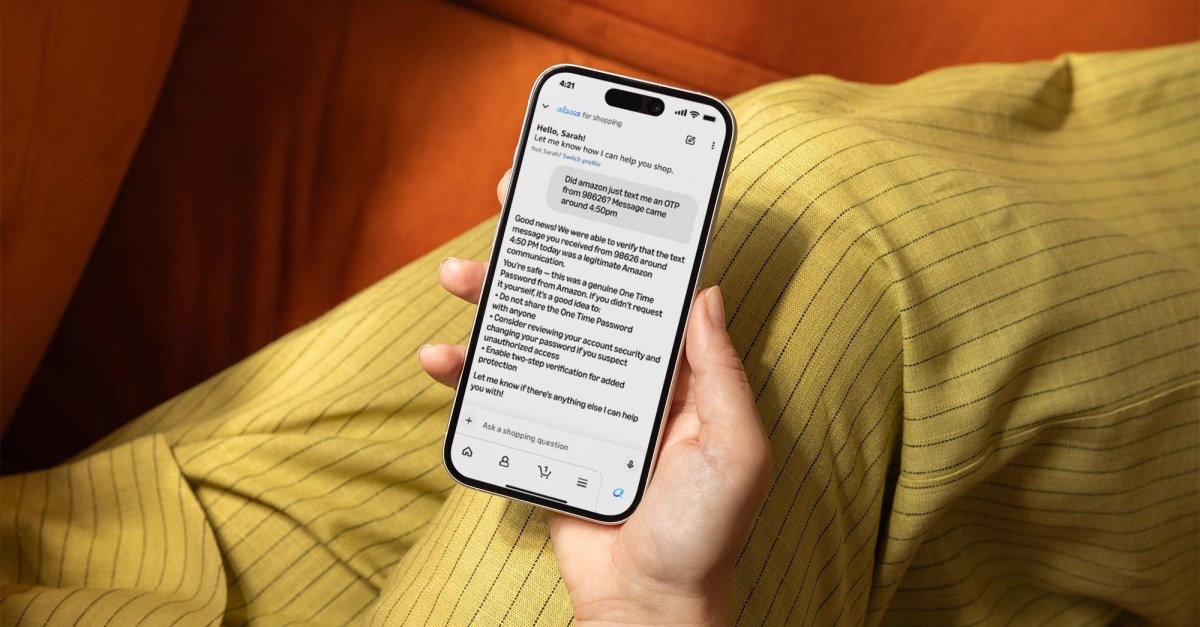
Amazon says U.S. customers can now use Alexa for Shopping to verify Amazon messages, including suspicious emails, texts and phone calls that claim to come from the retailer. The feature, announced September 2, is meant to answer a narrow but useful question: whether a communication appears in Amazon’s own records, rather than whether every non-Amazon message is safe.
Amazon says about 360,000 customers contact its customer service each year to ask whether an apparent Amazon communication is genuine. That is a lot of people doing forensic analysis on a package-delay text while trying to make dinner.
How do I ask Alexa to verify Amazon messages?
Customers tell Alexa for Shopping where the message came from, when it arrived and what it said. Amazon says the assistant then compares those details with its records of communications sent by Amazon teams, checking sender information, message content, timing and formatting.
The company says its catalog contains billions of communications sent globally. That is Amazon’s claim, and the feature’s effectiveness has not been independently measured in the material reviewed.
According to Amazon, the tool can return one of three outcomes:
Confirmed from Amazon: Alexa says the communication is official and can identify details such as its type, date and time.
Not from Amazon: Alexa says the supplied details do not match an official Amazon communication.
Unable to verify: Alexa cannot confirm the message with sufficient certainty and may ask for more specific information.
That third result is the important caveat. Amazon says it can conclusively establish when a message originated from its own systems, but it does not promise confirmation in every case. A failure to verify means the tool could not establish that the message was an official Amazon communication from the information provided.
What should customers do with a suspicious Amazon email or text?
For a communication that does not match its records, Amazon advises customers to check orders in the Amazon app, contact the company through amazon.com/support and avoid clicking links or replying. Amazon also says it will not request a password, one-time passcode or sensitive personal information by phone.
Amazon says every communication submitted through Alexa for Shopping is automatically sent to its customer-protection and enforcement team. The company says those reports can help it identify emerging scam methods and pursue bad actors, though it has not published performance data for that process.
The new Alexa option is not the only verification route. Amazon earlier introduced [email protected], where anyone worldwide, including non-customers, can forward a suspicious message for a response. The company also offers a verification form through its customer-service pages. Alexa for Shopping’s new verification feature, by contrast, is available to Amazon customers in the U.S., Amazon says.
It is also separate from SENTRIX, Amazon’s system for finding suspected phishing websites and seeking their removal. Amazon says SENTRIX scans suspicious URLs and sends high-risk sites for third-party human review before a takedown. Alexa’s feature is customer-facing and checks whether a received communication appears to be an official Amazon one. Different plumbing, different job.
This story draws on original reporting from The Verge.