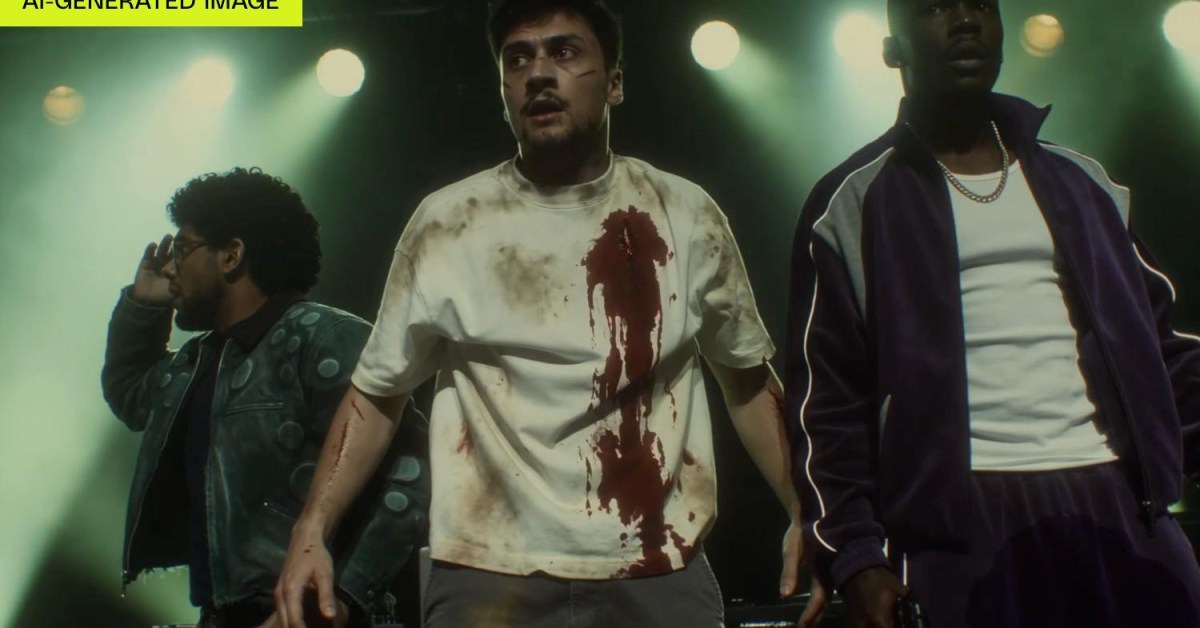
Cully Hill Boys, the cully hill boys ai movie released online by Higgsfield, is meant to sell filmmakers on the company’s Cinema Studio tools and newly added Seedance 2.5 capability. But Charles Pulliam-Moore’s review for The Verge argues that the film’s coherence comes chiefly from work people had already done: a screenplay by Tim Planagan, direction credited to Adilet Abish and Aitore Zholdaskali, and published prompts that invoke directors Edgar Wright and Guy Ritchie.
Higgsfield also published many of the prompts used for the project, making the provenance unusually visible for a promotional technology showcase. That does not turn the reviewer’s conclusion into a technical measurement, but it does make the ingredients easier to inspect than the usual fog machine surrounding AI-video demos.
The story follows Cal, Horace and Oli, three struggling East London rappers whose lives go sideways after they take money belonging to a crime lord. The Verge says the film establishes the friends’ relationships and individual pressures early, with a smoother visual and tonal progression than is common in AI-made films.
Who made Cully Hill Boys?
Planagan wrote the screenplay before Higgsfield became involved, according to The Verge. The script had appeared on the Black List’s submission service for unproduced screenplays. Higgsfield acquired rights to produce an AI adaptation, while Planagan kept the rights needed for a conventional production.
Abish and Zholdaskali are credited as co-directors. They also directed Higgsfield’s earlier project, Hell Grind. The record in the review establishes their credits, rather than detailing their respective work on each shot or sequence.
The three onscreen leads are streamer Mikyle “N3on” Rafiq, basketball creator Matt Kiatipis and UFC fighter Israel Adesanya. None filmed scenes on a set, The Verge reports. Each signed an agreement permitting Higgsfield to use their likeness.
- Documented human inputs: Planagan’s pre-existing script, the credited co-directors, licensed likenesses, and prompts that name Wright and Ritchie.
- Higgsfield’s stated purpose: demonstrate Cinema Studio, Seedance 2.5 and possible collaborations between studios and digital creators.
- The reviewer’s judgment: pacing, story construction and recognizable stylistic influence account for much of what works.
Why does Seedance 2.5 matter to the film?
The Verge says Seedance 2.5 can produce clips of about 30 seconds, longer than the few-second segments associated with some video-generation systems. Pulliam-Moore suggests that longer clips may be one reason Cully Hill Boys moves between scenes more smoothly. That is a plausible reading of the result, not proof that clip length alone created the continuity.
Higgsfield has already used a feature-length format to show off its tools. Variety reported that its 95-minute Hell Grind had visually consistent characters and fluid movement, while its plot and vocal performances exposed more obvious weaknesses. Higgsfield CEO Alex Mashrabov told Variety the project was a technology demonstration, not an attempt to make a Hollywood-quality film, and acknowledged that professional voice acting was missing.
Cully Hill Boys makes a narrower case for the tools. The images may be generated through an AI production pipeline, but the available record also shows a screenplay, named directors, recognizable film-language references and consented likenesses doing a conspicuous amount of the creative lifting.
This story draws on original reporting from The Verge.