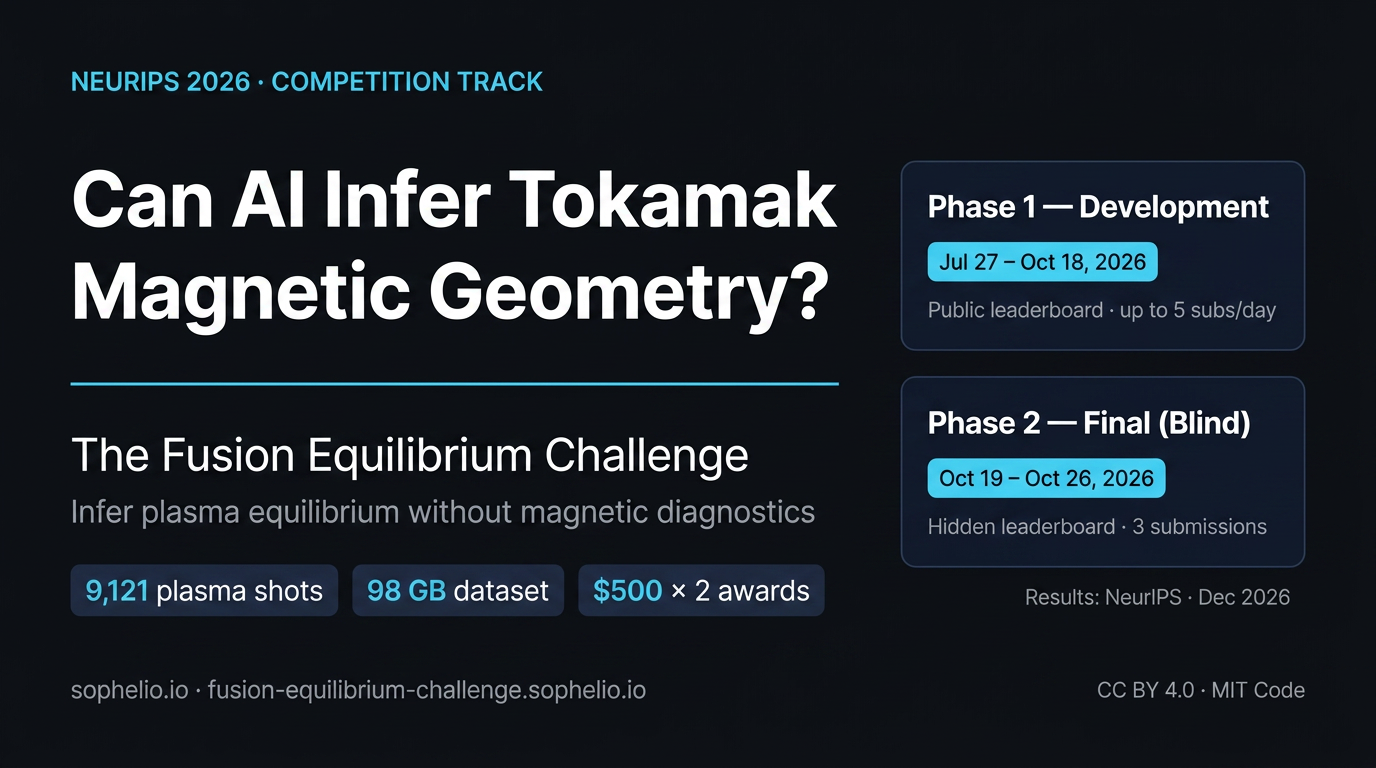
Sophelio has launched the Fusion Equilibrium Challenge, a NeurIPS 2026 competition that asks machine-learning teams to infer a tokamak plasma’s magnetic shape without feeding magnetic diagnostic readings into their models. The practical catch is transfer: models trained on DIII-D data must also make predictions for UKAEA’s MAST, a substantially different device with no MAST training split.
NeurIPS lists the challenge, “Inferring & Transferring Magnetic Geometry without Magnetic Diagnostics,” among the 16 competitions accepted to its 2026 Competition Track. Sophelio organized the benchmark with the DIII-D National Fusion Facility, UKAEA’s FAIR-MAST program and the University of Texas at Austin’s Institute for Fusion Studies.
The task concerns magnetic equilibrium, the calculation that describes the magnetic configuration confining plasma in a tokamak. Participants must predict a two-dimensional poloidal-flux map, along with quantities including q95 and normalized beta. Those outputs can be used to derive the plasma boundary during evaluation.
How does the Sophelio Fusion Equilibrium Challenge work?
Entrants may use shaping and field-coil currents, plasma current, electron-temperature profiles and electron-density profiles from Thomson scattering, plus fixed machine geometry. Public test sets withhold the EFIT-derived flux maps, equilibrium scalars and boundary information that models are meant to reconstruct. The coil-current inputs are commanded actuators rather than measurements of the plasma’s magnetic field, a distinction the benchmark documentation makes explicitly.
The open, CC BY 4.0 dataset has 9,121 experimental plasma shots. It is divided into 7,041 DIII-D training shots, 874 DIII-D public-test shots and 1,206 MAST public-test shots. The latter is test-only. That is the point of the second track: a team cannot tune on MAST examples before making its MAST predictions.
- Intra-machine track: train and reconstruct equilibrium on DIII-D, with results scored on a hidden DIII-D test set.
- Cross-machine track: train on DIII-D and predict MAST equilibrium zero-shot. Its ranking uses a ratio of the MAST and DIII-D scores, and requires a DIII-D flux-map R² above 0.6 for eligibility.
That design tests zero-shot generalization across machines with different geometry, coil arrangements, diagnostics and operating conditions. Organizers say it is intended to probe whether methods learn representations useful beyond correlations associated with one device. It cannot, on its own, establish why a given model transfers or whether it has captured the underlying plasma physics.
The competition’s development period runs through October 18, followed by a blind final phase from October 19 to October 26. Each track carries a $500 award. A public leaderboard is already running, while the final phase uses private folds and permits three submissions per team.
The reactor angle remains a research motivation rather than a result. Sophelio says neutron exposure in reactor-class machines may make magnetic sensors harder to maintain and reliable use more difficult, while long pulses can introduce field-integrator drift. The fusion equilibrium benchmark is therefore a test of whether other routinely available signals can fill part of that measurement gap. Its leaderboard will rank DIII-D-to-MAST submissions, not certify a reactor-control system.