A supercooled kidney transplant study from Texas A&M University suggests donated kidneys may not have to race the clock quite as brutally as they do now. Matthew Powell Palm and colleagues built a sealed device that held pig kidneys at minus 4 °C without ice formation, then transplanted the organs back into pigs after as long as 72 hours of storage.
That is a long time in transplant logistics. Kidneys are usually stored on ice at about 4 °C, and surgeons generally work within an 18- to 24-hour window before damage makes an organ harder or impossible to use. Kevin Myer, president and CEO of the Texas organ procurement organization LifeGift, called the work “a landmark achievement.” Myer was not involved in the research.
The stakes are not academic. Federal data cited by the researchers show more than 104,000 people in the US are waiting for a kidney transplant, and US organ donation statistics estimate that 17 people die each day while waiting for a transplant. In some years, roughly one in three donated kidneys has been discarded, often because the organ deteriorated before it could be matched and delivered.
How does supercooled kidney storage work?
Cooling slows an organ’s metabolism, which buys time. Freezing a large organ is the hard part: ice crystals can wreck tissue, and antifreeze-like cryoprotectant chemicals add their own regulatory and safety problems.
Powell Palm’s group took a different route. The device is a hermetically sealed chamber with a transparent lid. The kidney sits submerged in a preservation fluid already used in transplantation, while hardware at the base tracks temperature and checks for ice. According to Powell Palm, holding the organ under constant pressure allows it to remain below 0 °C without crystallizing and without cryoprotectants.
The design is intentionally plain: a compact chamber, not a miniature ICU. Powell Palm described it as “low-tech high science,” because the physics work is buried in the pressure, temperature, and ice-formation control rather than in a complicated clinical machine.
What did the pig transplants show?
The researchers removed one kidney from each pig, flushed the organ with standard preservation solution, and stored kidneys under several conditions. Some went on ice for two or 24 hours, matching common transplant practice. Others went into the supercooling device for 24, 48, or 72 hours.
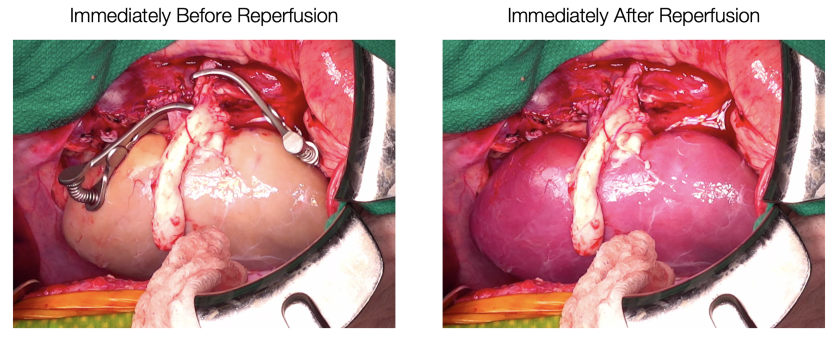
Each stored kidney was then transplanted back into the same pig. During that operation, the animal’s remaining kidney was removed, so the pig had to survive on the preserved and reimplanted organ.
Kidneys supercooled for 24 hours began making urine immediately after transplant, a basic sign that they were functioning. Powell Palm said other measures of kidney performance returned to normal in about 10 days. That was slower than kidneys stored on ice for two hours, but faster than kidneys kept on ice for 24 hours.
The 48- and 72-hour supercooled kidneys performed similarly, according to Powell Palm. Heidi Yeh, a transplant surgeon at Mass General Brigham for Children who studies organ preservation and was not part of the work, said the result was impressive because kidneys stored for 48 hours in other studies often take a week or two to start working again.
The team also reported longer follow-up. Over 30 days, the pigs grew by about 30%, and the transplanted kidneys enlarged as well, nearly doubling in size as they compensated for the animals’ growth and the loss of the second kidney. One pig was followed for 200 days before the kidney was removed and analyzed; Powell Palm said it still appeared healthy. The findings were presented at the American Transplant Congress in Boston.
What could this change for kidney donation?
A 72-hour storage window could give transplant teams more time to evaluate organs, find better recipient matches, and move kidneys over longer distances, Myer said. He said it could also make international donation and cheaper transport more practical.
The Texas A&M group thinks the window may stretch further. In preliminary studies, kidneys stored for up to 120 hours appeared healthy, although those organs have not yet been transplanted.
Human use remains unproven. Powell Palm and colleagues hope the absence of cryoprotectant chemicals will help them seek faster US Food and Drug Administration clearance to begin human transplant testing. Powell Palm also said he and Sebastian Giwa plan to form a company to develop the device and related organ-preservation protocols.
This story draws on original reporting from MIT Technology Review.