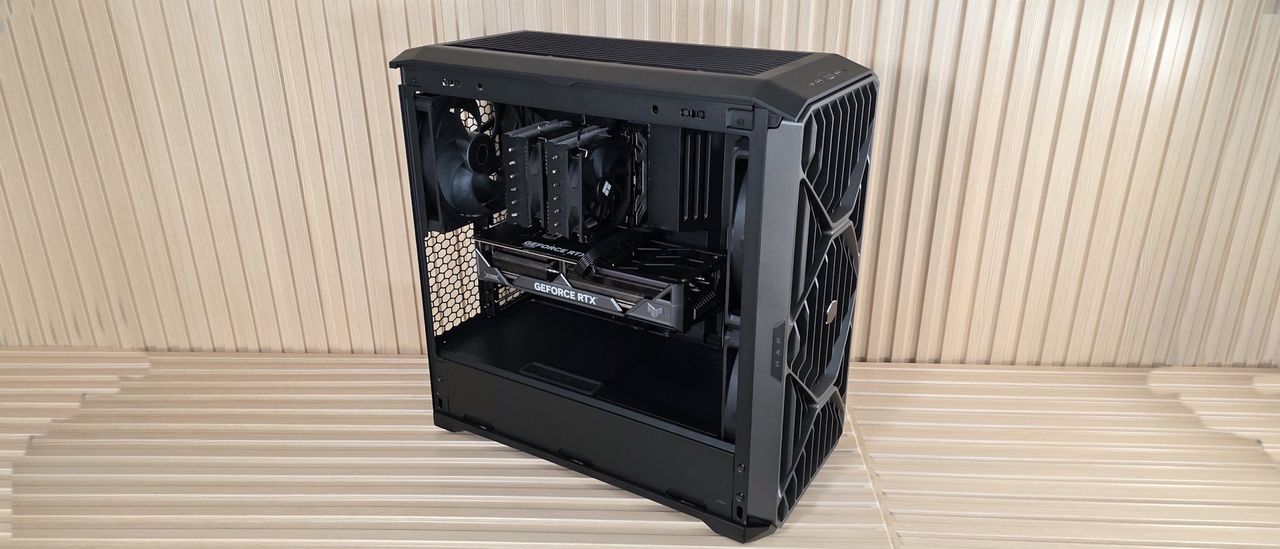
Cooler Master has brought its high-airflow HAF case line back with the HAF II 500, a $199.99 mid-tower aimed at builders whose graphics cards now look suspiciously like toaster ovens with PCIe connectors.
The case is built around three unusually large pre-installed fans: two 220 mm intake fans at the front and one 180 mm exhaust fan at the rear. Cooler Master lists all three as 40 mm thick. The pitch is straightforward enough: move more air at lower speeds, so a high-power gaming, rendering, or compute system can stay cool without sounding like a floor dryer.
Tom’s Hardware tested the case and found that the big-fan approach mostly does what Cooler Master says it does. In noise-normalized testing at 42 dBA, the HAF II 500 kept the test CPU to a 90 degrees Celsius peak, tying for the best result among five current Intel-platform case datasets in that test. The GPU result was the stronger showing: Tom’s Hardware reported the lowest graphics-card temperature in the group by 5 degrees, against a 69 degrees Celsius group average.
With the fans set to full speed, Tom’s Hardware measured 49 dBA from one meter away. CPU temperature dropped by 6 degrees compared with the quiet test, averaging 84 degrees Celsius, while GPU temperature fell to 67 degrees Celsius. That is not silence, but the review described the sound character as mostly airflow rather than mechanical noise.
Built wide, because physics remains annoying
The HAF II 500 is a black-only mid-tower measuring 21.5 by 21.9 by 10.1 inches, according to Cooler Master’s specifications. The width is the tell: over 10 inches, largely to accommodate the 220 mm front fans and leave enough internal clearance for modern hardware.
Cooler Master lists support for Mini-ITX, DTX, MicroATX, ATX, CEB, and E-ATX motherboards. GPU clearance is 430 mm, and the case has eight PCIe expansion slots. Tom’s Hardware said the layout can handle two 3.5-slot graphics cards, or four double-slot cards with tighter thickness limits. Vertical GPU mounting is supported, though the required riser adapter is sold separately.
The chassis also has a split lower compartment for the power supply and drives. Storage support is three 3.5-inch drives or six 2.5-inch drives, which is more than many current gaming builds need now that M.2 drives have eaten much of that job.
Air goes where the GPU needs it
Inside, Cooler Master uses a sloped divider near the front intake to push much of the incoming air toward the graphics card. That is the less glamorous part of case design that tends to matter: air that enters the box still has to reach the parts burning the watts.
The front intake fans are Cooler Master Mighty40 F220 units, rated by the company for 200 to 1,500 RPM, more than 203 CFM each, 3.1 mmH2O static pressure, and 36 dBA. The rear Mighty40 V180 is rated for 25 to 1,370 RPM, more than 161 CFM, 4.0 mmH2O, and 34 dBA. Those are manufacturer specifications, so treat them as lab claims rather than gospel.
Cooling expansion is broad. Cooler Master lists front and top support for triple 120 mm fans or radiators, or dual 180 mm fans or radiators. The top panel exposes the company’s MasterRail mounting system, which lets builders reposition fans and radiators rather than living with a few fixed holes.
The front I/O includes one USB 3.2 Gen 2x2 Type-C port rated at 20 Gbps, two USB 3.2 Gen 1 Type-A ports, a power button, reset button, and a combined 3.5 mm audio jack. Dust filters cover the top, front, and power-supply intake.
Tom’s Hardware did flag one omission: the case does not support rear-connector motherboard designs such as BTF, Stealth, or Project Zero. For a roomy $199.99 chassis launching into a market suddenly interested in hiding cables behind the board, that absence is awkward rather than fatal.
Cooler Master lists a two-year warranty for the case and five years for the fans.
This story draws on original reporting from Tom's Hardware.