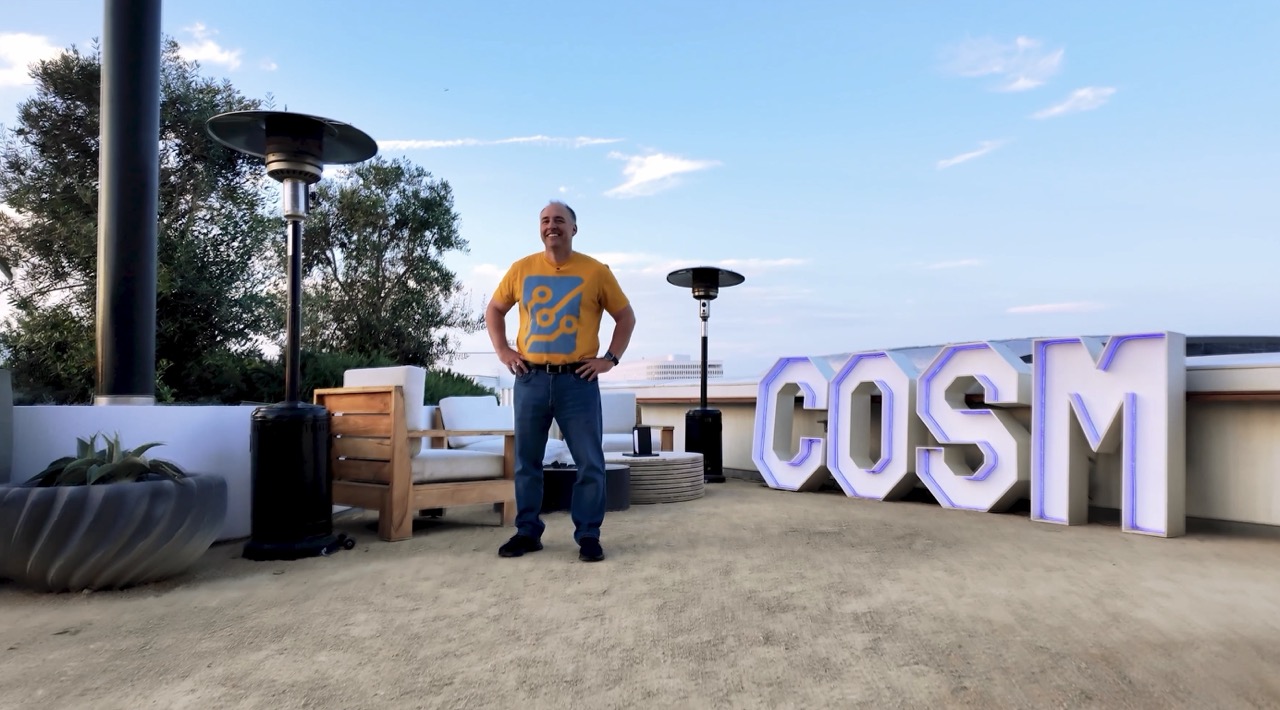
Cosm Los Angeles is selling sports fans a different kind of expensive seat: one inside a 27-meter LED dome in Inglewood, California, fed by Cosm’s own cameras at live events rather than a blown-up television broadcast.
ServeTheHome toured the venue with Devin Poolman, Cosm’s chief product and technology officer, and reported that the system combines high-resolution video capture, real-time rendering and distributed computing to create what the company calls “shared reality.” The phrase is marketing, but the mechanism is concrete enough: Cosm deploys its own camera and production gear at stadiums and arenas, then synchronizes those feeds for playback across the curved display.
That matters for viewers because the dome is not locked to the same framing as a network broadcast. For sports, the format can show a wider field of view and let Cosm’s production team shift perspective as play moves around the venue.
A dome, not a big TV
The Los Angeles location, which opened last year alongside a sister venue in Dallas, is built around the 27-meter LED dome. ServeTheHome described the effect as distinct from sitting in front of a conventional cinema or Imax screen, with the image wrapping across a curved surface rather than appearing as a large flat rectangle.
Cosm uses the venue for live sports including hockey, UFC, soccer and basketball, as well as movies and special programming. ServeTheHome reported that the backend can be reconfigured for different events in the same day, which is the sort of operational detail that separates a real venue system from a very enthusiastic home theater.
Poolman told ServeTheHome that Cosm’s technology and intellectual property grew out of work on planetariums. That lineage makes sense: planetariums solved the problem of filling a curved surface with synchronized imagery long before “immersive” became a word attached to every room with LEDs and venture funding.
Sports coverage with movable perspective
According to ServeTheHome, hockey showed the format well because the motion and speed of play translated cleanly across the dome. UFC coverage used Cosm cameras positioned to give viewers a ringside perspective, including angles tight to the octagon fencing.
For soccer, ServeTheHome said Cosm used Premier League footage to place viewers inside stadium environments where the crowd became part of the presentation. During the tour, fans in team apparel were arriving for a match after filming ended.
Basketball creates a different advantage. ServeTheHome reported that the wider image can expose details such as courtside celebrities or players’ shoes during live play. For football-style field sports, the author noted that a fan sitting in one end zone at a stadium can lose sight of action at the opposite end, while Cosm’s production can change camera positions as play moves.
The venue is not limited to sports. ServeTheHome saw a demonstration of the Sistine Chapel rendered as a real-time 3D environment, letting viewers move closer to fresco details than they could from the Vatican floor. Movie screenings also add effects and graphics around the film rather than only projecting the movie onto the dome.
Dell in the machine room
ServeTheHome said Dell powers the experience and made the introduction for the tour. The publication also disclosed that Cosm let its team watch a game the night before filming and provided a food-and-beverage credit.
Cosm leadership wants to expand to more than 100 venues worldwide, according to ServeTheHome. That ambition depends on whether the company can repeat the whole stack: camera capture at live events, synchronized transport, rendering, venue operations and enough programming to keep a dome filled when there is no playoff game on. The tour shows the Los Angeles system working, but rollout claims remain claims until more buildings open.
This story draws on original reporting from ServeTheHome.