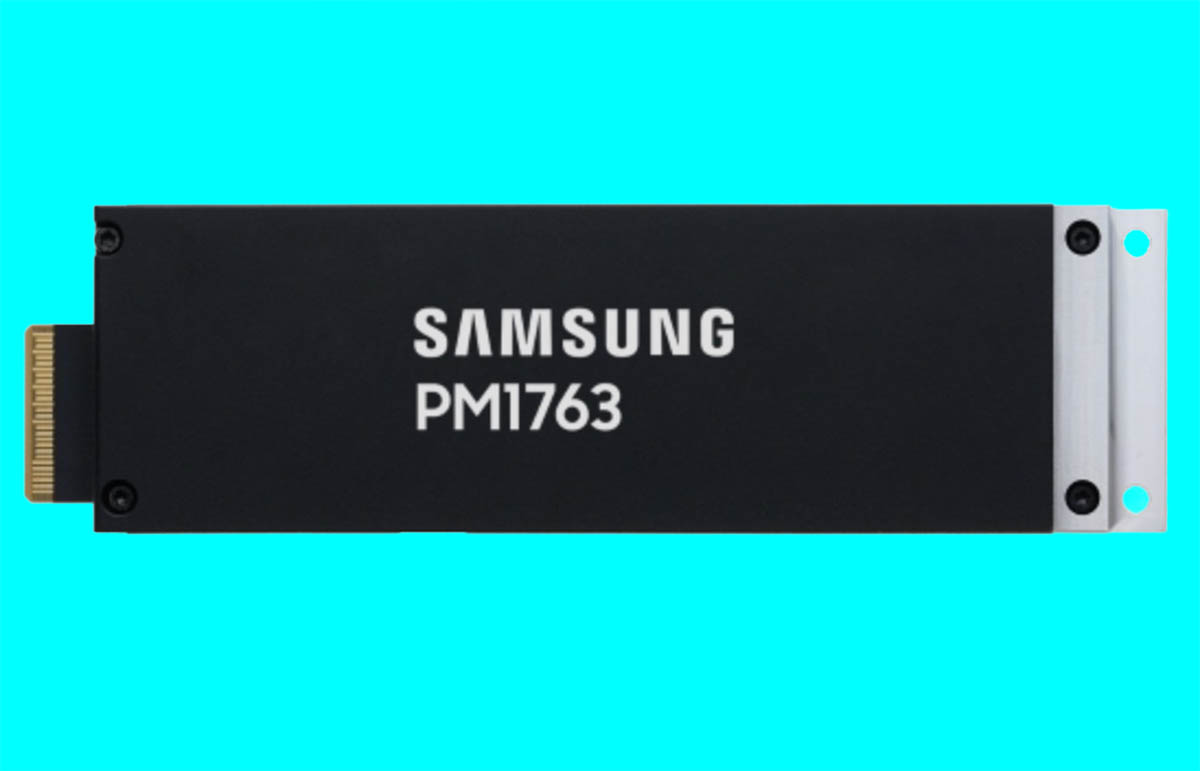
Samsung Electronics says it has begun mass production of the PM1763, an enterprise NVMe SSD built around PCIe 6.0 for AI and high-performance computing servers. For operators buying the next wave of accelerator-heavy machines, the point is blunt: CPUs and GPUs can ask for data faster than older storage stacks can comfortably supply it.
The drive uses Samsung’s ninth-generation V-NAND and a controller built on a 4 nm process, according to the company. In the 16 TB version, Samsung lists sequential read performance at up to 28,400 MB/s and sequential writes at up to 21,900 MB/s. Samsung says that is more than twice the performance of the prior PM1753.
Those are vendor numbers, so treat them like vendor numbers until independent systems get tested under real workloads. Still, they put a useful shape on what PCIe 6.0 storage is supposed to do: move large chunks of data between local flash, host processors and accelerators with less waiting around.
Samsung framed the PM1763 around AI infrastructure, because apparently no server component is allowed to leave the factory in 2026 without an AI badge. The specific claim is more concrete: Samsung says the drive can move a 40 GB large language model in about 1.4 seconds. The company says that could cut latency between processors and accelerators during AI work.
What changes with the drive
The PM1763 is not being pitched as a capacity-first SSD. Samsung is offering it in 4 TB, 8 TB and 16 TB sizes, which points it at fast local storage inside servers rather than the fattest possible flash shelves. ServeTheHome notes that this fits the pattern from earlier PCIe Gen4 and Gen5 transitions, where the first drives on a new interface tended to chase performance before capacity.
The timing also lines up with the server platform shift ServeTheHome described. PCIe Gen6 support is starting to show up around new hyperscale CPUs, Nvidia Vera and AMD’s coming EPYC Venice platform. A faster slot does not help much if the devices plugged into it are still built for the old bus. SSD vendors have to show up too.
Samsung also says the PM1763 is designed with liquid cooling in mind. That detail is less cosmetic than it sounds. Dense AI servers are pushing more heat out of racks through liquid loops, and storage devices sitting in those systems need a way to survive that thermal design instead of pretending the fan wall is still doing all the work.
Security features aimed at long-lived deployments
Samsung says the PM1763 supports post-quantum cryptography algorithms, a feature meant to protect stored data against future quantum-computing attacks. The company also lists support for TDISP, the TEE Device Interface Security Protocol, which is intended to secure device data paths in virtualized environments.
That security language is forward-looking, but enterprise SSDs tend to stay in service for years. Samsung is selling the PM1763 as a component for systems that will be deployed into the PCIe 6.0 era rather than a lab curiosity. The more immediate question for buyers will be boring and essential: how the drive behaves under sustained load, heat and mixed real-world I/O once it lands in actual servers.
This story draws on original reporting from ServeTheHome.