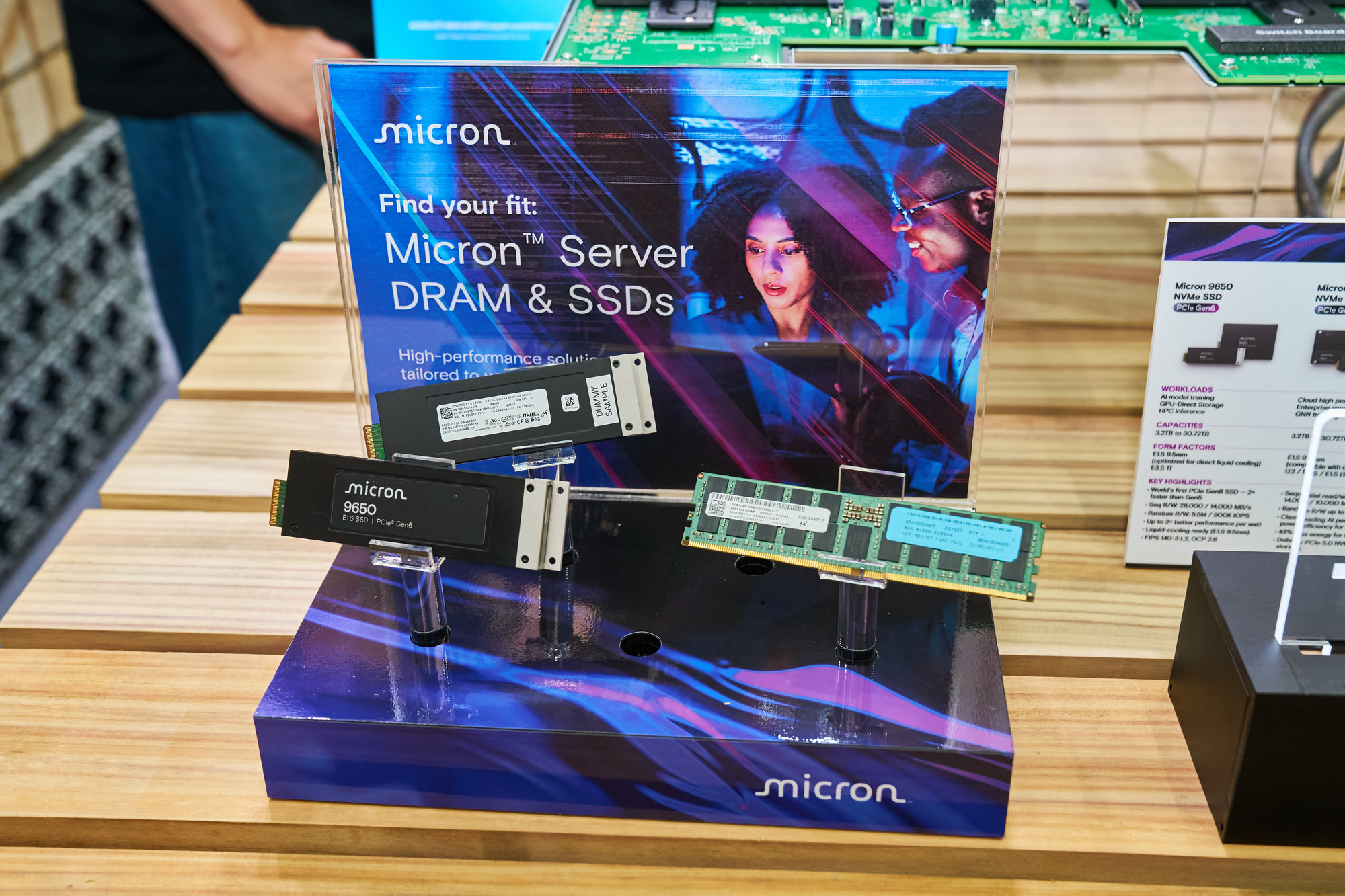
Micron used Computex 2026 to show the 9650, its first PCIe 6.0 enterprise SSD, aimed squarely at data centers waiting for faster storage behind AI training and inference systems. ServeTheHome reported the drive was on display as the memory industry deals with tight DRAM and NAND supply, a timing quirk that does not exactly hurt companies selling high-end storage.
The 9650 is already in mass production, according to Micron. The catch is more mundane: servers that can expose PCIe 6.0 to these drives are not broadly shipping yet, so public demos on production platforms remain constrained by the annoying fact that the rest of the stack has to exist.
Read bandwidth is the headline spec
Micron rates the 9650 at up to 28GB/s sequential reads. That is enough to fill a PCIe 6.0 x4 link, according to ServeTheHome, which means Micron is using the extra bus bandwidth rather than treating the new interface as a sticker upgrade.
Random read performance is rated at up to 5.5 million IOPS. The write side is less dramatic: Micron lists up to 14GB/s sequential writes and 900,000 random write IOPS. Compared with Micron’s PCIe 5.0 9550 drives, ServeTheHome described the read uplift as much larger than the write gain.
That split says plenty about the product’s target. Micron is pitching the 9650 at high-end data center work, especially AI systems where GPUs need to pull model weights and data fast enough that storage does not become the dumbest bottleneck in a very expensive rack.
The controller does most of the new work
The 9650 uses Micron’s new PCIe 6.0 controller paired with the company’s ninth-generation TLC NAND running at 3600MT/s, according to the company details reported by ServeTheHome. Since that G9 NAND is already used in some other Micron products, the big performance move here appears to come mainly from the controller and the jump to PCIe 6.0.
Micron lists a 25-watt power target for the drive’s performance figures. That is a lot of heat to remove from a small server SSD, especially when the same chassis may already be trying to cool GPUs, CPUs, memory and networking hardware with little patience for airflow optimism.
The E1.S version is the sharpest example. ServeTheHome reported that Micron describes the compact E1.S model as liquid-cooling optimized, rather than merely compatible with liquid cooling. In practice, that puts the 9650 in the same thermal direction as the GPU servers it is meant to feed.
Capacities and the missing platform problem
Micron plans two lines. The read-optimized PRO drives will reach capacities up to 30.72TB, while the mixed-workload MAX versions will top out at 25.6TB, according to the company.
The broader adoption clock now depends on servers. ServeTheHome said Nvidia and AMD appear focused on 2027 launches for PCIe 6.0-capable platforms, while other hyperscale designs and Arm AGI CPU-based systems are expected in the next few quarters. Until those machines arrive in volume, Micron has a fast SSD looking for enough slots that can actually speak its language.
This story draws on original reporting from ServeTheHome.