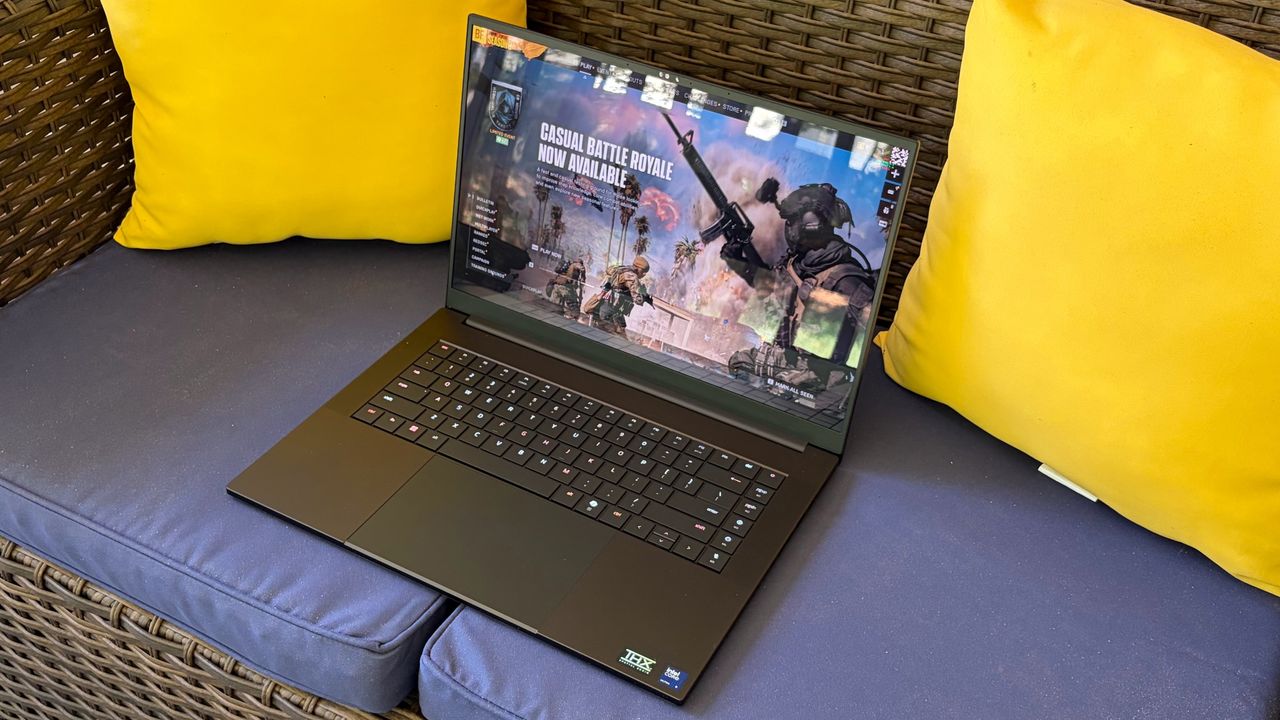
Razer’s 2026 Blade 16 gives buyers the familiar thin black slab, an Nvidia GeForce RTX 5090 laptop GPU, and a result gaming laptops rarely deliver: long unplugged runtime when the GPU is not being hammered.
In testing by Tom’s Hardware, the $4,899.99 configuration paired Intel’s Core Ultra 9 386H with an RTX 5090 rated at a 175 W maximum TGP, 32GB of LPDDR5X-9600 memory, and a 2TB PCIe 4.0 SSD. The trade is clear enough: Razer used a 25 W processor instead of the beefier 55 W HX chips in some rival machines. That helps battery life, and it costs the Blade 16 in multi-threaded CPU work.
Gaming performance stays competitive
Tom’s Hardware compared the new Blade 16 with last year’s Blade 16, MSI’s Raider 16 Max HX, and Alienware’s 16 Area-51. The new Razer machine did well in several game tests, though it did not sweep the field.
In Shadow of the Tomb Raider at the Highest preset, the 2026 Blade 16 reached 182 fps at 1080p and 133 fps at 1600p. In Cyberpunk 2077 using Ray Tracing Ultra, it scored 65 fps at 1080p and 42 fps at 1600p. Far Cry 6 put it at 106 fps at 1080p and 108 fps at 1600p, while Red Dead Redemption 2 exposed the CPU compromise with 94 fps at 1080p and 71 fps at 1600p, behind last year’s Ryzen-based Blade 16.
The machine recovered in Borderlands 3, where Tom’s Hardware measured 175 fps at 1080p and 126 fps at 1600p. During a 15-loop Metro Exodus stress test, it averaged 133.39 fps at 1080p using the RTX preset. The reviewer also reported 110 to 120 fps in Battlefield 6 at native resolution with Overkill detail mode, DLSS Quality, and Frame Generation enabled.
The cooling system is not subtle. Tom’s Hardware said the two fans became very loud during gaming, loud enough that headphones were useful. Surface temperatures also climbed: the keyboard area between the G and H keys hit 102 degrees Fahrenheit, the touchpad reached 92 F, and the underside near the rear center measured 130 F during the Metro Exodus stress test.
Battery life is the headline number
The 90 Whr battery lasted 12 hours and 46 minutes in Tom’s Hardware’s battery test, which mixes web browsing, video streaming over Wi-Fi, and OpenGL work at 150 nits. That result beat the Ryzen AI 9 HX 370 version of the Blade 16 by more than five hours, the Alienware 16 Area-51 by more than nine hours, and the MSI Raider 16 Max HX by more than four hours.
That runtime is the payoff from the lower-power Panther Lake chip. The bill comes due in productivity tests. In Geekbench, the 2026 Blade 16 posted 2,895 single-core and 16,971 multi-core. MSI’s Raider 16 Max HX, using a Core Ultra 9 290HX Plus, reached 3,231 and 20,656. In Handbrake, the Razer took 3 minutes and 17 seconds to transcode a 4K file to 1080p, compared with 1 minute and 51 seconds for the MSI.
The rest of the hardware is very Razer
Razer kept the matte-black aluminum design, measuring 13.98 x 9.86 x 0.69 inches and weighing 4.71 pounds. That is much lighter than the 5.73-pound MSI Raider 16 HX and the 7.49-pound Alienware 16 Area-51 listed in the review.
The 16-inch OLED display runs at 2560 x 1600 and 240 Hz. Tom’s Hardware measured 90 percent DCI-P3 color volume, 127 percent sRGB, and 408.2 nits of brightness. Ports include Thunderbolt 5, Thunderbolt 4, three USB 3.2 Gen 2 Type-A ports, HDMI 2.1, an SD UHS-II reader, a headphone jack, and Razer’s proprietary power connector.
Upgrade access requires removing 10 Torx screws. Inside, Tom’s Hardware found two M.2 2280 SSD slots, with one occupied by a 2TB Lexar NM790 drive, plus an accessible Intel BE213 Wi-Fi 7 adapter. Memory is listed as LPDDR5X, so buyers should treat the RAM capacity as something to choose at purchase.
The review’s complaints are familiar premium-laptop annoyances: a mechanical trackpad instead of a haptic one, loud fans, weaker multi-threaded performance than heavier rivals, and a nearly $5,000 price. Lower configurations start at $3,499.99 with an RTX 5070 Ti, while an RTX 5080 version is listed at $3,999.99.
This story draws on original reporting from Tom's Hardware.