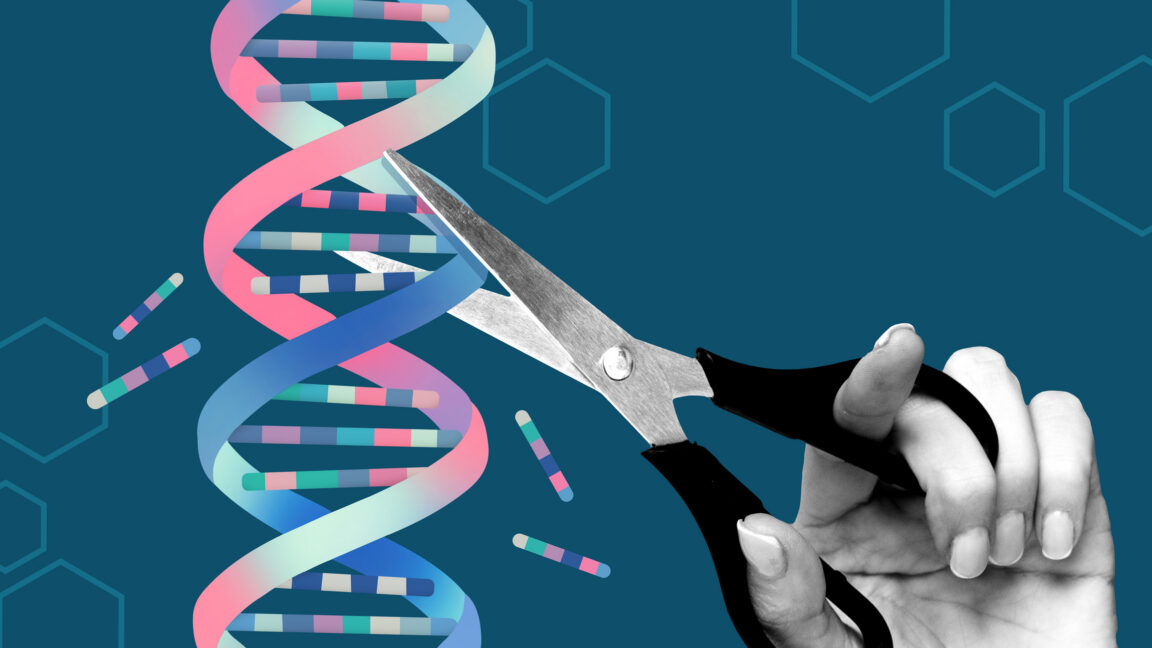
A research team in China has used AlphaFold gene editing analysis to redesign CRISPR-associated proteins so they are less willing to edit the wrong stretch of DNA, according to a paper published in Nature. The work targets a practical problem for gene-editing therapies: even a rare error matters when a treatment edits many cells.
CRISPR-style editing relies on a guide RNA that pairs with a chosen DNA sequence, a Cas protein such as Cas9 that recognizes the RNA-DNA pairing, and an editing enzyme that changes the DNA once the complex is in place. Researchers already try to choose guide RNAs that look unlike other places in the genome. That helps, but it does not make the system perfectly picky.
The reason is mechanical, not mystical. A guide RNA usually checks roughly 18 bases of DNA, a sequence length that should be rare in a random genome. The human genome is about 3 billion bases, while an exact 18-base match would be expected about once in 70 billion random bases. Cas9, however, can still bind when a small number of bases do not match, depending on where those mismatches sit.
How does AlphaFold make CRISPR safer?
The researchers used AlphaFold to compare how Cas9 contacts matched and mismatched RNA-DNA structures. Their idea was that bad edits happen partly because Cas9 can flex into shapes that tolerate imperfect pairing, so the amino acids that make those unwanted contacts are possible redesign targets.
First, the team built a large set of off-target sites using a modified CRISPR system that converts the DNA base adenine into inosine. They ran the method with 10 different guide RNAs, then collected and analyzed DNA fragments carrying the chemical mark to map the kinds of wrong-site edits that occurred.
The group initially asked AlphaFold to model a full complex containing DNA, guide RNA, Cas9, and a base-modifying enzyme attached to Cas9. That model failed in an obvious way, placing one protein in the wrong location. The researchers then reduced the problem to DNA, guide RNA, and Cas9, which produced structures consistent with experimentally determined CRISPR complexes.
Comparing on-target and off-target models exposed the useful signal. According to the Nature paper, about two-thirds of off-target sites pushed Cas9 into a modestly different overall structure. More than 95 percent changed which amino acids contacted the RNA.
AlphaFold already estimates “contact probability,” meaning the likelihood that two parts of a modeled complex sit within a short distance, eight angstroms in this case. The team turned those outputs into a computational workflow it called ContactSeek, then looked for clusters of Cas9 amino acids whose contacts changed around mismatched sites.
What did the redesigned Cas proteins do?
The researchers made 23 amino acid swaps across 10 positions flagged by ContactSeek. One redesigned Cas9 variant kept activity near normal at properly matched target sites while reducing off-target activity from 28 percent to 5 percent in the reported tests.
The team said similar results appeared with other guide RNAs. It also applied the strategy to Cas12, another Cas protein used to recognize guide RNA and DNA, suggesting the method is not limited to Cas9.
Other labs have already produced more selective Cas9 proteins through methods such as directed evolution. In comparisons reported by the researchers, the new designs performed similarly or slightly better on activity and specificity. The catch is that ContactSeek may produce fixes tuned to particular guide RNA and mismatch combinations rather than broad, one-size-fits-most Cas proteins.
The paper does not show whether these AlphaFold-guided mutations can be combined with earlier high-specificity Cas9 variants. The narrower takeaway is still useful: if a therapy candidate has known off-target edits, a structure-guided pass over the Cas protein may offer a direct way to reduce them. The Nature paper is available at DOI: 10.1038/s41586-026-10794-z.
This story draws on original reporting from Ars Technica.


