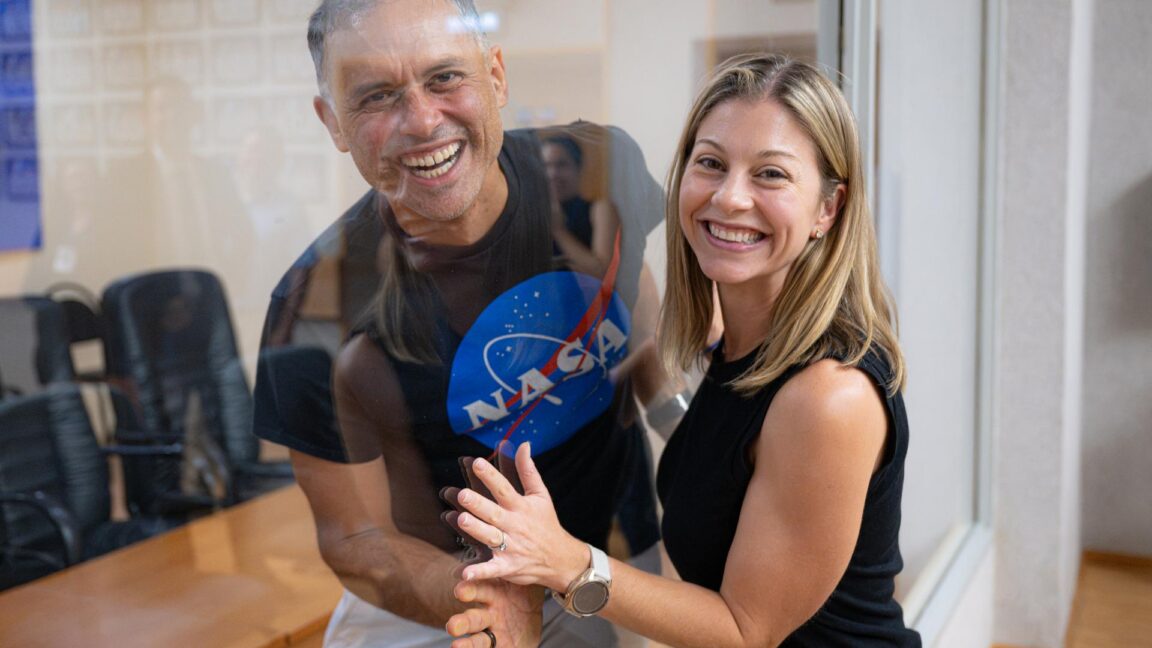
Anil Menon, a physician who once concluded his astronaut chances were gone, launched to space Tuesday evening local time on a Russian Soyuz spacecraft, according to NASA. For the people who worked with him, the flight closes a loop that ran through NASA clinics, SpaceX’s Crew Dragon program, COVID-era factory medicine, and four failed astronaut applications.
Menon’s path is not the clean brochure version of astronaut selection. He told Ars Technica he had applied to NASA four times before being rejected again in 2017, despite reaching the final round. At 39, he said he thought there was “a zero percent chance” he would be picked.
He had already built the kind of résumé that makes normal career ladders look lazy. Menon studied neurobiology at Harvard, earned mechanical engineering and medical degrees at Stanford in 2006, worked as an emergency physician in Los Angeles, joined the Air National Guard, and served on search-and-rescue helicopter missions in Afghanistan. He also practiced medicine on Mount Everest and helped with relief work in Haiti after the 2010 earthquake.
From NASA doctor to SpaceX’s human-flight doctor
Menon joined NASA in 2014 as a flight surgeon, the job that keeps astronauts medically fit before, during, and after missions. He supported six long-duration space station crews launching on Soyuz from Baikonur, Kazakhstan, during the years when that Russian vehicle was NASA’s only ride to orbit.
After the 2017 rejection, Menon told Ars he decided to focus on space medicine: if he could not fly, he could help others fly. In 2018, he left NASA for SpaceX, which was preparing Crew Dragon for its first human mission. Menon said the move from Houston to California was a “big gamble” for him and his wife, Anna Menon, who had been working as a flight controller at Johnson Space Center.
Lee Rosen, then Menon’s boss at SpaceX, told him to be entrepreneurial because the company was still figuring out what it needed from a flight surgeon. Menon worked with NASA astronauts Doug Hurley and Bob Behnken before Demo-2, the 2020 test flight that returned NASA astronaut launches to U.S. soil.
The timing was a mess, in the usual aerospace way where “final paperwork” and “global pandemic” land in the same inbox. Menon told Ars that SpaceX President Gwynne Shotwell sent a companywide email early in the COVID-19 pandemic giving employees his contact information for medical questions. He said his inbox quickly filled up.
Menon’s pandemic work at SpaceX included antibody testing, a collaboration with Harvard-affiliated researchers, and research later published in Nature journals. SpaceX also built 4,000 solenoids for Medtronic ventilators, and volunteers produced 55,000 masks for emergency departments in the Los Angeles area, according to the account.
NASA called again
While SpaceX and NASA were trying to get Demo-2 cleared to fly, NASA opened applications for its 23rd astronaut group. Menon applied again, among more than 12,000 U.S. applicants. He told Ars he worked on his interviewing and used meditation to build confidence after earlier failures.
In 2021, Reid Wiseman, then chief of NASA’s Astronaut Office, called Menon while he and Anna were at Big Bear Lake in Southern California. Menon said Wiseman first asked about Crew Dragon’s toilet, a very real spacecraft problem and a deeply unserious way to start a life-changing call. Wiseman then offered him a NASA astronaut slot.
The Menon household soon had a second astronaut trajectory. Anna Menon, who had joined SpaceX in crew operations, worked with Jared Isaacman’s Inspiration4 crew before its 2021 Crew Dragon mission. Isaacman later invited her onto Polaris Dawn, which flew in 2024. She reached space two years before her husband, and NASA selected her as an astronaut a year later.
Anil Menon was initially assigned to Boeing’s Starliner for his first flight before NASA moved him to Soyuz, according to Ars. That put him back on the same launch system he had once supported as a NASA doctor. Anna Menon traveled to Baikonur with their children, family, friends, and Isaacman, who became NASA administrator last December.
At a ceremonial prelaunch meeting at the Cosmonaut Hotel, Isaacman called Menon a friend and, now, an employee. “Few have ever worked harder in their life to chase their dream,” Isaacman said. “No one has earned this more.”
This story draws on original reporting from Ars Technica.