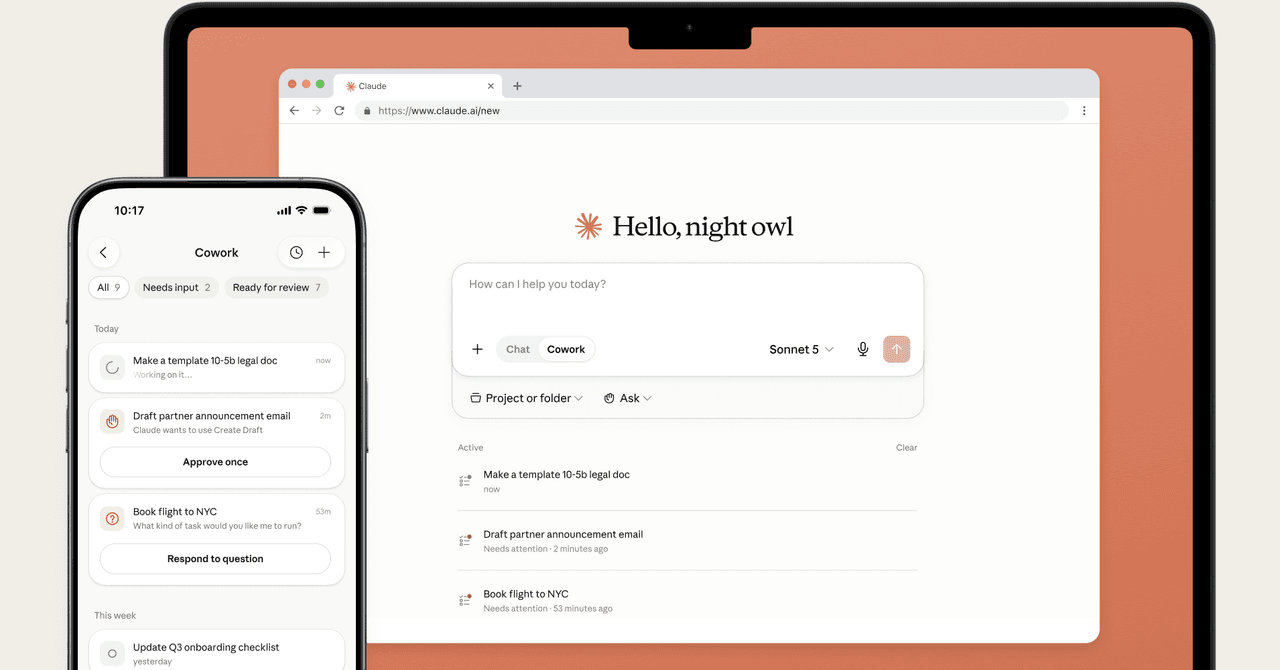
Anthropic said Tuesday that Claude Cowork, its agent for carrying out digital chores, can now run without keeping a desktop app alive. For users who had been leaving laptops open so an agent could finish work overnight, that removes a very dumb dependency from a product sold as automation.
The company said limited Cowork access is being added to the existing Claude smartphone app and to the web browser. Until now, phone-based control depended on a feature called Dispatch, which let users send tasks from mobile to a desktop session. Anthropic’s own support description said the computer had to be awake and the app had to be open for Claude to work on those tasks.
The change means Cowork can keep handling jobs after the user closes the laptop or ends the desktop session. Anthropic also says scheduled tasks can run overnight, including after new messages arrive late in the day.
What Anthropic says Cowork can do
In a launch video, Anthropic shows a user preparing for a business renewal meeting. The prompt asks Cowork to collect information from email threads, Slack channels, meeting transcripts, and recent online discussion, then create a reference document and draft an email.
That is the pitch: the chatbot becomes the front door for an agent that reads across connected work tools, assembles context, and produces documents or messages. The mechanics are less magical than the demo language tends to imply. Cowork needs access to the services involved, instructions from the user, and enough runtime to move through those systems. Anthropic is now shifting more of that runtime away from the user’s own active desktop session.
WIRED’s Reece Rogers previously tested Claude Cowork after its January launch and reported that it could complete laptop tasks such as sorting screenshot files into labeled folders and helping schedule calendar events. Rogers also noted that the agent was imperfect and still carried security risks, including prompt injection, where hostile instructions hidden in content can try to steer an AI system away from the user’s intent.
Who gets it first
Anthropic plans to start the revamped Cowork rollout as a beta for Claude Max subscribers. That plan starts at $100 a month. The company expects the features to reach Claude Pro users later; Pro costs $20 a month. Anthropic has not said whether free users will get access, and free accounts currently do not include Claude Cowork.
Anthropic also released a report on Cowork usage. The company claims white-collar workers are using the tool more often in their workflows. According to Anthropic, the two largest recent categories are business process and operations work, such as reports and checklists, and content creation and copywriting, such as slide decks and partnership proposals.
The phone becomes the agent console
Anthropic is not alone in trying to make agents controllable from a phone. OpenAI introduced Codex Remote in June, letting users manage desktop agent work from smartphones. In July, OpenAI added iOS features for creating, searching, opening, forking, and managing Codex tasks from a conversation, according to its developer changelog.
The broader race accelerated after OpenClaw, a homebrew agent with a lobster mascot, went viral at the start of 2026 as early adopters ran it around the clock and gave it broad control over online tasks. OpenAI hired OpenClaw’s creator and released Codex, while Google launched Spark, its own always-on agent effort.
Anthropic’s version is aimed less at terminal-loving developers and more at people who already use Claude as a chat app. The product decision is plain enough: put agent controls where users already type, then let the system keep working after the laptop lid comes down. The hard part, still, is making that useful without turning every connected inbox and Slack thread into an attack surface with a monthly subscription.
This story draws on original reporting from WIRED.