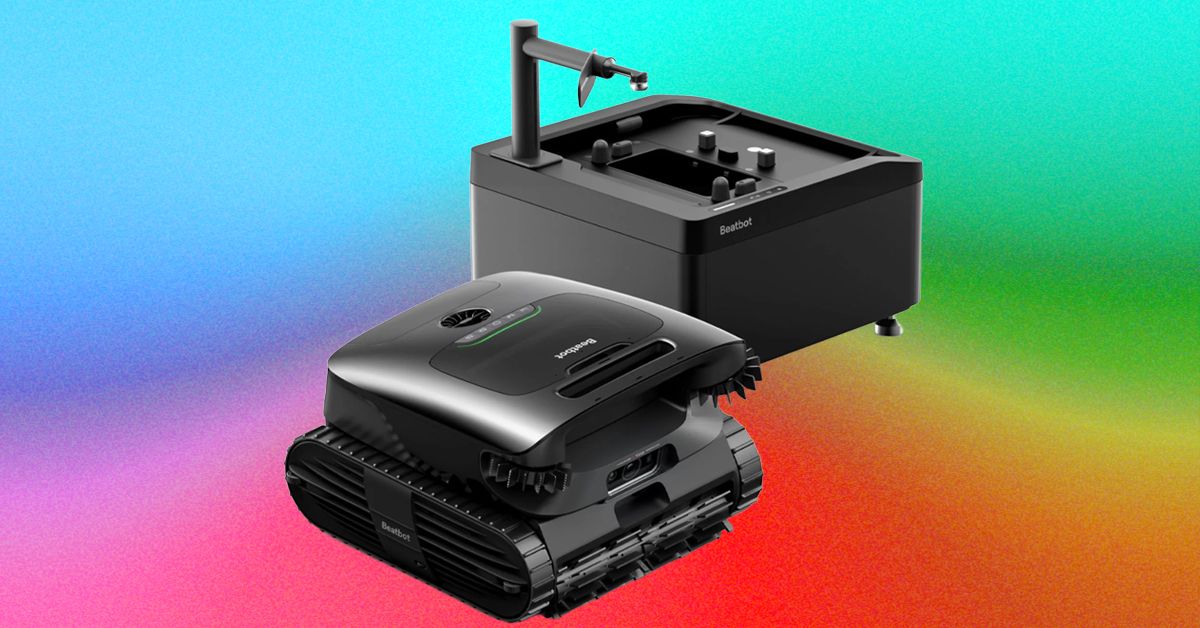
Beatbot’s AquaSense X brings a long-promised feature to pool robots: a system that rinses out the robot’s debris basket without the owner digging through soggy leaves after every run. In testing by WIRED contributor Christopher Null, the idea worked, though with enough caveats to keep the word “self-cleaning” on probation.
The AquaSense X is listed at $3,999 at Beatbot and Amazon, down from $4,250, according to WIRED. The publication rated it 7 out of 10, praising its cleaning on pool floors, walls, and the waterline, while faulting its price, heavy hardware, involved setup, weak skimming, and the fact that the dock still needs cleaning.
The trick is that the robot does not clean itself alone. Beatbot ships it with a separate AstroRinse station, a 42-pound base that also charges the robot. The AquaSense X itself weighs 29 pounds before it comes out of the pool full of water, so this is less “drop in a robot” and more “install a small appliance beside your pool.”
How the cleaning dock works
According to Null, setting up the AstroRinse took about 30 minutes and required attaching a cleaning arm, connecting an inlet hose and drain hose, supplying power, and leveling the unit. The included water hose is 12 feet long, so the station needs to sit near a spigot unless the owner adds an extension. It also needs drainage and an electrical outlet nearby, which may force awkward placement around some pools.
The robot then pairs wirelessly with the AstroRinse station and connects to Beatbot’s mobile app over Bluetooth and either 2.4 GHz or 5 GHz Wi-Fi. Null reported one firmware-update hiccup that broke pairing between the two devices, though repeating the pairing process fixed it.
After a cleaning cycle, the AquaSense X parks at the waterline for retrieval. The owner still has to lift it out and place it on the AstroRinse base. Once seated correctly, the station swings a top arm into the robot’s skimmer opening and blasts water into the internal 5-liter filter basket for three minutes. A one-minute quick mode is available in the app. Debris lands in a 22-liter container and mesh bag in the base, while water drains through a lower screen.
That mechanism reduced the hand work, but it did not eliminate it in WIRED’s testing. Null said the AstroRinse never removed all debris from the robot’s basket; a few leaves remained after each run. Beatbot says the dock’s debris container and mesh bag should need cleaning only every two months, but WIRED noted that wet organic debris and lingering water in the base raise a practical question: how long owners want that sitting in the yard.
Good pool cleaning, bad surface skimming
In the pool, WIRED found the AquaSense X behaved much like Beatbot’s AquaSense 2 Ultra. The robot uses a 13,400 mAh battery and runs for about 4.5 hours on floor cleaning, according to the review. Beatbot’s app offers combinations of floor, wall, waterline, and surface-cleaning modes, with up to two passes per zone. An AI Quick Mode uses the onboard camera to look for debris rather than waiting to bump into it.
Null reported strong floor performance. In tests using organic and synthetic debris, the robot collected an average of 97 percent of the material and handled steps and platforms well. Surface cleaning was the weak spot: WIRED said it collected less than half of floating debris and pushed much of the rest underwater, despite side brushes intended to draw leaves toward the intake.
The buying problem is the delta. WIRED concluded that the AquaSense X saves some short-term cleanup effort, but not enough to justify paying $1,800 more than the AquaSense 2 Ultra. The dock cleans the robot, sort of. The owner still moves the heavy machine, still services the base, and still gets to meet the remaining leaves by hand.
This story draws on original reporting from WIRED.