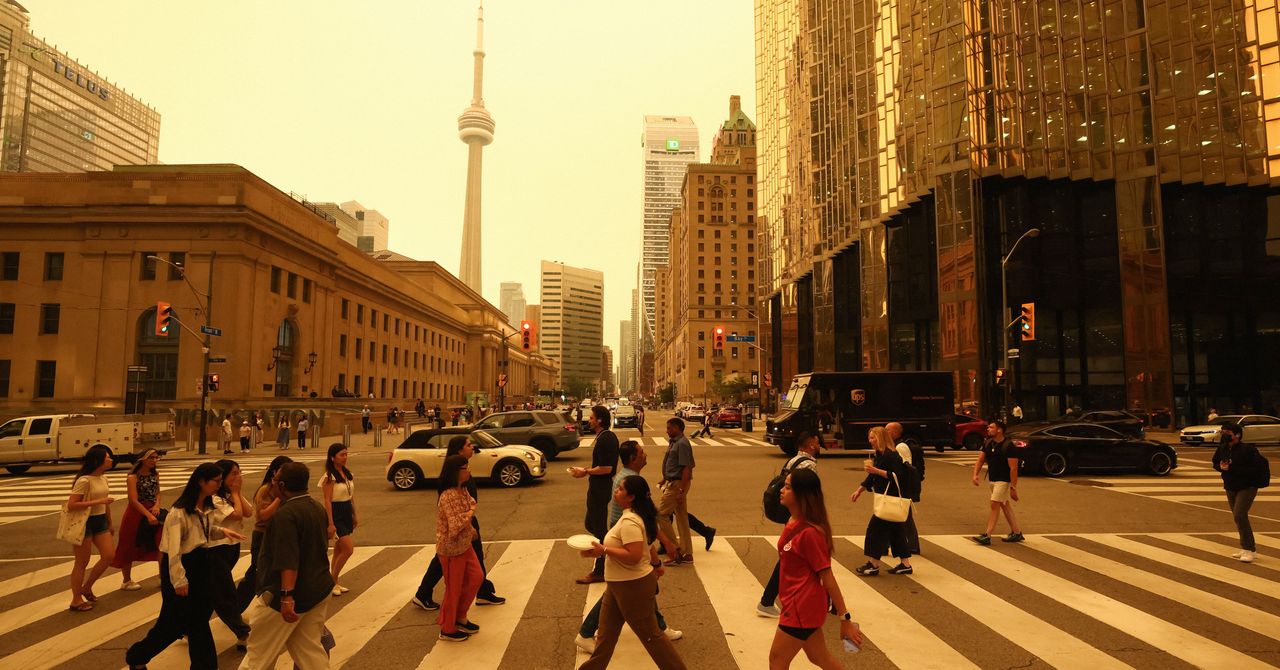
Smoke from Canadian wildfires spread across much of the Midwest and Northeast this week, pushing cities to warn residents about dirty air at the same time a heat wave is driving temperatures above 90 degrees Fahrenheit in many places.
As of Wednesday, more than 100 fires in Canada were burning out of control, with many more being monitored or fought. Winds carried the smoke south and east, leaving hazy skies from Minnesota to New York. Toronto commuters saw orange skies Wednesday morning, a familiar warning screen for a continent that keeps learning the same lesson: fire does not need to be nearby to make the air bad.
New York City’s air quality index reached 180 on Wednesday evening, placing it in the “unhealthy” category under the US Environmental Protection Agency’s system. Duluth, Minnesota, recorded conditions above 500 on the same scale. The EPA labels anything over 301 as “hazardous” and unsafe for anyone. Smoke was expected to intensify Thursday in parts of the Northeast, including New York.
What is in the smoke
The main health concern is PM2.5, the fine particulate matter small enough to get deep into the lungs. The name refers to particles smaller than 2.5 micrometers, about one-thirtieth the width of a human hair.
PM2.5 comes from many sources, including vehicle traffic and power plants, but wildfire smoke is its own mess. As fires reach towns, they can burn cars, houses, playgrounds, and other human-made material. That can add pollutants beyond what comes from burning trees and brush.
Nicholas Nassikas, a pulmonologist and assistant professor of medicine at Harvard Medical School, said people with asthma or other lung disease should reduce time outdoors during heavy smoke. He also singled out children and older adults as higher-risk groups: children breathe more rapidly, while many older people have existing health conditions or spend time in buildings with weaker ventilation.
Jennifer Stowell, an assistant professor at the University of Maryland’s School of Public Health, said even healthy adults should consider precautions once the air quality index rises above 100. Her advice was plain: cut outdoor exposure where possible. For people who must stay outside for long periods, she recommended an N95 mask.
N95s can filter some particles, but they are not a magic force field. They do not remove every pollutant in wildfire smoke, including gaseous contaminants. New York City opened cooling centers during the heat wave and distributed masks at some of them, but cooling spaces also need clean indoor air, especially when heat and smoke arrive together.
A recurring smoke problem
A similar wave of Canadian wildfire smoke hit the Northeast in 2023. The broader pattern is also getting harder to ignore. Higher temperatures are lengthening fire seasons and creating hotter, drier conditions that can produce more intense fires.
A study published last year estimated that wildfire smoke already contributes to 40,000 deaths annually in the United States. If warming continues, the study projected that number could rise to 70,000 deaths a year by 2050.
Dan Westervelt, an associate professor of climate physics at Columbia University, said he planned to keep his children indoors and avoid strenuous exercise during the smoky period. He also said long-term exposure to high pollution levels has been repeatedly linked in research to premature death.
Westervelt said the United States has made progress cutting pollution from vehicles, fuels, and electricity generation. The harder problem now, he said, is wildfire smoke: it arrives across state and national borders, ignores city planning decks, and gets into lungs anyway.
This story draws on original reporting from WIRED.


