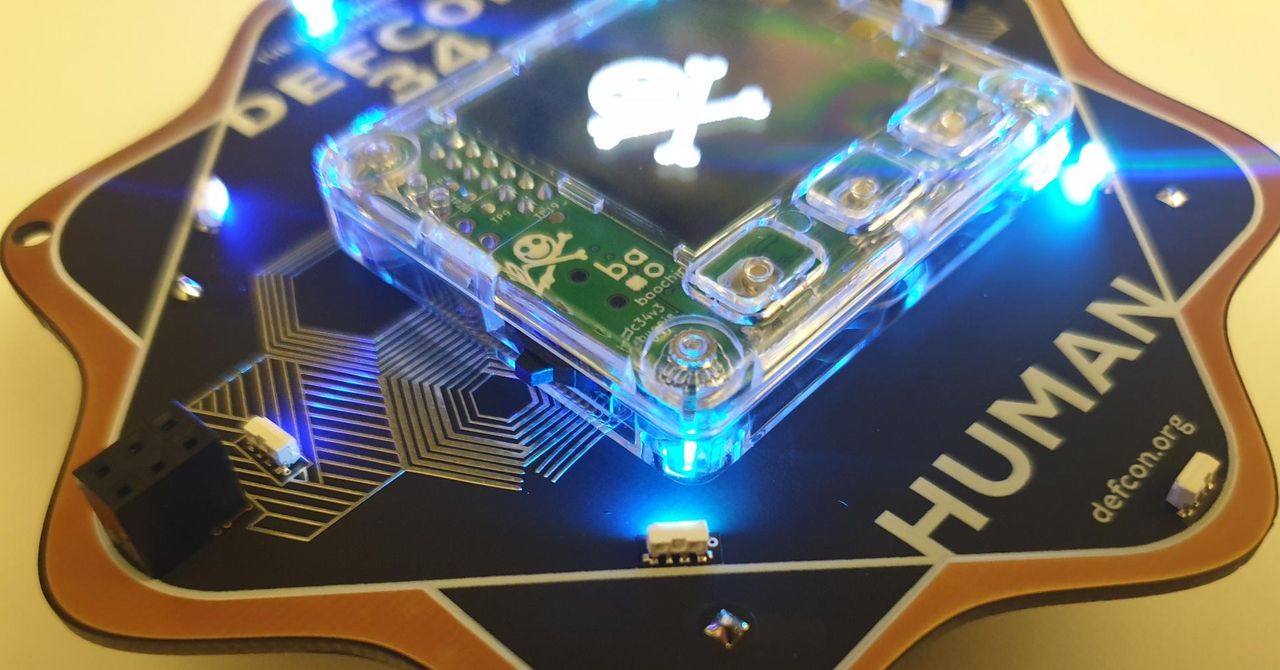
The Defcon 34 badge is built around Baochip-1x, a mostly open source microcontroller designed by hardware hacker Andrew “bunnie” Huang that can be inspected in ways ordinary security chips cannot, according to WIRED. The detachable core module is meant to survive the conference as a FIDO hardware security token, rather than becoming another blinking souvenir in a drawer.
Defcon asked Huang to make this year’s badge, WIRED reported. The result puts the chip ahead of the usual badge theater: puzzles, lights, and Easter eggs are still present, but the real bet is on verifiable hardware. Huang has published the chip’s operating system, firmware, processor core, cryptographic engines, and input-output system on GitHub, making much of the design available for outside review.
What is the Baochip-1x?
Baochip-1x is a microcontroller that Huang has been developing for three years through his company Baochip. Unlike common chips sealed in opaque plastic, it is packaged so infrared light can pass through the back of the silicon, letting researchers examine internal structures and compare them with the published design.
That packaging is aimed at a nasty supply-chain problem: even when chip designs are open, buyers often still have to trust that the manufactured silicon matches the files. Huang plans to show Defcon attendees how to inspect the chip under infrared light, WIRED reported.
The openness has limits. Huang told WIRED that some physical-design and manufacturing pieces remain proprietary, including elements tied to TSMC’s 22-nanometer process. His claim is narrower and more useful than a marketing slogan: he says the chip is much more open than other security-oriented chips, not that every atom of the stack is public.
How did the Defcon badge chip get made?
Fabricating a custom chip can cost millions of dollars, but Huang got help from Crossbar. According to WIRED, Crossbar contacted him three years ago because it wanted to build an open source, secure chip. Huang agreed to help if he could place his CPU on the same wafer run, sharing manufacturing rather than paying for a separate run.
The Crossbar version and Huang’s Baochip share infrastructure and peripherals, but use different processor cores. Crossbar’s chip uses a proprietary ARM core, while Huang’s version uses an open source RISC-V core implementation. The Baochip disables Crossbar’s microprocessor because Huang does not have rights to distribute it.
Defcon founder Jeff Moss saw the chip as a fit for the conference’s “agency” theme, which Defcon defines around technology and choices that increase self-determination. The badge run also gives Baochip its first broad distribution: WIRED reported that 27,000 badges will carry it, after only a small development release before now.
What can the removable badge module do?
The detachable module can operate as a FIDO security key. Its software also supports time-based one-time passwords and password management. Huang told WIRED it is probably the first open source security token that can be inspected from bootloader down to transistors.
The module includes a camera for enrolling QR codes with authentication systems. Because Defcon bans covert photography and has strong privacy norms, Huang made the camera low resolution and near-sighted. By default, the chip uses black-and-white camera data and does not support storing photos, according to WIRED.
The badge still has conference-specific behavior. Different badge types, including attendee, speaker, goon, and black Uber badges, start with distinct LED colors and flashing patterns. Users can add colors and more elaborate patterns when badges communicate with one another.
How secure is Baochip-1x?
Huang told WIRED the chip runs an operating system written in Rust and includes secure boot, a true random number generator, and hardware protections intended to make attacks harder. He expects it to be especially resistant to remote attacks that do not require physical access.
The chip uses resistive RAM, or RRAM, which Huang says makes physical extraction of stored data harder than conventional flash memory. He also put a ceiling on the claim: he estimates Baochip could resist attacks costing tens of thousands of dollars, while an adversary with millions of dollars and a serious hardware-analysis lab could probably break it.
Huang expects Defcon attendees to find flaws, including possible zero-days in the code, and sees that scrutiny as part of the launch. The hardware uses a 350 MHz RISC-V processor, 2 MB of SRAM, 4 MB of RRAM, and four 700 MHz PicoRV32 cores for input-output. It already runs MicroPython and has C and Rust development kits, while Huang says future uses could include HSM-style roles or even Linux if the platform stretches far enough.
This story draws on original reporting from WIRED.