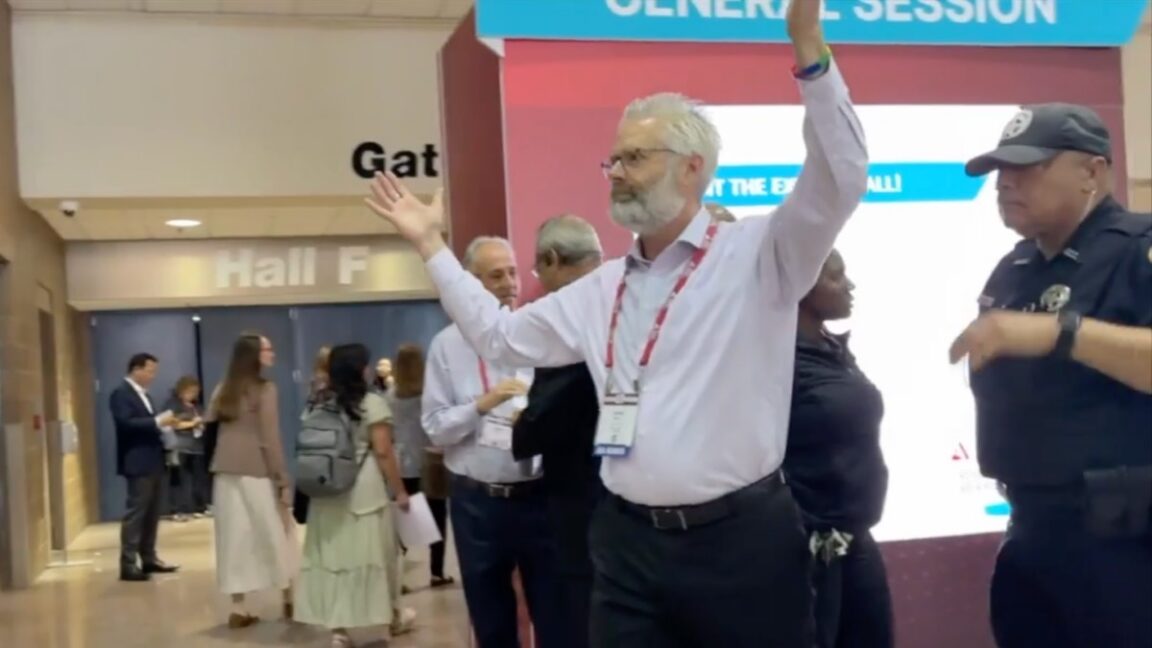
Senior editors at Diabetes Care have taken their fight with the American Diabetes Association public, posting an editorial package they say the ADA refused to publish after five scientists were removed from the association’s June conference in New Orleans.
The dispute matters for diabetes researchers because Diabetes Care is an ADA journal, and the episode has turned a fight over conference rules into a larger argument about editorial independence, scientific advocacy, and who inside the association ordered police to eject members from its own meeting.
Deputy editors Elizabeth Selvin and Cheryl A.M. Anderson posted the editorial and seven opinion pieces to Zenodo. They wrote that ADA leadership had received the pieces before publication and was invited to publish a response at the same time. According to the deputy editors, the ADA declined to run them.
The ADA had not merely made a public-relations mess, the deputy editors argued. They wrote that it was “unusual and unacceptable” for a medical society to work against its members and journal editors, particularly over efforts to discuss federal science policy and cuts affecting the National Institutes of Health.
What happened in New Orleans
On June 5, five scientists distributed copies of an April Diabetes Care editorial criticizing the Trump administration’s actions toward scientific research. The group included Steven Kahn of the University of Washington, editor-in-chief of Diabetes Care, along with former ADA president Desmond Schatz, Aaron Kelly, Justin Ryder, Irl Hirsch, and Maureen Gannon.
They handed out the editorial outside the conference’s opening address. Jay Bhattacharya, then head of the NIH under President Donald Trump, had been scheduled to speak but canceled shortly before the event. Senior NIH official Rick Woychik spoke instead.
Police escorted the scientists from the conference within minutes, according to accounts cited by the scientists and earlier reporting. Louisiana State Police later told media outlets they acted at the ADA’s request. The ADA also barred the five from the rest of the meeting.
The association first said through its media team that the scientists had violated the meeting code of conduct, according to MedPage Today. It later told members the issue was distribution of unapproved materials, not the viewpoint expressed, according to Science. In a Sunday statement, the ADA invoked its obligations as a 501(c)(3) nonprofit to maintain a nonpartisan environment. IRS guidance, however, does not bar leaders from speaking personally about politics or addressing public policy issues.
ADA CEO Charles Henderson later apologized in a video and said the group would commission an independent review of the events, policies, procedures, and decision-making behind the removals.
New allegations from editors and members
In the new Zenodo package, the five scientists say that, a month later, they have not had a meeting with ADA leadership, have not received an official apology beyond Henderson’s video, and have not been cleared of wrongdoing. They also say the association has not identified who made the decision to remove them.
The five are asking for the promised investigation, a formal way for professional members to raise concerns, stronger advocacy for patients and research funding, and support for journal editors’ publication decisions.
Selvin and Anderson trace part of the tension to a 2025 session they organized on the U.S. health care system. They say ADA leaders objected that the panel was “unbalanced” because it included Rep. Kim Schrier, a Washington Democrat, pediatrician, and person with Type 1 diabetes, and asked for a Republican lawmaker or other speakers with opposing views. The session went ahead, they wrote, but the ADA did not advertise it.
John Buse of the University of North Carolina, who replaced Kahn as chair of a symposium after the ouster, made the sharpest allegation. He wrote that he now believes the removals were premeditated. The New Orleans Five say Schatz texted ADA Chief Scientific and Medical Officer Rita Kalyani before the meeting to ask that Kahn be told where distribution would be allowed. Kalyani replied that she was traveling and would check after landing, they wrote, but did not follow up.
According to the scientists’ account, a security official referred to ADA as “the client” while directing removals, including Gannon’s. Buse called the episode an “ambush” and said ADA leaders could have contacted Kahn rather than using venue security and armed police.
Mark Atkinson, former chair of the Scientific Sessions Meeting Planning Committee, also wrote that he resigned after the incident. He said a June 6 letter was released with his name although he had not approved the final text. Remaining chair, he wrote, would have signaled trust in a process he no longer trusted.
This story draws on original reporting from Ars Technica.