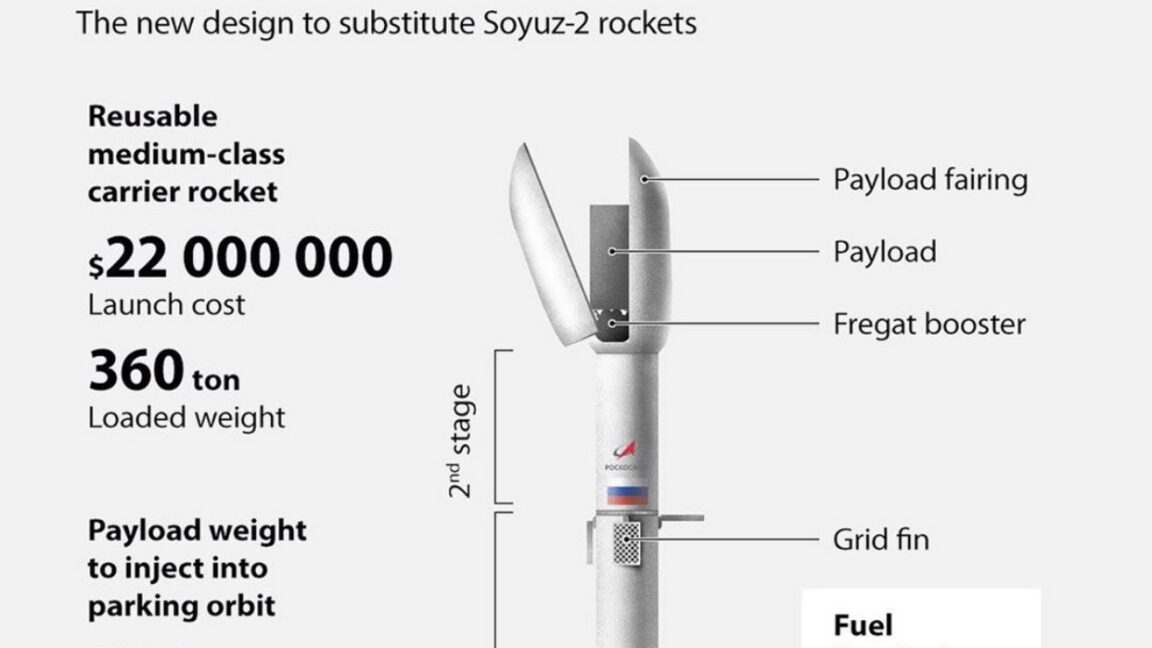
Russia’s planned reusable Amur-LNG rocket, billed by Roscosmos as a replacement for the country’s Soyuz 2 workhorse, is still years from a real flight. Dmitry Baranov, Roscosmos’ deputy director general for rocket programs, told the Russian business publication RBC that engineers are now focused on a first-stage demonstrator rather than an orbital vehicle.
That is a long slide from the schedule Roscosmos described when it announced Amur-LNG in 2020. At the time, Russian space officials said the rocket could debut in 2026. Six years later, the public plan has shifted to test hops in 2028 and, according to a Roscosmos display shown at the International Security Forum in May, flight tests in 2031.
The delay matters because reusable boosters are no longer a SpaceX parlor trick. SpaceX launches and lands Falcon 9 first stages at a regular cadence. Blue Origin has demonstrated landing and reflight capability for a large orbital booster, although its New Glenn booster is currently grounded. In Asia, China recently recovered a booster after an orbital launch, Japan’s space agency has been running hop tests, and Honda has carried out vertical reuse tests.
What Roscosmos says it will test
Baranov told RBC that the Amur program’s next visible hardware will be a demonstrator for the rocket’s first stage. The test vehicle sounds like a hopper: a stripped-down machine built to prove launch, descent, engine restart, and landing behavior before anyone commits an orbital rocket to the job.
The first planned test, beginning in 2028, would send the demonstrator to less than 1 kilometer in altitude. Its engine would remain running for the whole flight, and the vehicle would aim to come back to its launch point.
A second test would be harder. Baranov said the vehicle would climb to 10 kilometers, shut its engine down, restart it for descent, and land on deployable legs. That sequence is the part reusable rockets have to get right: a booster must survive the flip from ascent hardware to returning aircraft, then relight with enough precision to avoid becoming expensive scrap.
Roscosmos has said Amur-LNG will use methane-fueled engines and a reusable first stage. The rocket is intended to carry 10.5 metric tons to low Earth orbit when flown in reusable mode. Russian officials have previously disclosed that the RD-0169A engine planned for Amur is still in preliminary test firings, which fits a program that is working toward hopper tests rather than operational launches.
Soyuz 2 keeps the job
Baranov said the goal is for Amur to replace Soyuz 2 “definitely and fairly quickly,” according to RBC. Soyuz 2 currently handles Russian crew and cargo launches to the International Space Station, so any replacement has to be more than a reusable-rocket press release with landing legs attached.
Baranov did not give RBC a new date for Soyuz 2 replacement. The 2031 flight-test marker displayed by Roscosmos in May suggests Soyuz 2 has breathing room. Russia conducted the world’s first orbital launch nearly seven decades ago, but on reusable orbital boosters, its answer to Falcon 9 remains mostly schedule, aspiration, and engine-stand work.
This story draws on original reporting from Ars Technica.