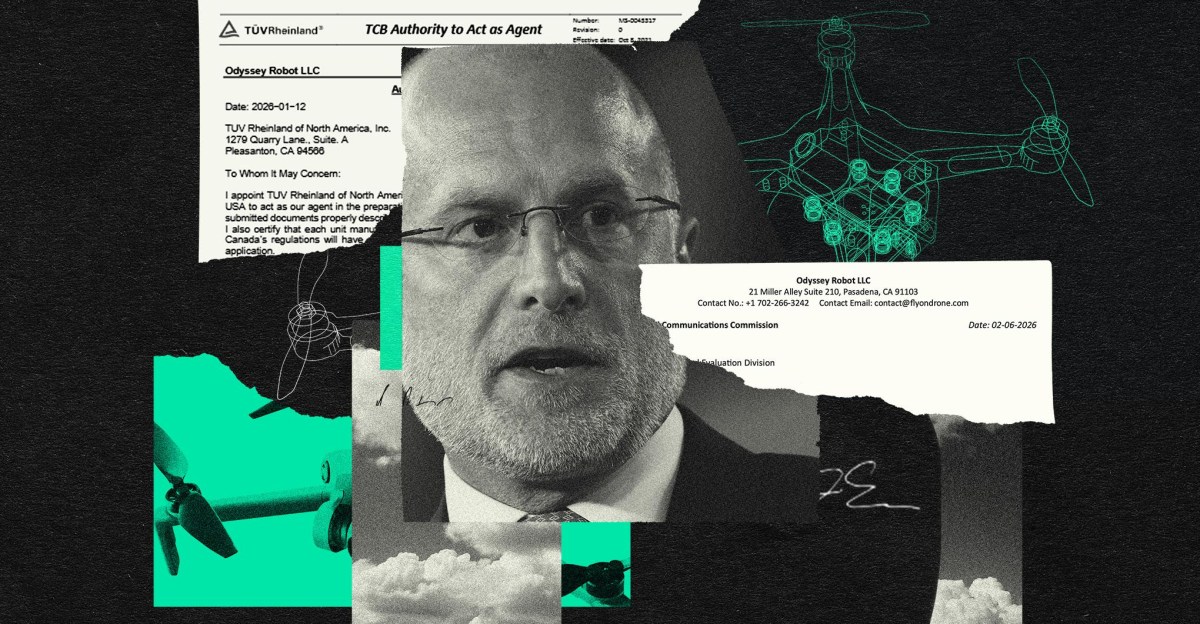
The FCC drone ban is getting the kind of scrutiny that policy built on undisclosed security claims tends to invite. The Verge reported that Odyssey Robot, a U.S. drone startup tied to the new waiver system for foreign-made drones, listed a Pasadena, California, office that showed little visible evidence of an active drone operation.
According to The Verge’s Sean Hollister, the company’s reported headquarters is Office 18 inside a coworking space. During a visit, The Verge found a small private office with three desks and chairs, no visible monitors, keyboards, chargers, power strips, decorations, or other signs of day-to-day work. Two desks were covered with sealed cardboard packages, the report said.
The detail matters because Odyssey Robot was presented as part of the domestic alternative universe that the U.S. government’s drone restrictions are supposed to encourage. The Verge said the office was also the place where Odyssey Robot claimed it was manufacturing drones. A bare coworking room is a thin answer to a supply-chain problem, if that is the policy goal.
What is the FCC drone ban?
On December 22, 2025, FCC Chairman Brendan Carr, with help from other agencies, blocked future foreign consumer drones from entering the United States unless they receive a new special waiver, The Verge reported. The government said foreign consumer drones posed an unacceptable national security risk, but The Verge said no public evidence was offered to support that claim.
The rule targets foreign-made drones entering the U.S. market. The ban does not appear, based on The Verge’s description of the waiver process, to work like a technical security review of radio modules, firmware behavior, data flows, or cloud dependencies.
What does the waiver ask companies to prove?
The Verge reported that the waiver application does not ask applicants to explain how they would restrict or improve the security of the drones themselves. That is the policy’s awkward bit: if the stated risk is national security, a waiver process with no product-security questions leaves a fairly obvious hole in the mechanism.
Instead, The Verge characterized the waiver as a system that gives Carr and President Donald Trump broad discretion over which companies can sell drones in the country. That is a political filter more than a technical audit, at least from the public-facing details described in the report.
The FCC’s move follows a similar approach Carr took with consumer internet routers, according to The Verge, where the publication also questioned whether the restriction was tied to the actual security properties of the devices.
For drone buyers, manufacturers, and public agencies that rely on small unmanned aircraft, the unresolved question is practical: whether the U.S. is replacing foreign supply with vetted domestic capacity, or just adding a waiver gate that can be gamed by paperwork and a mailing address. The Odyssey Robot office visit, as reported by The Verge, does not settle that question. It does make the FCC’s current answer look less convincing.
This story draws on original reporting from The Verge.