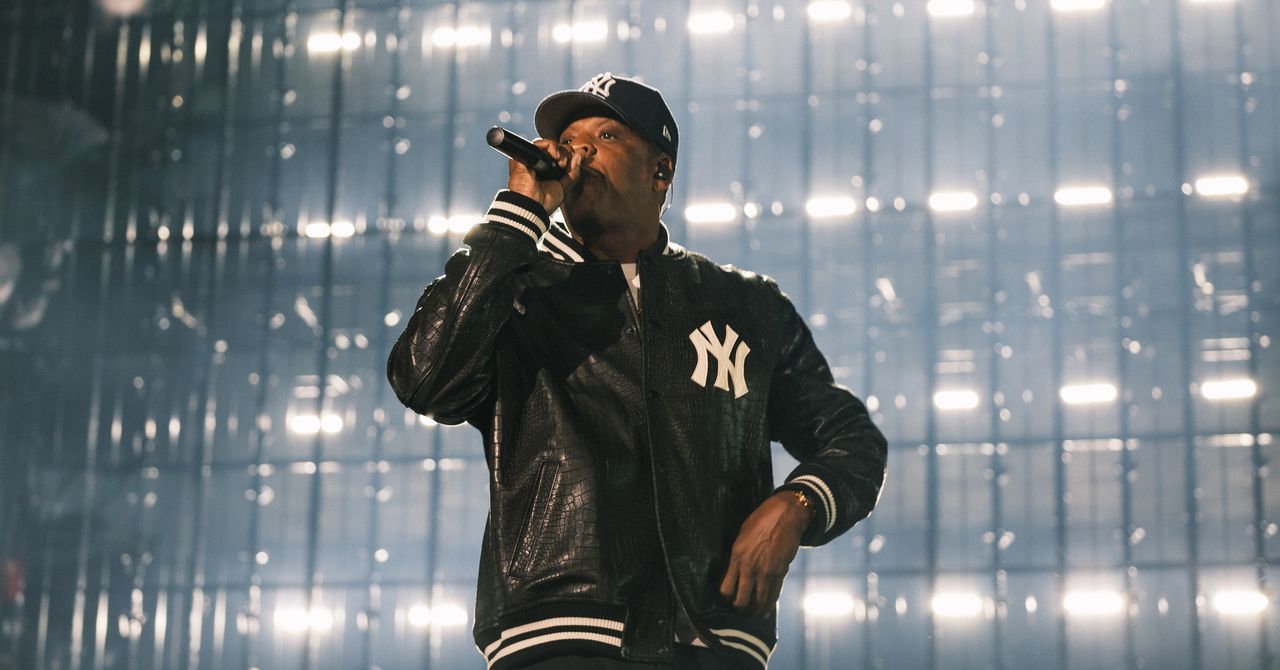
Jay-Z opened a three-night Yankee Stadium run Friday with a show built around restraint, which counts as a design choice when 45,000 people are staring at the outfield and several thousand more are waiting to clip the best moments for TikTok.
The concerts mark anniversaries for two of his defining albums: 1996’s Reasonable Doubt and 2001’s The Blueprint. The plan began as two nights, with Friday tied to Reasonable Doubt and Saturday to The Blueprint. A third Sunday date, billed as “Extra Innings,” was added after the first two sold quickly, according to Scott Krug, the Yankees’ chief financial officer.
Willo Perron, who designed the show, told Wired that the production was meant to put Jay-Z rather than stage machinery at the center. The setup used a mostly bare stage backed by a 2,952-square-foot screen stretching across the outfield, showing images from Jay-Z’s earlier New York years.
Friday’s performance ran about two hours. Jay-Z performed with a 10-person band and an 18-piece string section. The guest list did plenty of the work that pyrotechnics usually get paid to do. Beyoncé sang the chorus on “Can’t Knock the Hustle,” Nas joined for “Dead Presidents,” Blue Ivy Carter played keys on “Feelin’ It,” and Jaz-O appeared as well.
Later in the set, Jay-Z performed “Empire State of Mind” with Alicia Keys, who introduced it with Billy Joel’s “New York State of Mind.” The Knicks’ OG Anunoby was seen in the crowd, according to Wired, though the team did not come out for the song.
A stadium show with baseball constraints
The show’s clean look hid a less glamorous engineering problem: Yankee Stadium is still a baseball park in season. Krug told Wired the Yankees host the Los Angeles Dodgers the following Friday, so the playing surface had to survive the residency intact.
That meant no vehicles on the diamond and no staging placed directly on it. Perron’s team covered the infield with a vinyl-mesh layer that also served as a projection surface. On Friday, it carried a live feed of Jay-Z’s performance. Perron said the same staging would be used Saturday and Sunday, with different set lists and footage.
Areas with concert seating in the outfield were protected with polypropylene panels designed with flat undersides so they would not dig into the Kentucky bluegrass below. Krug said baseball remained the venue’s first obligation, which is the kind of sentence that turns a rap residency into a turf-management meeting.
The loading plan had its own constraints. Krug said the stadium’s surrounding city streets leave little space for trucks to wait, so deliveries had to be timed tightly: one truck out, the next one in. Celebrity arrivals used similar controlled access, coordinated with artist security, a process Krug said the Yankees already use for high-profile guests.
New York as part of the production
The shows also came with a wider anniversary campaign around Jay-Z’s New York history. He worked with Spotify on a subway takeover, partnered with Brooklyn Public Library on special JAŸ-Z30 library cards, and opened a Dumbo pop-up in a warehouse featured in the “Dead Presidents” video.
Isra Ali, a professor of media, culture, and communication at NYU Steinhardt, told Wired that demand for in-person contact rises when audiences are seeking authenticity. She also said Jay-Z occupies a complicated place in the city’s current mood: a Bed-Stuy-raised artist and a billionaire mogul at once.
Jay-Z addressed that tension from the stage in a line built for the phones: “They said I sold out. Hell yeah, I sold out. Three nights. Yankee Stadium.”
This story draws on original reporting from WIRED.


