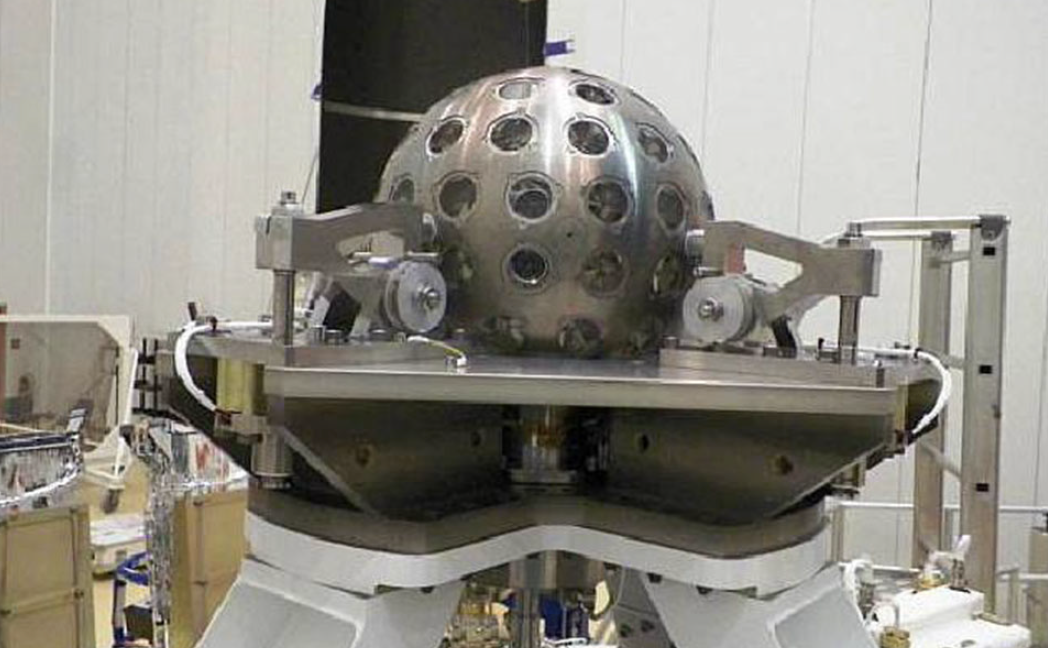
A dense, mirror-covered satellite has helped physicists make the sharpest measurement yet of how Earth’s rotation drags spacetime around with it, according to a study published in Nature.
The effect, known as frame dragging or the Lense-Thirring effect, follows from Albert Einstein’s general theory of relativity. A rotating mass slightly twists the geometry of spacetime nearby. Around black holes, that twist is easier to see. Around Earth, which is light and slow by relativistic standards, the signal is small enough that the measurement becomes an argument with every stray force in orbit.
The team, led by Ignazio Ciufolini of the Wuhan Institute of Physics and Mathematics in China, reports that it reduced the uncertainty in the terrestrial measurement from a few percent to 0.2 percent. The measured drift matched the prediction of general relativity to within one to two parts per thousand, the researchers said.
A satellite built to be boring
The newer spacecraft in the experiment is LARES-2, short for Laser Relativity Satellite 2, developed by the Italian Space Agency and launched on a Vega-C rocket in July 2022. It is not much of a spacecraft in the modern sense. It has no thrusters, solar panels, or electronics.
Instead, LARES-2 is a 294.8-kilogram sphere of Inconel 718, a nickel-chromium alloy, a little more than 40 centimeters wide. Its surface carries 303 corner-cube retroreflectors, which return incoming laser light back toward its source. That design gives it a very low area-to-mass ratio for a satellite in medium-Earth orbit, reducing the shove from sunlight and other non-gravitational effects.
Ciufolini told Ars Technica that the point was to measure gravity while suppressing forces from photons hitting the satellite. In physics terms, LARES-2 is meant to behave as close as possible to a test particle: a compact object whose motion mostly reflects the gravitational field around it.
Ground stations fired short laser pulses at LARES-2 and timed the return light. Ciufolini’s team used about 200,000 observations collected from July 2022 through June 2025, locating the satellite to roughly 1 millimeter.
Canceling Earth’s messy shape
Millimeter tracking alone was not enough. Earth is not a sphere, and its equatorial bulge creates ordinary Newtonian changes in satellite orbits far larger than the relativistic signal the team wanted.
The fix used geometry rather than wishful thinking. LARES-2 flew in tandem with LAGEOS, a NASA laser-ranging satellite launched in 1976. The two satellites occupied supplementary orbital inclinations whose angles added to 180.01 degrees. In that arrangement, the orbital shifts caused by Earth’s oblateness largely cancel because they act in opposite directions. The Lense-Thirring contribution, by contrast, pushes both orbital planes the same way, so it adds.
The remaining headache was the K1 lunisolar tide, a gravitational effect from the Moon and Sun that changes Earth’s gravitational field by deforming the planet. Ciufolini identified that tide as the experiment’s main obstacle.
The team handled it by analyzing one full 1,050-day precession cycle. Over that span, the K1 tide’s known period and phase allowed the researchers to average it out and remove it from the data, along with six smaller tidal components with periods from 135 to 910 days.
After those corrections, the combined satellite data showed a steady drift of about 61.3 milliarcseconds per year. The researchers identify that drift as Earth’s frame-dragging signature.
What the result rules in, and out
The measurement is another win for general relativity, but Ciufolini said its value also lies in constraining rival theories. He pointed to Chern-Simons theory, an alternative framework associated with quantum-gravity work that predicts a different amount of frame dragging. The new result does not eliminate Chern-Simons theory, but the team says it cuts away a large range of possible versions.
The work also produced a sharper measurement of the K1 tide’s strength. Ciufolini said Chinese colleagues told him better tide models could indirectly improve earthquake studies, though that is a downstream earth-science use rather than the experiment’s main result.
LARES-2 and LAGEOS may keep paying rent for a long time. Ciufolini said laser-ranged satellites of this kind can remain useful for hundreds of years, and longer tracking records should further tighten frame-dragging measurements.
This story draws on original reporting from Ars Technica.


