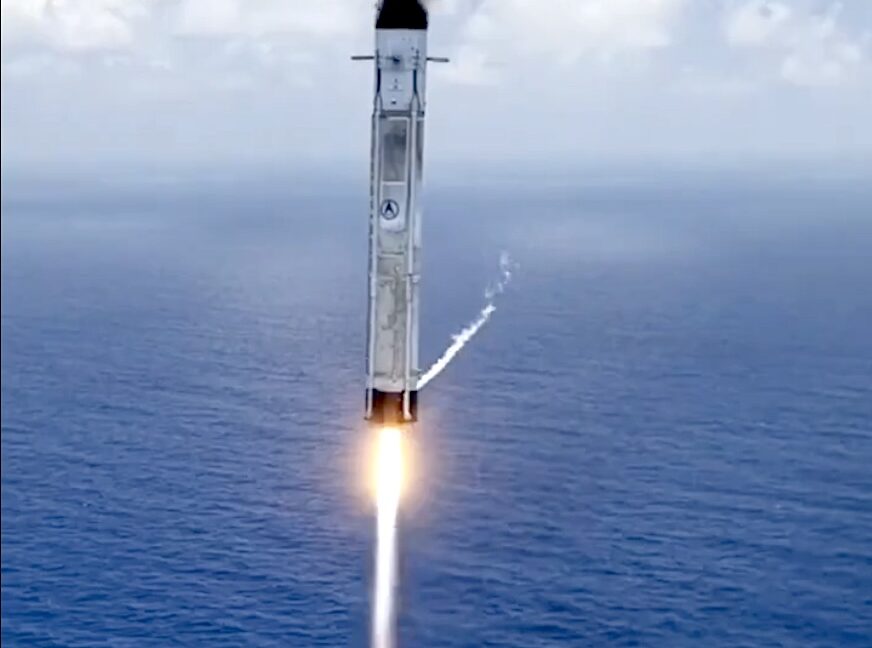
China’s main state-owned rocket builder said it recovered an orbital-class booster on Friday, a first for the country and a useful proof point for a launch program trying to copy the economics of SpaceX without copying the hardware bolt for bolt.
The China Aerospace Science and Technology Corporation, working through the China Academy of Launch Vehicle Technology, launched the Long March 10B from the Wenchang Commercial Space Launch Site on Hainan Island at 12:15 a.m. EDT, or 12:15 p.m. local time. The 63.6-meter rocket flew on seven kerosene-fueled first-stage engines.
About 10 minutes after liftoff, the first stage came back from space and steered itself toward an offshore recovery vessel in the South China Sea. Instead of landing on legs, the booster descended into a four-legged frame fitted with tensioned cables arranged in a grid. The cables caught the vehicle as it shut down its landing engines, leaving the still-smoking stage suspended above the ship.
The upper stage continued to orbit and released a payload identified by Chinese officials only as CX-26. Chinese officials described the mission as a “complete success.” Mao Ning, a spokesperson for China’s Foreign Ministry, wrote on X that the flight marked China’s first controlled rocket recovery and a step toward reusable launch capability.
A different catch
SpaceX and Blue Origin have already recovered orbital-class boosters. SpaceX first landed a Falcon 9 booster in 2015, later catching a Starship Super Heavy booster with launch-tower arms in 2024. Blue Origin landed a New Glenn booster on an offshore platform last November.
CASC’s method sits somewhere between those approaches. Falcon 9 and New Glenn use propulsive landings onto pads or ships. Starship’s Super Heavy booster is caught at the launch site by mechanical arms. Long March 10B instead returned downrange to a vessel and used a net-like capture system.
The engineering trade is clear enough. A booster without landing legs carries less dead weight. A downrange recovery also avoids spending as much propellant to fly back toward the launch site. Both choices help limit the payload penalty that comes with reuse, assuming the booster can be refurbished and flown again rather than celebrated once and quietly retired.
CASC said the flight validated technologies for reusable launch, including multiple engine restarts at altitude, precision guidance and control, and capture with a sea-based net system. The company said it expects a first-stage reuse flight test by the end of this year.
Part of a larger Moon and satellite push
The Long March 10B is a medium-lift vehicle designed to put about 16 metric tons into low Earth orbit, slightly below SpaceX’s Falcon 9. Its booster uses seven YF-100K engines burning kerosene and liquid oxygen. Its second stage uses a single methane-fueled YF-219 engine.
The rocket is related to the Long March 10A, which is intended for future crew launches to China’s Tiangong space station using the Mengzhou spacecraft. A heavier Long March 10 configuration would strap together three reusable first-stage boosters and support China’s stated goal of landing astronauts on the Moon by 2030.
China tested a smaller Long March 10A-related vehicle in February with a Mengzhou abort-system prototype. In that test, the capsule separated as planned and the rocket continued flying before making a controlled splashdown. Friday’s catch was the next, more ambitious step.
Reusable launch is also a military and commercial capacity problem. U.S. officials have said China’s progress in reuse could let it place more satellites in orbit more quickly. Maj. Gen. Brian Sidari of the U.S. Space Force said last year that he was concerned about China reaching reusable lift that would increase its on-orbit deployment rate.
China is still behind the U.S. launch rate, where SpaceX dominates with Falcon 9 and has used that cadence to deploy more than 12,000 Starlink satellites. Chinese companies, including LandSpace, Space Pioneer, CAS Space, i-Space and Galactic Energy, are also developing reusable rockets. Some have already tried and failed to recover boosters. CASC now has a recovery to point to, and the harder test comes next: flying the same hardware again.
This story draws on original reporting from Ars Technica.


