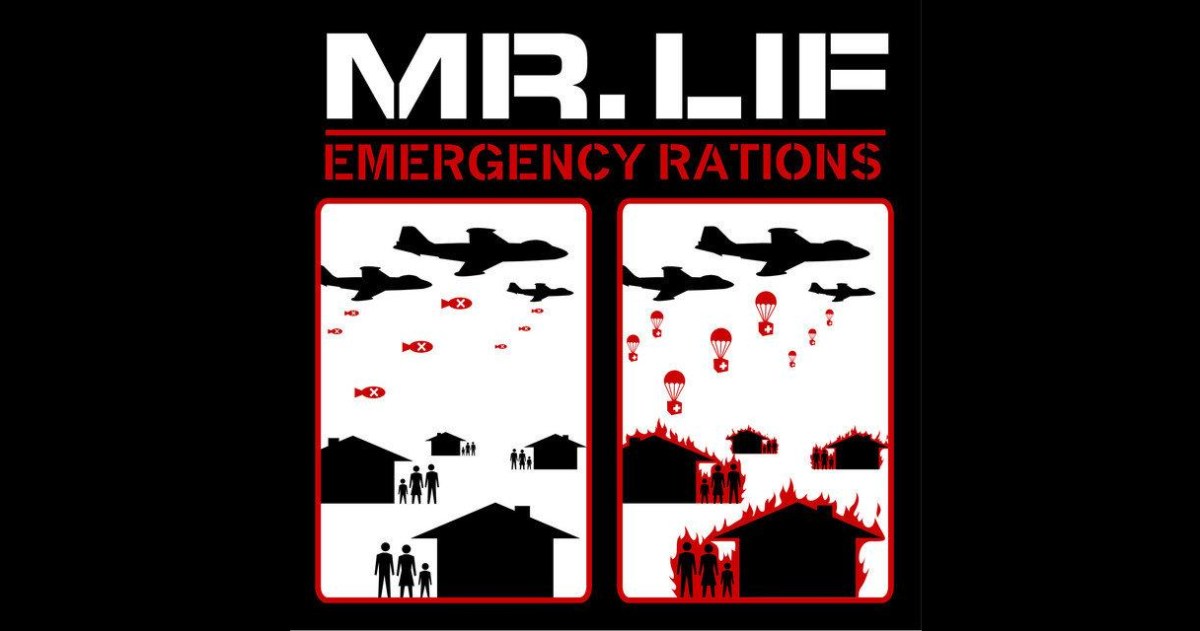
A new review by The Verge’s Terrence O’Brien revisits Mr. Lif’s 2002 EP Emergency Rations as one of the more confrontational political rap records to come out of the post-9/11 underground.
The piece, published July 5, places the record inside the early Definitive Jux catalog, when the label, also known as Def Jux, was building a reputation around experimental, politically engaged hip-hop. O’Brien writes that Mr. Lif occupied the label’s most recognizably “conscious rapper” lane, while label head El-P appeared to treat that voice as central to Def Jux’s identity.
That argument starts with the label’s release history. According to O’Brien, Def Jux’s first record was Mr. Lif’s Enter the Colossus EP in 2000. Emergency Rations followed in 2002 and arrived shortly before Lif’s full-length I Phantom.
The EP’s production credits also explain why the thing still has teeth. O’Brien identifies El-P, Edan, and Lif himself as producers on the project. The review describes the record as moving through several modes: dark underground rap, boom bap, and synth-heavy futurism. That is a lot of aesthetic plumbing for a short EP, which was Def Jux’s whole operating model at the time: make the beats weird, make the politics louder, and trust the listener to keep up.
The record opens with a skit built around Lif’s disappearance, with the implication that government agents have taken him. Pitchfork dismissed that framing in 2002 as “unfortunate and sophomoric,” a judgment O’Brien quotes in the review. More than two decades later, O’Brien argues that the premise lands differently, citing current reporting on masked agents detaining suspected undocumented immigrants, the prosecution of political opponents, and the White House barring established news organizations.
O’Brien does not treat the opening bit as flawless. He notes that the skit can come off as blunt. His larger claim is that the music after it carries the record: seven tracks of urgent political writing, hooks that are more memorable than the subject matter might suggest, and production that keeps the EP from flattening into sermon mode.
The review also points to the EP’s structure as part of its staying power. Lif performs from inside a loose narrative, casting himself as a revolutionary trying to build resistance against a police state. That setup gives the rapid dystopian writing a container, instead of leaving it as a stack of disconnected grievances.
The result, in O’Brien’s reading, is a record that used paranoia as a political form before that felt like cheap internet wallpaper. Emergency Rations was released as a bridge to I Phantom, but the review argues it stands on its own as a compact document of Def Jux’s early ambitions and of hip-hop’s immediate post-9/11 dissent.
This story draws on original reporting from The Verge.