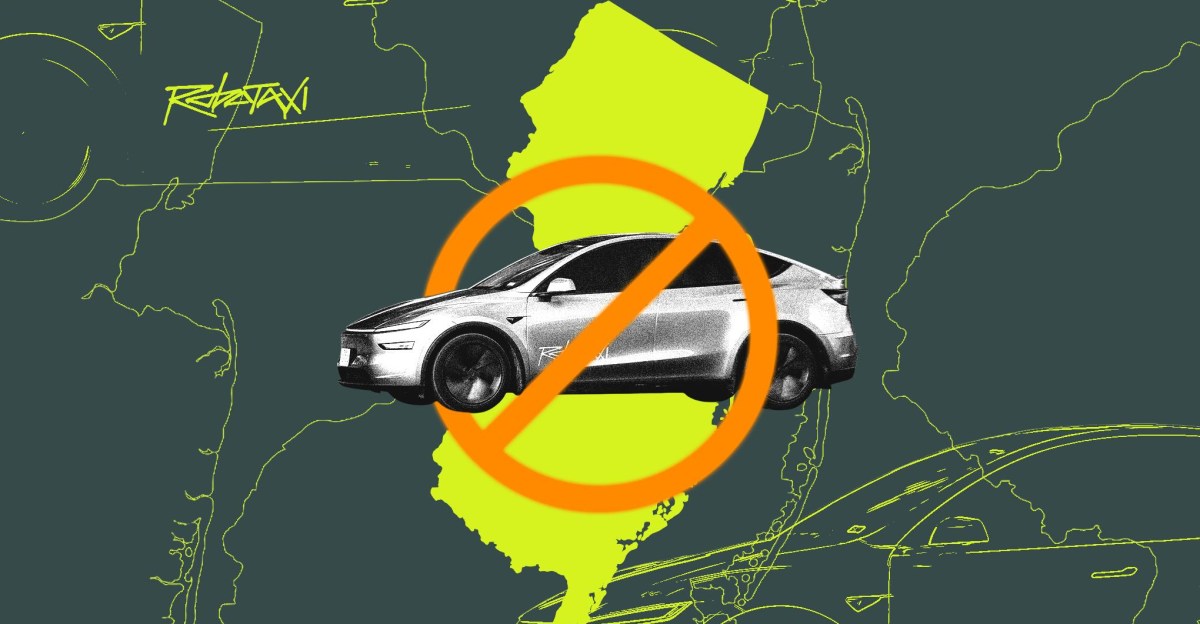
New Jersey lawmakers are considering a robotaxi bill that would put hardware requirements into state law, and Tesla is the obvious company with a problem. The proposal would require fully autonomous vehicles in the state to use cameras plus two other sensing technologies, typically lidar and radar, before operating without a human driver.
The bill, sponsored by Democratic state Sen. Andrew Zwicker, is expected to face a vote later this year. If enacted, New Jersey would become the first state to write a sensor mandate of this kind into autonomous-vehicle rules. A similar proposal is pending in New York.
The practical effect is plain enough: Tesla’s current robotaxi approach relies only on cameras, so it could not operate under the New Jersey program unless Tesla changed the vehicle hardware or lawmakers changed the bill. Tesla did not respond to requests for comment, according to The Verge.
What the bill would do
The measure would create a three-year pilot program for testing and deploying fully autonomous vehicles in New Jersey. Companies would need state approval before running commercial driverless service, would have to report certain crashes, and would need to complete at least 50,000 miles of supervised testing in New Jersey without a major incident before removing the safety driver.
The sensor rule is the sharp edge. It does not regulate driver-assistance features that still require a licensed person behind the wheel. Zwicker has said the bill is aimed at fully autonomous vehicles, not Tesla Autopilot or similar systems.
Zwicker, a physicist at the Princeton Plasma Physics Laboratory, told The Verge he became optimistic about autonomous vehicles after riding in a Waymo robotaxi in Phoenix. He said the technology could improve mobility and safety, but argued that camera-only autonomy has not yet shown enough evidence to justify broad deployment in New Jersey, the country’s most densely populated state.
The camera fight, now with statutes
Tesla CEO Elon Musk has long argued that cameras and artificial intelligence are enough for autonomy. His case is partly cost and partly philosophy: humans drive with vision, so software should eventually be able to do the same. Musk has also argued that lidar and radar can create conflicts when sensor readings disagree with camera data.
Most major robotaxi developers have made the opposite bet. Waymo and Zoox use cameras, lidar, and radar together. The reason is not mystical. Cameras read signs, lights, lane markings, pedestrians, and color. Radar is useful in rain and fog and measures speed and distance. Lidar builds a 3D view of nearby objects using lasers. Redundancy is boring, expensive, and often the point.
Philip Koopman, a Carnegie Mellon professor who studies autonomous-vehicle safety, told The Verge that camera-only systems may improve enough someday, but he does not consider them ready for 24/7 operation across most public roads in New Jersey. He supports the bill, while also saying he would prefer additional requirements, including conventional controls such as steering wheels and pedals so first responders could move disabled vehicles.
Koopman also warned that scale changes the risk profile. A small fleet may miss rare edge cases by luck. A larger deployment runs into more floodwater, school buses, bad weather, weird road geometry, and all the other things reality throws at software.
Tesla pushes back
Tesla has lobbied against the New Jersey legislation, Zwicker told The Verge. The company also sent a message to New Jersey Tesla owners urging them to contact lawmakers, arguing that the bill would bar Tesla’s autonomous technology from the state rather than judge systems by safety performance.
Zwicker said his office received about 4,000 emails within a day, many framing the bill as an attack on Autopilot. He rejects that claim, saying the proposal covers only fully driverless vehicles in the pilot program.
The nonprofit SAVE-US, which advocates stricter autonomous-vehicle regulation, has backed provisions like the sensor requirement. Shua Sanchez, the group’s national campaign director, told The Verge the organization objects to camera-only autonomous vehicles rather than Tesla as a company.
The fight exposes the gap left by Congress, which has debated autonomous-vehicle legislation for years without passing a comprehensive national framework. California requires extensive permits and public reporting, though it does not dictate sensor stacks. Texas lets companies self-certify readiness. New Jersey is now considering a more prescriptive route: if a robotaxi wants to drive itself there, the bill says it needs more than eyes.
This story draws on original reporting from The Verge.