Pickleball paddle makers are settling on foam cores, and that shift is already making top-end paddles feel more alike. In its latest buying guide, WIRED says the foam-core move has produced more consistent paddles than older carbon-fiber honeycomb designs, while paddle shapes have also narrowed toward elongated and wide-body formats.
The practical effect for players is less mystical than the gear marketing suggests: foam can spread useful response across more of the hitting surface. That means a larger sweet spot, more forgiveness on ugly contact, and less of the dead-zone lottery that cheaper or older constructions can bring. WIRED also says foam cores should hold up better than honeycomb cores, which can compress after repeated hard shots, although the textured face still matters because grip wears down.
WIRED says its recommendations are based on testing more than 130 paddles over three years, including games with friends and family and use with a Slinger ball machine. The publication also discloses that its product picks are independently selected by editors, while retailers may compensate WIRED through affiliate links. Translation: useful testing, but still commerce on the page.
Selkirk’s SLK Dauntless gets the beginner nod
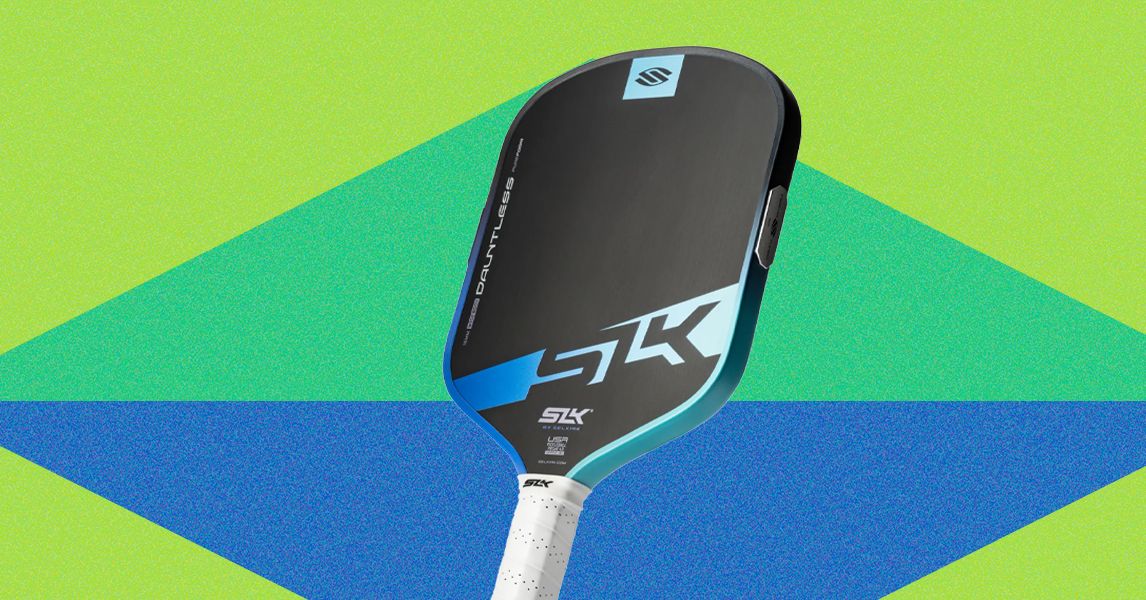
For newer players, WIRED’s top pick is Selkirk’s SLK Dauntless, a $150 foam-core paddle. The guide singles out the wide-body version for having an unusually large and forgiving sweet spot, especially for players who are new to racket sports or still late to incoming drives.
The Dauntless also uses Selkirk’s MOI Tuning System, the same balance idea WIRED previously associated with Selkirk’s Boomstik. Two small side clips act as weights, shifting balance toward the center of the paddle and widening the useful strike zone. WIRED describes the paddle as more control-oriented than purely power-focused, though still capable of hard shots.
For players who want the same family of gear at a lower price, WIRED points to the SLK Valkyrie at $80. That paddle uses a fiberglass face and polymer core rather than the newer foam setup, so WIRED says buyers should expect less spin and shorter life than the Dauntless. For beginners chasing more power, the guide names the $100 Jojolemon Shark 002, which uses carbon fiber and Kevlar in the face and foam around the perimeter rather than a full foam core.
Paddletek’s Honeyfoam TKO-X leads the advanced picks
For more advanced players, WIRED’s top overall paddle is Paddletek’s Honeyfoam TKO-X, priced at $250. The guide says Paddletek’s earlier paddles had a reputation for pop and power, while the Honeyfoam line adds more of the control and consistency associated with foam-core designs.
The TKO-X uses three foam types: low-density foam in the center, denser EVA closed-cell foam in the lower half for energy return and shock absorption, and another foam around the perimeter to help shape the sweet spot. The paddle has a raw carbon face, which WIRED says provides strong spin.
WIRED’s cheaper advanced-player alternative is the $90 Onix Hype X. It uses a thermoformed honeycomb core and carbon-fiber face. The guide says it lacks the large forgiving sweet spot a beginner might want, but offers pop and a weight distribution suited to harder hitters.
The guide also flags stranger experiments. Reload sells a $200 paddle with replaceable textured faces, addressing the grit wear that WIRED says can appear in as few as 50 games. SXY PKL uses a bamboo face over a carbon core for a distinctive look and a surprisingly gritty surface. Scorpion’s Pioneer Plus LED, sold as a $100 two-pack, charges by USB-C and lights up in two dozen colors, though WIRED says it plays closer to a low-cost paddle with a honeycomb core and fiberglass face.
This story draws on original reporting from WIRED.